



 30 / 168

[
] 30
First and foremost, there is still a lack of political or institutional
commitment to DRR efforts under normal circumstances. Often,
it is only after large-scale disaster that countries are motivated to
improve DRR measures. This has been observed in many recent inci-
dents, most notably the Indian Ocean tsunami of 2004, the Kashmir
earthquake of 2005, and cyclone Nargis in 2008.
Secondly, there is also a lack of dedicated or adequate resources,
including human and technical capacities for disaster risk reduc-
tion. These constraints are especially reported in low-income
countries as well as at lower levels of government and community
levels within them. In those circumstances, disaster risk reduc-
tion efforts often depend on external funds and partners, both
bilateral and multilateral. Furthermore, they tend to be seen as ad
hoc initiatives rather than continuous practices, with insufficient
transfer of skills and competency.
Finally, while new institutional and legislative frameworks have
been established in line with HFA Priority 1, the link between
national policies on disaster risk reduction and sector policies is
often weak or not explicit. DRR organizations often do not have
the political authority or technical capacity to intervene in develop-
ment planning, environmental planning and other relevant fields. In
this context, the creation of an integrated multi-sector institutional
system for disaster risk reduction that could bring greater cohesion
and synergy to ongoing sector-based approaches remains difficult.
Despite many gaps and challenges, the HFA has already produced
tangible results on many fronts, most notably, a change in the ways
people understand and respond to imminent disaster risks. However,
in view of growing losses from natural disasters, further efforts to
accelerate the implementation of the HFA are crucial. Therefore, it
is necessary to enhance the effectiveness of HFA policy guidelines
across countries, both high-income and low-income, and at different
levels of government. In this respect, the HFA still lacks consist-
ency among its priority areas in terms of how concrete and how
useful these areas might be. HFA Priority 4 is a case in point, where
there are difficulties in integrating disaster risk reduc-
tion, climate change adaptation and development due
to its cross-cutting nature, involving a wide spectrum
of policy sectors. More pragmatic guidelines, together
with appropriate technical support, are necessary for
all levels of government. Less than four years remain to
achieve the planned objectives of HFA. To attain more
meaningful results, countries should set strategies based
on their own analysis of strengths and weaknesses and
by prioritizing their activities.
Challenges and future perspectives
Regional cooperation on DRR in the Asia-Pacific region
has stemmed from the overwhelming need to respond
to recurring catastrophic events, as mentioned above.
Particularly since the 2004 Indian Ocean tsunami,
regional and sub-regional initiatives have proliferated.
Questions have been raised as to whether this prolifera-
tion reflects enhanced regional or national capacities to
withstand disasters.
Nevertheless, the entire picture should be seen
as a reflection of the diversity and dynamism of the
Asia-Pacific region, and as an indicator that a mere
streamlining of existing mechanisms and institu-
tions will neither work nor provide a viable solution.
Instead, measures should be taken to ensure that all
these efforts continue to enhance, not impair, the
relevant countries’ ownership of current and emerging
activities. Measures should also be taken to maintain
or strengthen the coherence between these initiatives,
and to establish clear links between them, thereby
delivering practical gains at all levels, including the
community level, and further enhancing the ‘culture
of safety’ in this region.
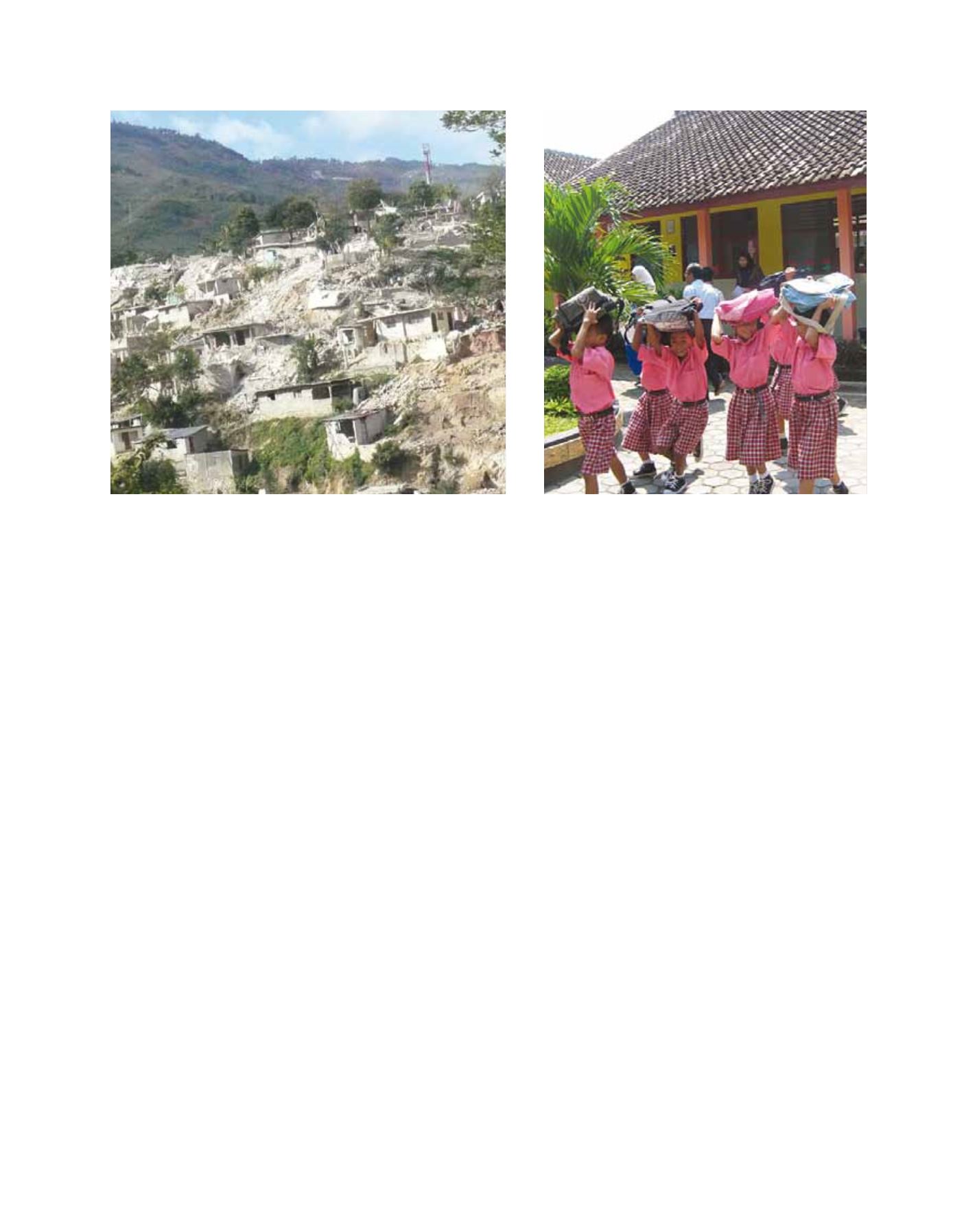
Haiti earthquake, January 2010
Disaster education, Jakarta Indonesia, March 2010
Image: ADRC
Image: ADRC