


 35 / 168

[
] 35
Capacity-development and DRR:
an Indian experience
Professor Santosh Kumar, National Institute of Disaster Management, Ministry of Home Affairs, Government of India
I
ndia’s vulnerability to frequent catastrophic disasters
has forced a reorganization of people and systems.
Several ‘loud’ natural disasters – such as the Orissa
super-cyclone in 1999, the Gujarat earthquake in 2001, the
Indian Ocean tsunami in 2004 and the Kashmir earthquake
in 2005 – happened suddenly and in quick succession, and
shocked the country by killing more than 100,000 people
and making millions homeless. Silent disasters have also hit
the country in recent years – for example, there were three
consecutive years of drought in 2001-2003, while floods hit
Assam, Bihar, Mumbai Karnataka and Andhra Pradesh in
2006, 2007 and 2008.
Sixty per cent of India’s land mass area is exposed to earthquake,
16 per cent is affected by drought, 12 per cent is flood-prone, 8 per
cent is cyclone-prone and 3 per cent is at risk from land-
slides, while 7,600 kilometres of coastal area is exposed
to tsunamis (although the tsunami of 2004 was the
only one India has faced in recorded history). A high-
powered committee constituted by the Government
of India has identified 32 types of hazard, including
natural and human-induced disasters.
Paradigm shift and institutional development
All these events and spatial geographical realities have
emphasized the need among the Government and the
public for radical transformation in the field of disaster
management. India became one of the first countries to
declare a national commitment to set up an appropri-
ate institutional mechanism for more effective disaster
2021
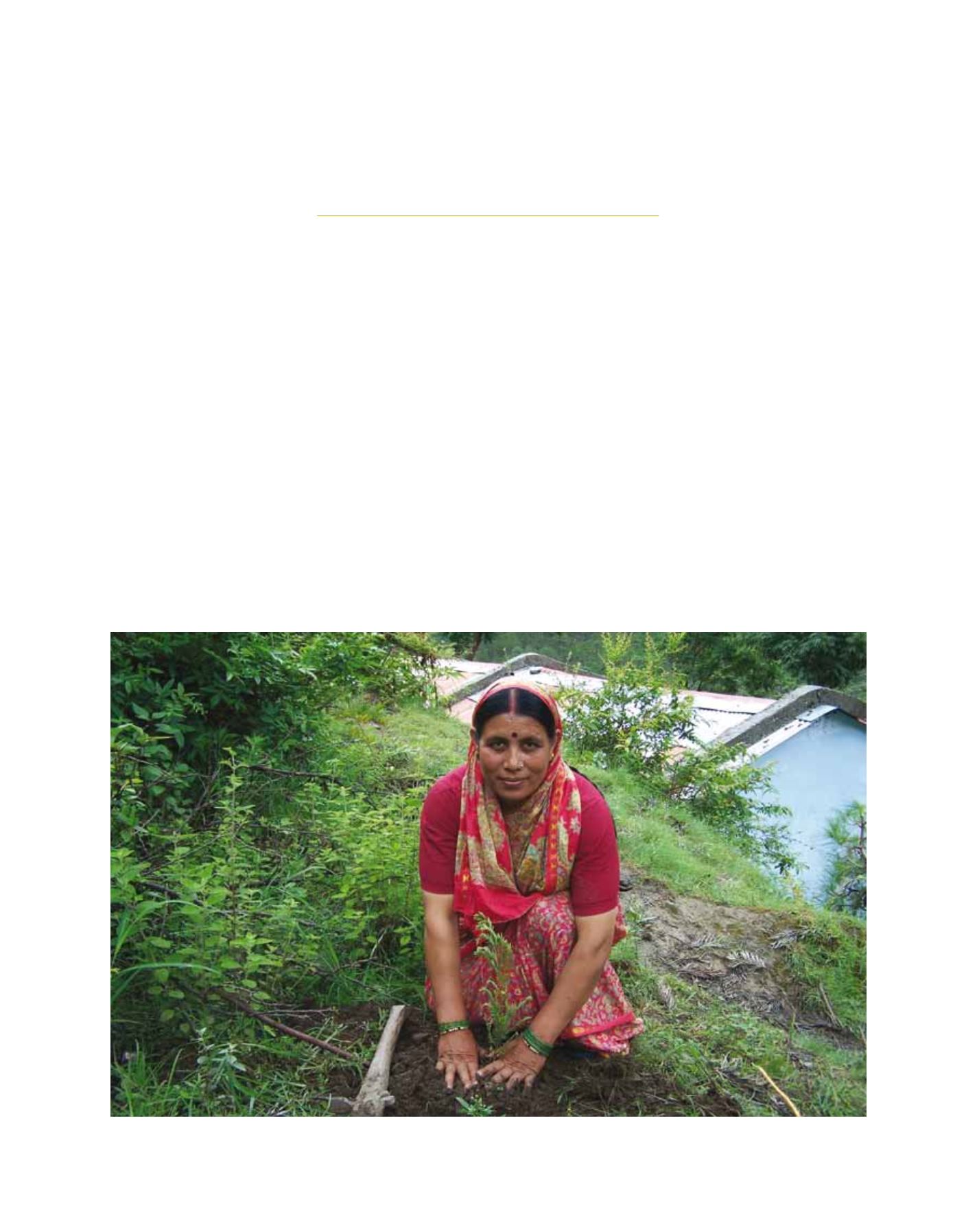
Women pledged to change the environment and helped lead the development scheme
Image: Mr. Chandi Prasad Bhatt