


 40 / 168

[
] 40
management have been finding it difficult to coor-
dinate with theses agencies for conducting studies
or facilitating the SDMC in such studies. Visits to
field locations, accessing of reports and documents
and meetings with concerned authorities have been
beset with multiple challenges that have hindered the
process of trans-boundary risk assessments. SDMC
finds it extremely difficult to network with such a
complex web of institutions.
Lack of trained manpower and adequate financial
resources within the regional organizations have
further constrained the recording of trans-boundary
risk assessment. The SAARC Disaster Management
Centre does not always have in-house professionals
to conduct such studies and outsourcing has not been
easy as requisite financial resources are not always
available for funding them.
Despite these challenges, the regional cooperation
on disaster management in South Asia has not been
insignificant considering the fact that the process of
such cooperation started less than five years ago. In
this context, reference may be made to three interest-
ing initiatives of regional cooperation in the recent past.
First is the South Asia Disaster Knowledge Network
(SADKN), which is one of the flagship projects of the
SAARC Disaster Management Centre. It is a virtual
network involving eight member countries of SAARC
and hundreds of organizations and institutions within,
and outside, the governments in the region that are
Constraints of resources have been another limiting factor in the
implementation of the agreed framework and road maps. SAARC
has been hidebound in receiving assistance from external sources.
Almost all the initiatives of SAARC have been funded by contribu-
tions from the Member States, as per the sharing formula worked
out on the basis of the size and the population of respective state.
Reluctance persists among members to enhance their contributions,
which constrains the implementation of regional projects.
Member states have also been reluctant to share critical data on
transborder hazards and vulnerabilities, particularly on issues like
discharge and withdrawal of water from rivers and reservoirs and
rainfall in upper catchment which are necessary for developing
regional flood early warning systems.
South Asia is an extremely data scarce region. The observational
networks for collection of hazard data are low, with the result that
comprehensive data on natural hazards at a micro level are scarce.
Secondly, real time transmission of data is mostly non-existent.
Historical and time series data on hazards, vulnerabilities and risks
are scattered in multiple agencies and very little effort has been made
to digitize the data. The Member States and their specialized agen-
cies have also been very conservative in sharing data with outside
agencies including the regional organizations. For example, micro
level seismic and hydrological data are invariably not shared which
makes it extremely difficult to conduct detailed trans-boundary risk
assessments of floods, earthquakes and landslides.
A number of different scientific, technical and research organiza-
tions are involved with risk assessments. These in turn are under
the administrative control of different ministries and authorities
of the member states. Even the national focal points on disaster
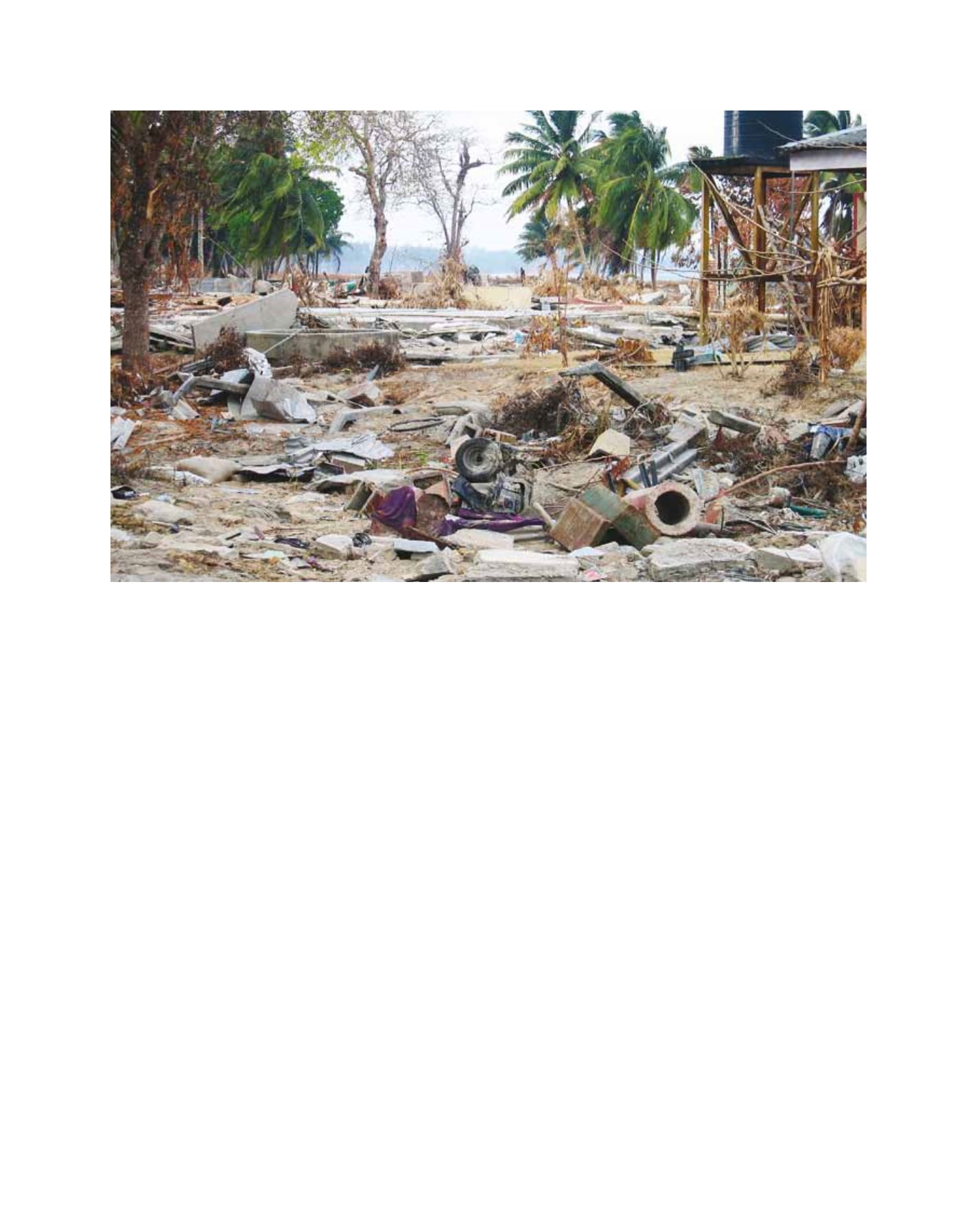
Community and population vulnerability of Hutbay, Andaman due to 2004 Sumatra – Andaman tsunamis
Image: Mishra et al., 2005