


 43 / 168

[
] 43
economic growth by around half a percentage point in the 2010-11
financial year.
The supply chains for coal exports were severely hampered and
production at several big mines has been seriously disrupted. On
top of this the disasters destroyed a significant part of the country’s
food crops. Production will be reduced by around A$8 billion and
may take months, and in some cases years, to recover.
The Australian tourism sector suffered seriously, and other indus-
tries – such as manufacturing, retail and transport – have been put
under enormous pressure. This is a cruel blow for export sectors
already struggling to cope with an unfavourable exchange rate.
The loss of production has also translated into higher prices for
families – especially for fruit and vegetables. The region affected
by cyclone Yasi produces 90 per cent of Australia’s bananas and
around one third of sugar cane. The estimated cost of this year’s
disasters to the Australian Government alone is expected to exceed
A$5.6billion. The total cost to the Australian economy may be
billions more again.
Developments in disaster resilience
The size, severity, timing, location and impact of disasters are
difficult to predict, and a changing climate is increasing the
uncertainty about future risks. With international scientific
modelling suggesting that climate change will likely result in
more frequent and severe weather events, Australia’s mostly
coastal communities are realizing that rising sea levels are
increasing the likelihood of coastal erosion and severe inunda-
tion. A potential escalation in the frequency and magnitude of
hazards may also present Governments with unprecedented calls
on their resources and expertise.
Against this background, Australian governments – common-
wealth, state and local – have recognized that a nationally
coordinated and cooperative effort is required to enhance the
nation’s capacity to withstand and recover from emergencies and
disasters. In some cases this may require governments and busi-
Learning through the eyes of children
Raising children’s awareness of a wide range of natural
hazards is a priority across Australia. The Australian
Government has funded a series of projects to achieve this,
especially where the projects relate to the use of television or
can be digitally interactive.
The peak national fire fighting body, the Australasian Fire and
Emergency Service Authorities Council, which also embraces
the national collective of state emergency service agencies,
has used Australian Government funding to commission the
production of a programme of hazard education for 5-10
year olds in such natural disasters as storms and floods,
tsunamis, bushfires and cyclones. Using the attraction of a
group of cartoon characters, replicating country children and
bush animals calling themselves Li’l Larikkins, specific safety
messages for such emergencies as electrical storms, flash
flooding and riverine flooding, fires and high tides are projected
directly to the children. They learn to clean up before bad
weather and why they need to stay inside. A complimentary
teacher support package of DVD and teaching materials on
the cartoon series has been delivered directly to some 14,000
primary schools across Australia.
For older children an interactive online game has been
developed, which involves children in solving safety scenarios
that threaten the imaginary town of Dingo Creek. Once again
teacher support materials are made available to schools.
Teenagers have not been ignored. A series of digital stories
using the direct interview methodology, have been compiled
involving young people who have actually been personally
affected by bushfires and floods. DVDs of this series are made
available online and distributed through non-government
agencies such as Red Cross, to youth groups and family
recovery agencies.
Further information on these initiatives is available from the
Australian Emergency Management Institute Website -
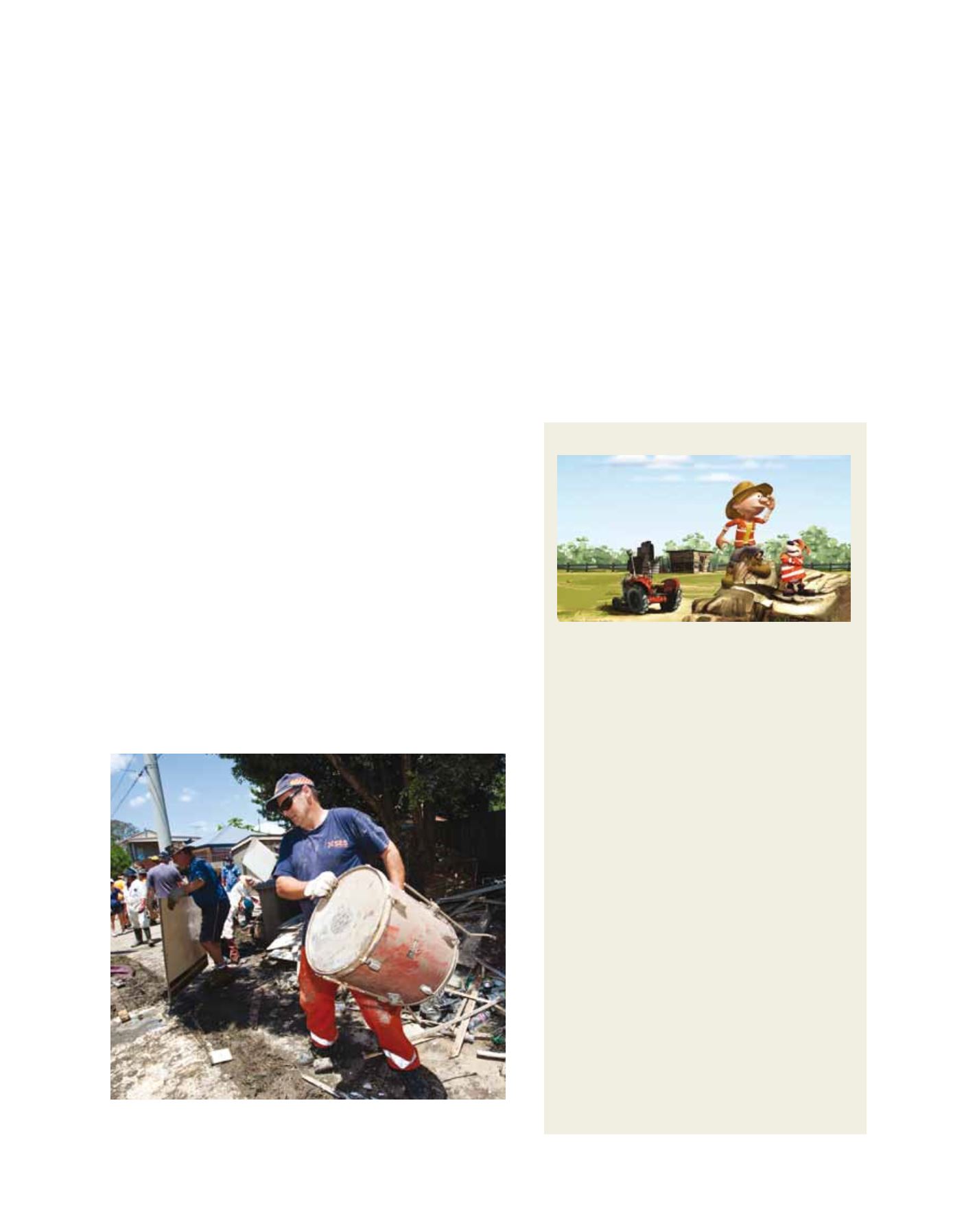
www.ema.gov.auMembers of the community spontaneously volunteer to help the emergency services
clean up the city of Brisbane
Image: EMQ
nesses to spend more up front to make long-term
savings – to rebuild our infrastructure not just the
way it was before but in a different way so that it is
able to better withstand future disasters.
As a nation, Australia is now working to increase
the collective investment – in dollars, time and effort
– in disaster resilience and mitigation initiatives. Such
activities will lead not only to long-term savings for
recovery and reconstruction but they will lessen the
overall impact of damage to communities in psycho-
logical and social terms.
In early 2011, a National Strategy for Disaster
Resilience was adopted by the Council of Australian
Governments (COAG) – the intergovernmental body
involving State Premiers and Territory Chief Ministers
under the chairmanship of the Prime Minister. The