


 45 / 168

[
] 45
It is the goal of every disaster management strategy to encourage
the provision of resources, expertise and many essential services
on which the community depends. Businesses, including critical
infrastructure providers in such areas as water, power, medical
and transport, make a contribution by understanding the risks that
they face and ensuring that they are able to continue providing
such services during or soon after a disaster.
This continuity of business, alongside the continuity of govern-
ment services, can be the leadership strength a community needs to
draw on to create confidence in recovering from a devastating event.
Role of non-government organizations
: Non-government and commu-
nity organizations are at the forefront of strengthening disaster resilience
in Australia. It is to them that Australians often turn to for support or
advice, and the dedicated work of these agencies and organizations is
critical to helping communities to cope with, and recover from, a disaster.
Red Cross and St John Ambulance are held in high regard for their long
association with response agencies and for taking a primary role during a
disaster recovery phase. Some agencies are faith-based such as Anglicare,
the Salvation Army, St Vincent de Paul Society and the Adventist Disaster
Relief Agency. Many are linked to government services such as the
Lifeline counselling service, which often share their contribution beyond
the immediate requirements of post-disaster service.
Australian governments will continue to partner with these agen-
cies and organizations to spread the disaster resilience message
and to find practical ways to strengthen disaster resilience in the
communities they serve.
Role of individuals
: Community disaster resilience also requires
individuals to take their share of responsibility for preventing,
preparing for, responding to and recovering from events, the sever-
ity of which is not often under their control. They can do this by
drawing on guidance, resources and policies of Government, and
other valid sources such as community organizations.
The disaster resilience of people and households is significantly
increased by active planning and preparation for protecting life and
property, based on an awareness of the risks relevant to their local-
ity. It is also increased by knowing about and being
involved in local community disaster or emergency
management arrangements. In Australia, many are
involved as volunteers in emergency services related
groups such as the State Emergency Services and
Rural Fire Services which have literally thousands of
‘vollies’ as they are colloquially called. Then there are
the Coastal Sea Patrol units, Surf Life Saving teams and
Volunteer Rescue Associations. It has been estimated
that some 500,000 Australians give freely of their time
and energy. Some organizations are a mix of paid staff
and volunteer operators – such as helicopter rescue
groups and a flying doctor service, which flies to very
remote rural and indigenous communities.
Understanding and communicating risks
The National Strategy for Disaster Resilience also recog-
nizes that a disaster resilient community is underpinned
by a sound knowledge and understanding of local disaster
risks. Communities and individuals share responsibility
to understand these risks, and how they might affect
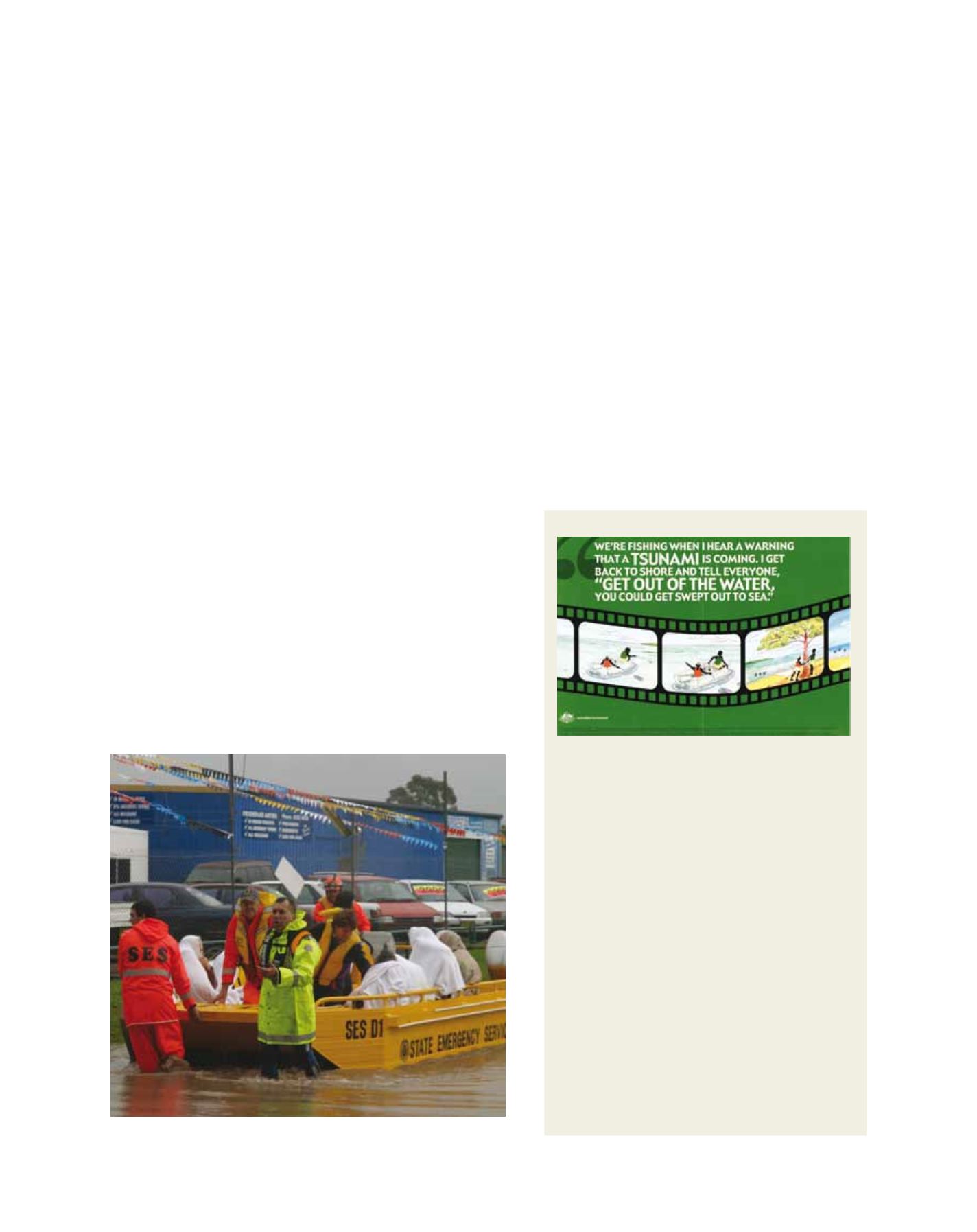
Flood boat rescue in a northern New South Wales coastal community
Image: NSWSES
The potential for a major earthquake–driven tsunami to
impact coastal Australia is significant considering the fact
that tectonic plates throughout the region are currently
showing much activity. Recent undersea earthquake
movement near Indonesia and in the Pacific Ocean adjacent
to the island nations of Vanuatu and Timor as well as near
Chile triggered the activation of the Joint Australian Tsunami
Warning Centre in Canberra. Such activation puts a number
of Australian emergency agencies on alert for that potential
coastal impact – whether it is simply a marine and harbours
alert or a full-blown land inundation prediction – with
response agencies fully prepared to evacuate scores of
residents in anticipation of severe flooding.
Indigenous youth in Aboriginal and Torres Strait Islander
communities have been identified at risk during a tsunami event,
particularly in northern and north-eastern coastal regions.
This vulnerability was addressed as one of several activities
of the national tsunami working group with the development of
the Tsunami Community Education Kit for Aboriginal Australians
in Remote Coastal Communities in 2009 and the Tsunami
Community Education Kit for Torres Strait Islanders in 2010.
With some remote indigenous communities experiencing
literacy issues the strategy identified a visual story-book
method of explaining what to do when a tsunami warning is
issued by the authorities. These visual tools are utilized by
schools and community groups with much success.
Indigenous youth tsunami awareness