


 49 / 168

[
] 49
Indonesia has also launched its National Platform for DRR (
Planas
PRB
) in 2009, a multi-stakeholder forum to promote DRR and mobi-
lize relevant stakeholders to implement risk reduction measures
based on the Hyogo Framework for Action.
Training for villagers
Starting from 2008, ForumMerapi has conducted obligatory disaster
management training (ODMT) for residents of villages close to the
volcano. The training programme was initially promoted by Pusat
Studi Manajemen Bencana Universitas Pembangunan Nasional, the
Center for the Study of Disaster Management at National Veteran
University Yogyakarta, Merapi Disaster Prepared Communities, and
the Bureau for the Study and Development of Volcanic Technology,
with support from UNICEF.
The three-day ODMT programme has been implemented in 28
villages in the most hazardous areas in four districts bordering
Merapi Volcano. To date, 29 training programmes have been organ-
ized at the village level, nine at the sub-district level and four at
the district level. Participants studied the characteristics of Merapi
hazards and risks, risk mapping and formulation of village-level
DM plans, risk reduction and disaster preparedness, and emergency
response drills. ODMT has trained 941 people, 147 women and 794
men.
As part of efforts to build an integrated DM system, a National
DM Plan for 2010-2014 has been formulated. At the operational
level, BNPB has coordinated the implementation of risk reduction
measures based on this plan and the Hyogo Framework for Action,
including the formation of two Disaster Rapid Response Teams that
can be mobilized in hours to respond to major disasters. The agency,
in cooperation with other ministries and agencies, has facilitated the
setting up of early warning systems, produced contin-
gency and preparedness plans, and organized disaster
simulations and other initiatives to build resilience at
all levels. Many other ministries and agencies have also
implemented DRR programmes in line with their key
duties and responsibilities.
In terms of DRR investment, Indonesia has received
substantial technical cooperation from its interna-
tional development partners. UNDP has supported
the country through an umbrella DRR programme,
Safer Communities through Disaster Risk Reduction
(SCDRR). The initiative engages ministries and local
government agencies to develop comprehensive disaster
management systems in several target areas. The World
Bank has introduced structural as well as non-structural
risk mitigation measures into the post-disaster recon-
struction of Yogyakarta and Central Java through its
Java Reconstruction Fund. With its Global Facility
for Disaster Reduction and Recovery, the Bank also
supports the national Government in developing DRR
frameworks and standards. Substantial assistance has
also been received from the Australian Government
through its Australia-Indonesia Facility for Disaster
Reduction that supports DRR policies and practices at
the national and regional levels.
It is communities that directly face disaster risks, and
in recognition of this fact, in future the Government of
Indonesia will invest more in DRR at the village level.
The Ministry of Health has developed a
Desa Siaga
(‘Prepared Village’) programme in around 74 per cent
of the country’s 70,611 villages. Although the focus is
on equipping communities for disease outbreak, the
programme also addresses disaster preparedness and
risk reduction. The Ministry of Agriculture has devel-
oped 2,700 villages that can maintain a certain level of
food security. Similarly, the Ministry of Marine Affairs
and Fisheries has developed resilient villages in coastal
areas and small islands throughout Indonesia. The
Ministry of Education, supported by UNDP SCDRR,
has developed disaster-prepared schools in several
target districts/cities, in addition to the programme to
mainstream DRR into school curricula.
Currently efforts are underway by BNPB to enhance
villages in hazard prone areas through a programme
called
Desa Tangguh Bencana
(‘Disaster-Resilient
Villages’). BNPB has piloted the programme with
UNDP in 15 villages in two provinces. The World Bank
has also piloted similar initiatives with the Ministry
of Public Works in 43 villages. Results from these
pilot initiatives will be used to develop
Desa Tangguh
Bencana
programmes at villages in hazard-prone areas
in all 33 provinces throughout the country. Through
this programme and similar initiatives, it is expected
that village communities will develop the capacity to
identify risks, build structural mitigation infrastruc-
ture and facilities as appropriate, disseminate warning
messages, and engage in self-sustaining risk reduction
measures to minimize future damage and loss from
disaster impacts.
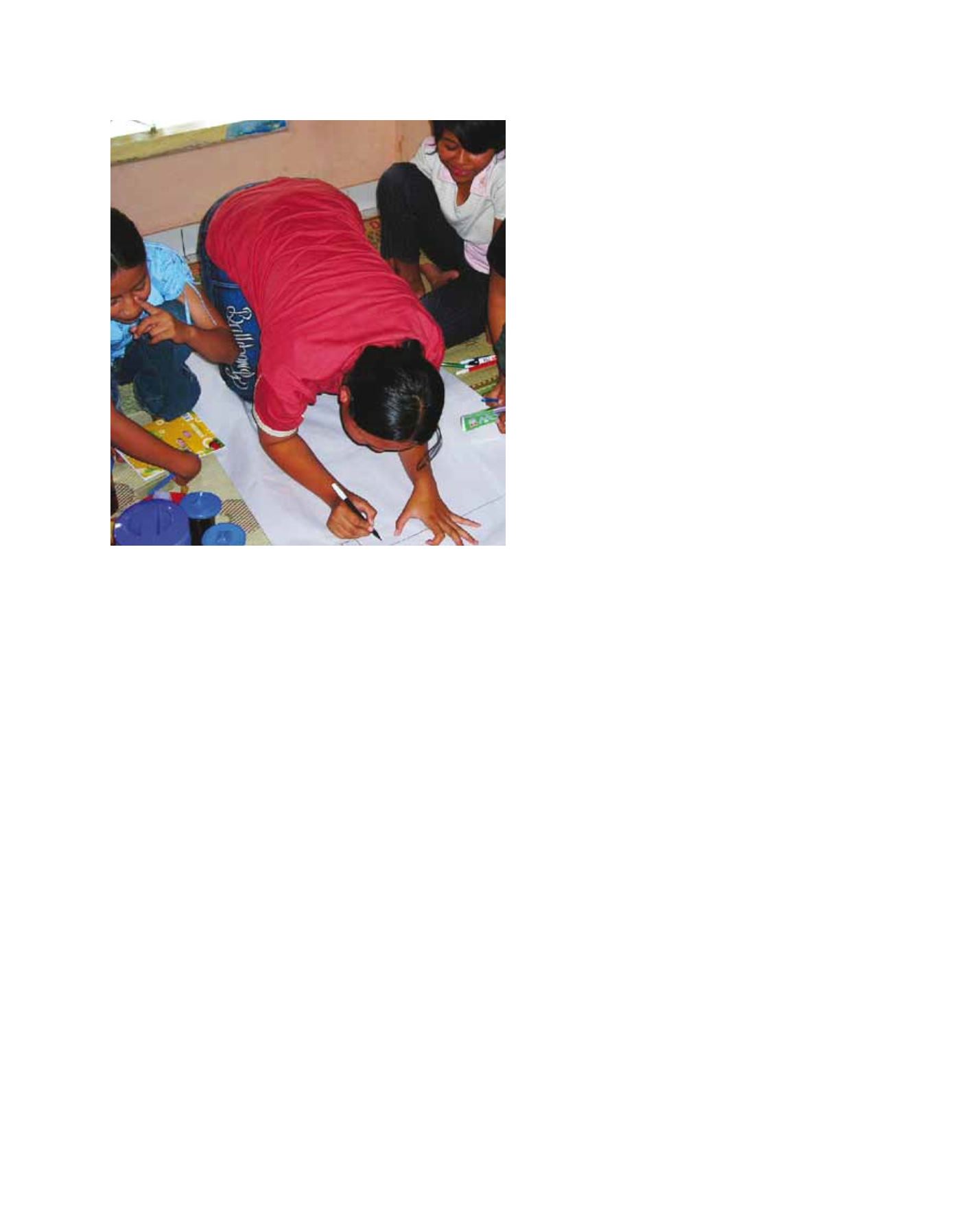
More than 900 people have participated in Forum Merapi’s obligatory disaster
management training
Image: Dr. Eko Teguh Paripurno, PSMB UPN Veteran, Yogyakarta