


 53 / 168

[
] 53
and by the RADIUS case study in Bandung city (1999-2000)
13
, supported
by the UN International Decade for Natural Disaster Reduction. The
projects’ components include earthquake risk assessment and risk
mapping of the city, which also entails an earthquake scenario-based
impact assessment, development of an earthquake risk reduction action
plan and implementation of selected urban earthquake risk reduction
activities. These include the development of emergency procedures for
the city, improvement of local building regulations, capacity-building
for related local government agencies, and earthquake risk awareness
programmes through the media and schools. Some limited replications
of the programme have followed in Bengkulu, Palu, Denpasar, Padang
and Pesisir Selatan in West Sumatra, between 2001 and 2003. All the
programmes were implemented by the Bandung Intitute of Technology,
collaborating with the relevant local and national government agencies.
Sustainability is a critical issue for the implementation of
the programmes, as illustrated by the fact that the local govern-
ments involved in the projects did not carry the action plan and
the earthquake risk reduction initiatives further in their develop-
ment programmes. Ownership of the programmes seemed not to be
transferred to the local governments involved for various reasons,
such as lack of capacity, competition with other priorities, and in
particular major changes in the political structure of local govern-
ments as Indonesia was going through a turbulent, major political
transition in the period 1998-2005. However, the establishment
of the Center for Disaster Mitigation at the Bandung Institute of
Technology in 2003 can be attributed as a sustainable by-product
of the initiatives and the accumulated knowledge developed during
the project implementation. The Center for Disaster Mitigation has
since contributed to many DRR initiatives in the country.
Future challenges and necessary action plans
The current Indonesian seismic hazard maps and national-level vulner-
ability data indicate that many Indonesian regions have a very high
potential for catastrophic seismic disasters, as recently seen in many
regions in Indonesia. A strategic long term earthquake and tsunami
national risk mitigation plan should be made available for a more
concerted approach in reducing the earthquake risk. The National
Action Plan for Disaster Risk Reduction 2010-2012 and the
National Disaster Management Plan 2010-2014 launched
by the Indonesian National Disaster Management Agency
in 2010 should serve as an integrated DRR management
plan that need to be implemented, monitored and reviewed
for improvement in the future. Disaster risk assessment
processes in different level of government administration
need to be conducted to formulate appropriate DRR poli-
cies and action plans and investment in earthquake disaster
mitigation needs to be prioritized. The investment could
consist of research in hazard mapping, vulnerability model
development, earthquake engineering research to improve
and enhance building codes and develop techniques for
earthquake-resistant buildings, and infrastructure design
and construction. Enhancement of good quality graduate
programmes in earthquake engineering and disaster mitiga-
tion inuniversities is also of great importance. Dissemination
of building codes to government officials and professionals
is crucial. There is an urgent need to strengthen the building
authority committees for building regulation enforcement.
Dissemination of guidelines for good practice in residential
housing must be improved, and training provided in good
earthquake engineering practice for government officials,
consultants, contractors and masons across the country.
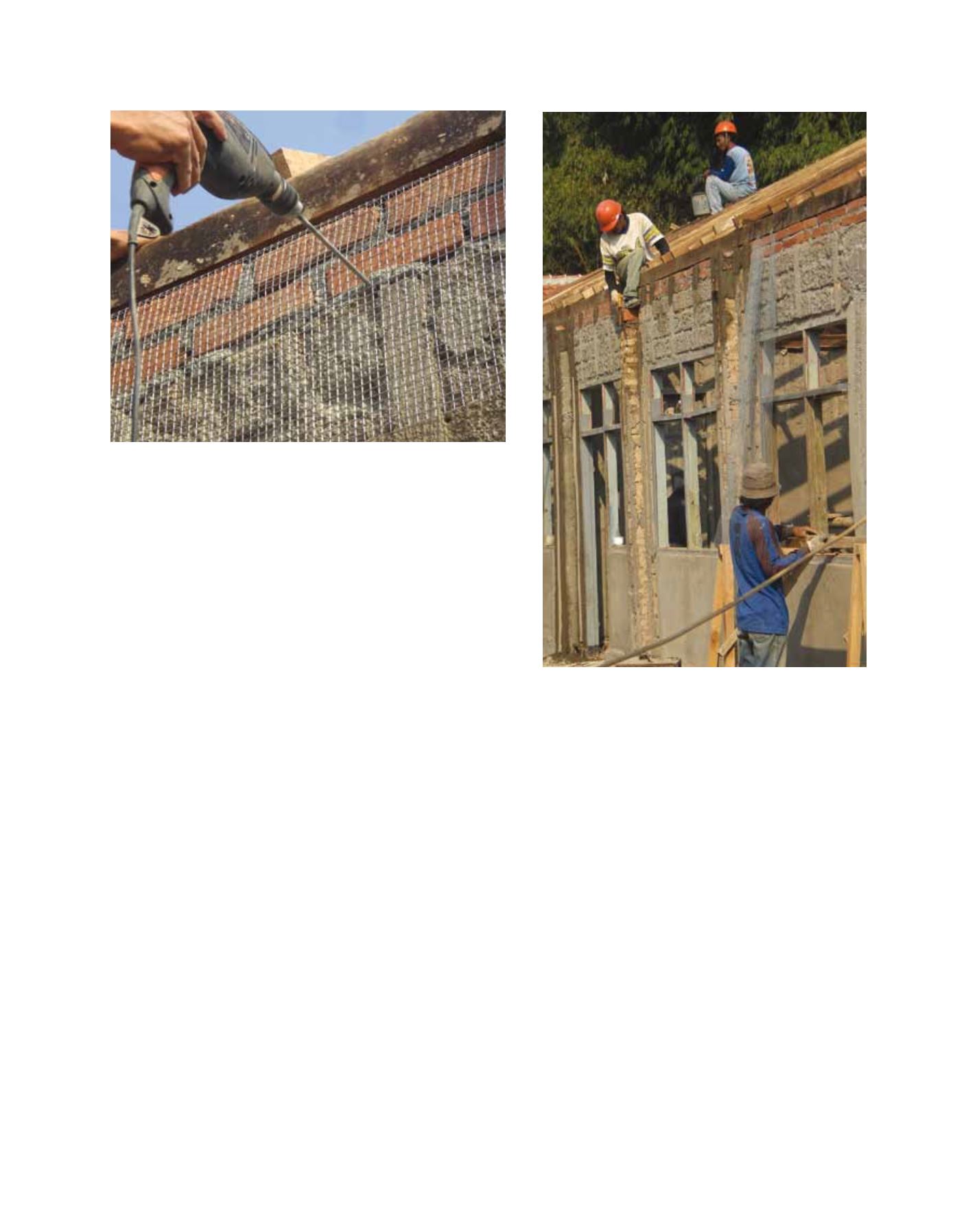
Retrofitting can reduce risk from future disasters
School retrofitting demonstration project, during retrofitting
Image: Krishna S Pribadi
Image: Krishna S Pribadi