


 42 / 168

Disaster resilience: a national goal in Australia
The Australian Attorney-General’s Department, Canberra
[
] 42
N
atural disasters are a feature of the Australian climate
and landscape. Though Australia is the smallest conti-
nent, it is the world’s sixth largest country with an area
of around 7.7 million sq km. This means the country is vulner-
able to a wide range of sometimes extreme weather conditions,
impacted by the tropics in the north and by Antarctic influences
in the south, and the Indian and Pacific Oceans. The shift to La
Niña weather patterns has meant a change from long periods of
drought to record levels of rain.
Such events can have personal, social, economic and environmen-
tal impacts that may take many years to dissipate. Australia has
coped well with natural disasters and continues to do so, through
well established and cooperative emergency management arrange-
ments, effective capabilities, and dedicated professional and volunteer
personnel. Australians are resourceful and community-minded when
faced with disasters. The people of this continent are also renowned
for their resilience to hardship, including the ability to innovate and
adapt, with a strong community spirit that supports those in need and
with the self-reliance to withstand and recover from disasters.
Despite existing strengths, every year Australian communities
are subjected to the damaging impacts of disasters on individuals,
the economy, infrastructure and the environment.
The country has recently experienced a number of large scale
and devastating natural disasters, including catastrophic bush-
fires, the highest level of tropical cyclone, far reaching
floods and damaging storms.
The devastating 2009 Victorian bushfires of
never-before-seen ferocity that destroyed dozens of
communities, took 173 lives, and destroyed more
than 400,000 hectares of forest and farmland, tested
all elements of response and recovery services to the
extreme. Bushfires are nothing new to Australians.
After all, the indigenous peoples have recorded them
over millennia. But this one shocked the whole nation
with its intensity.
The severe weather season of late 2010 and early
2011 has left an indelible mark on the Australian
psyche. Not only did extreme rainfall inundate huge
swathes of Queensland with flash floods resulting
in deaths and community destruction to coastal and
inland communities, but within days the coast was
struck by severe Category 5 Tropical cyclone Yasi.
The same weather pattern resulted in massive rain falls
across two other states, eventually causing flooding in
Victoria in the south to communities that had seldom
seen such floods.
The predicted economic impacts of this year’s
floods and cyclone Yasi are the largest in Australia’s
recent history. Together, they are expected to reduce
2017
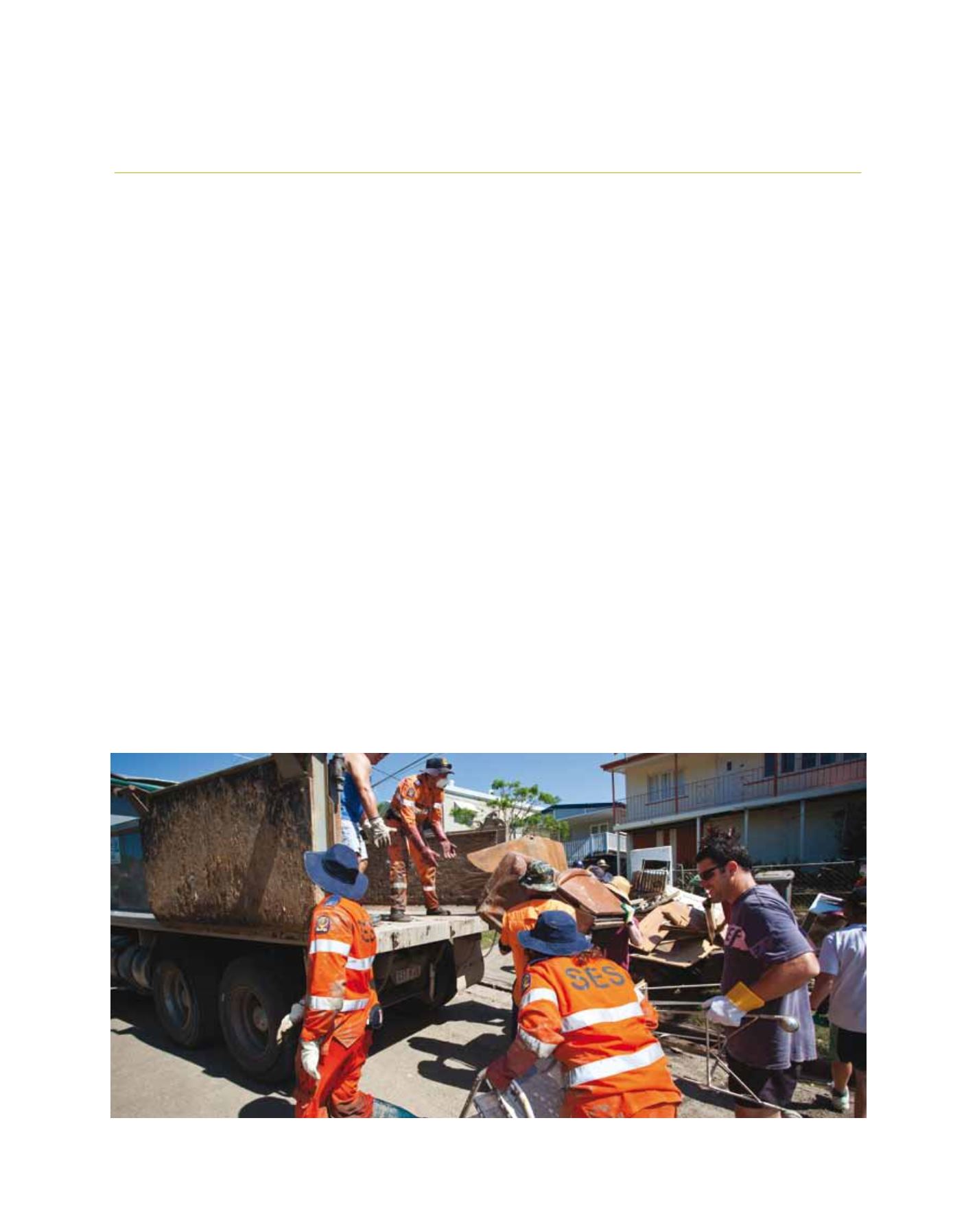
Queenslanders are renowned for their willingness to help each other in times of crisis
Image: EMQ