


 41 / 168

[
] 41
engaged in the collection, creation, dissemination and applications
of different aspects of knowledge on disaster management.
The objectives of the SADKN are to:
• Create a one stop source of information on disaster management
in SAARC
• Create a network of government, research/ academic institutions
and non-government organizations in SAARC Asia on disaster
management
• Provide immediate access to documented and published
information contributed by the networking organizations in the
field of disaster management
• Provide an organized collaborative knowledge base (K-base) to
organize and locate information easily
• Establish an environment, which will encourage people of
SAARC to create, learn, organize, share and reuse knowledge.
The detailed technical and operational guidelines of SADKN have
been developed and agreements have been signed with the member
countries for development of the portal. When fully operational, the
SADKN will connect the Governments, research institutions, univer-
sities, community-based organizations and individuals of the member
countries in a common blackboard to share and exchange knowledge,
information and data on various aspects of natural and man-made
hazards, risks and disasters. The first beta-version of the portal has
now been launched for testing and the final version is likely to be
hosted in the public domain in the near future.
Secondly, the preparation of a Digital Vulnerability Atlas of
South Asia, integrating spatial data on physical, demographic and
socio-economic features of different regions for each country is
underway. The atlas will be prepared by the SAARC
Disaster Management Centre on a WebGIS platform
using the latest remote sensing data showing geo-
physical and climatic hazard zone classification on a
specific scale and integrating available data on demog-
raphy, socio-economic conditions, housing types etc.
A feasibility study on the project was done through a
reputed agency and, based on the recommendations of
the study, the implementation of the project has been
taken up in collaboration with the specialized agencies
of the member states. The first version of the atlas is
likely to be launched soon.
The third initiative in the pipeline is the SAARC
Climate-related Disasters Initiative on the integration of
disaster risk reduction with climate change adaptation.
This is one of the four separate, but inter-related, climate
change initiatives on mountain, marine, monsoon and
climate-related disasters that figure in the
Thimphu
Statement on Climate Change
which was adopted at the
16th SAARC Summit in Thimphu on 28-29 April 2010.
An expert group will be consulted to give a final shape
to the initiative, which would essentially look into how
the diverse policy and institutional framework of DRR
and CAA in South Asia can be effectively integrated for
reducing the risks of disasters in the region. This would
be a pioneering project of its kind which would inform
the current global debates and initiatives on adapting
to climate change in a manner that would also reduce
the risks of disasters.
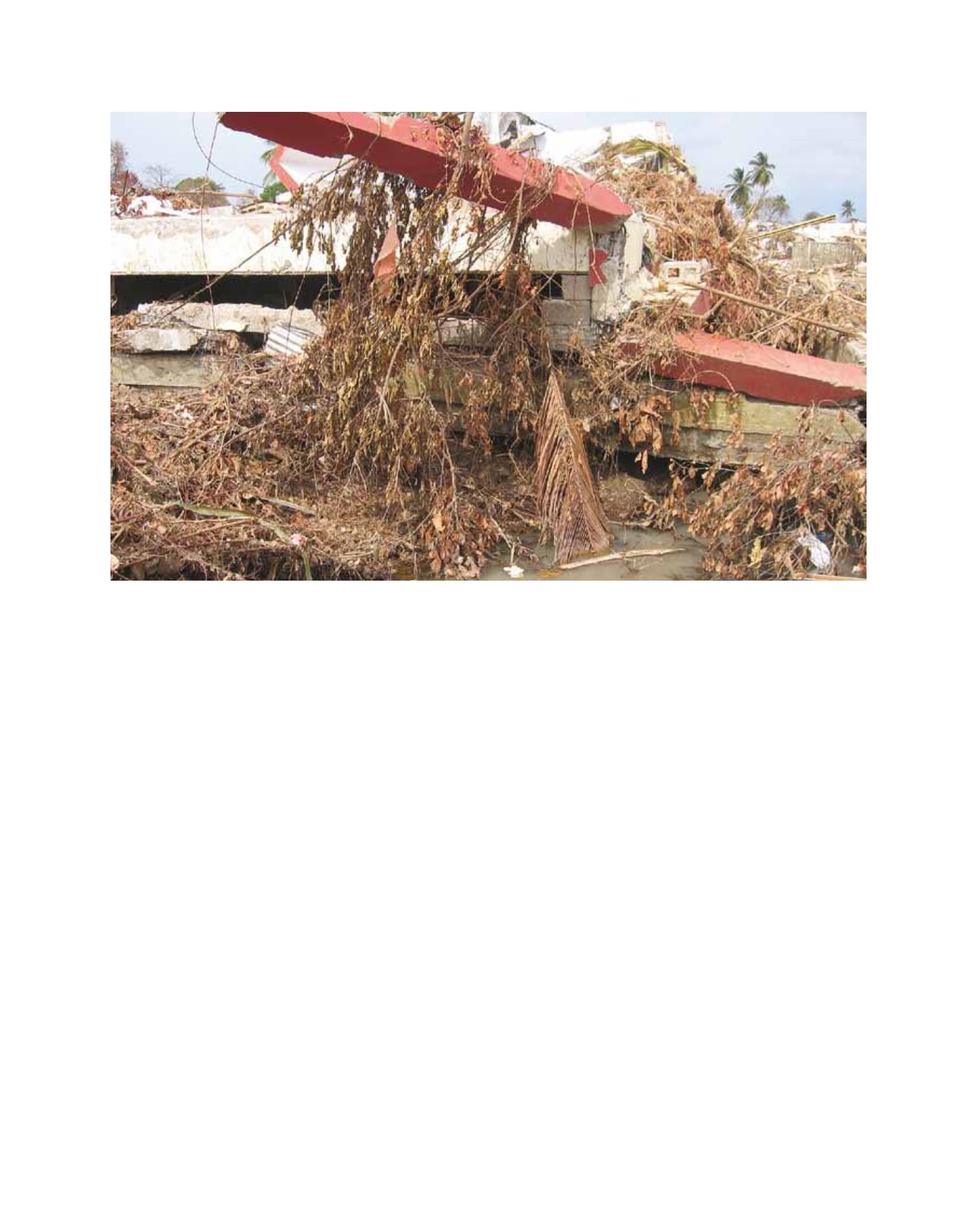
Vulnerability of Car-Nicobar Air Force Colony with its damage scenario during the 2004 Sumatra – Andaman Tsunamis
Image: Mishra et al., 2005