



 21 / 168

[
] 21
Concrete context
– Given the fact that disaster impacts are always local,
DRR education has the potential to provide a concrete context for ESD
activities. DRR education could help to contextualize the rather abstract
concept of climate change, for example, by addressing local urbaniza-
tion patterns along coastlines, the impact of agriculture and economic
development on the forest nearby or even the student’s own consump-
tion patterns.
Empowering learners
– By providing concrete tools for action
in the case of a disaster, DRR education can empower learners by
enhancing their sense of efficacy and making them feel that they
are in control of their lives. This feature of DRR education breaks
down the abstract global issues addressed by ESD into something
manageable and immediate for learners, something which they can
exercise control over and can act upon.
How DRR education benefits from ESD
Orientation, vision and context
– ESD offers a broad conceptual framework
toDRR education. Even though some current DRR educationpractices are
integrative, most would benefit frombeing associated with and informed
by an ESD approach that is more aligned with the broader picture of
sustainable development. ESD can serve as the cohesive link between
short-term post-disaster response, medium-term preparedness and the
long-termdrive towards sustainable development. ESD can thus provide
the orientation, vision and context for DRR education and, through the
mainstreaming of ESD, provide a vehicle for further integrating DRR
education into education systems struggling to come to terms with new
or more severe hazards and greater vulnerability. For example, building
skills and changing behaviours in regard to heavy rainfall are an impor-
tant part of DRR education in a flood-prone area, but such a response
may not challenge urbanization patterns along rivers or acknowledge
the ecosystem services of catchment basins upstream. Learning for DRR
in an ESD context would include a long-term perspective
with regard to the root causes and consequences of flood-
ing, thereby addressing the above-mentioned socio-natural
disasters.
Didactic and pedagogical framework
– Notwithstanding
its breadth of vision, ESD can be treated narrowly, being
confined to its content on sustainability and understood as
education about sustainable development. ESD’s real benefit
toDRR should not be limited in this way. That benefit stems
largely from the didactic and pedagogical framework in
which ESD operates, through which it builds competencies
for sustainable development: reflective learning processes;
participatory learning and the development of critical think-
ing skills; the use of holistic approaches, interdisciplinary
methods and investigatory learning such as field studies; the
inclusion of local and traditional knowledge, the history of
human activities and economic development in a locality or
region; and so forth.
Education for change, uncertainty and resourcefulness
– ESD can also be considered as education for change,
education for uncertainty or education for resourceful-
ness, oriented towards building skills and competences
that are useful in the context of globalization but can also
be of crucial importance in the short-term perspective of
a hazard. Experiences from the Kobe earthquake in 1995
show that 80 per cent of the people saved were rescued
by their neighbours and not by the authorities.
11
This
requires more than the learning of drills and life-saving
techniques but extends to developing attitudes, mindsets
and skills that typically are promoted by ESD, such as a
sense of responsibility and solidarity, an ability to take
action and the capacity to think independently and take
decisions in a fast-changing environment.
A winning combination
DRR relates to all three dimensions of sustainable develop-
ment, both prior to and after a hazard. This is even more
valid given that the frequency and intensity of meteorologi-
cal hazards are increasingly related to human activities and
environmental degradation. Education systems are chal-
lenged by this context and called upon to provide responses
to sustainability challenges and disaster risks.
The contribution of education systems could be made
more relevant if DRR education and ESD would integrate
some of their respective features. Both concepts can benefit
greatly from each other, both in terms of content and
methodological framework. This would help DRR educa-
tion to be more interdisciplinary, long-term oriented and
holistic in its approach to disasters. Meanwhile, ESD could
further benefit from an inclusion of DRR-related themes as
they offer a tangible operationalization which could help
convince ministries of education and other partners of its
importance and relevance today. During the remaining
years of the DESD and beyond, UNESCO will advocate
further enhancing the synergies between ESD and DRR
education in a more systematic and integrative way. This,
we believe, will be conducive to bothmore sustainability at
global and societal levels and better disaster preparedness
of communities.
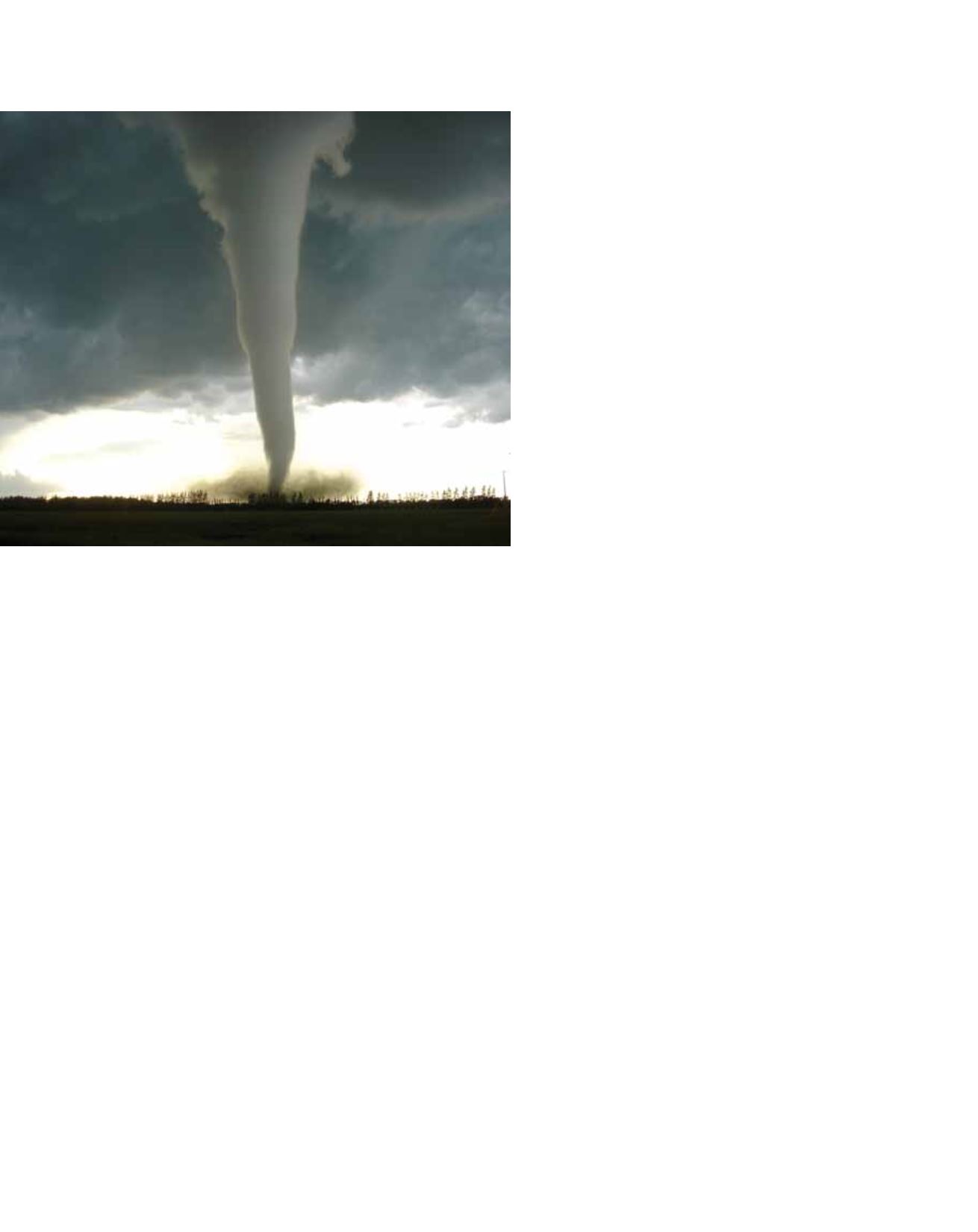
Tornado Elie in Manitoba, Canada, 2007
Image: © Wikimedia Commons/Justin Hobson