


 19 / 168

[
] 19
Education for sustainable development and
education for disaster risk reduction:
a winning combination
Olivier Laboulle, Assistant Programme Specialist and
Mark Richmond, Director, Division of Education for Peace and Sustainable Development, UNESCO
A
s long ago as the 18th century, the philosopher Jean-
Jacques Rousseau pointed out in one of his letters to
Voltaire that disasters were caused by the vulnerability
of the population rather than by the ‘God-made’ natural hazard
itself. After the earthquake that hit the capital of Portugal on 1
November 1755, Rousseau wrote: “concede, for example, that
it was hardly nature who assembled there twenty-thousand
houses of six or seven stories. If the residents of this large city
had been more evenly dispersed and less densely housed, the
losses would have been fewer or perhaps none at all. […] How
many unfortunates perished in this disaster for wanting to take
– one his clothing, another his papers, a third his money?”
1
Disasters are usually understood as the product of hazards and the
vulnerability of a community. As Rousseau implies, the same earthquake
striking an uninhabited desert would not have resulted in a disaster (or,
at any rate, not the same kind of disaster). Disaster risk reduction (DRR)
has therefore focused on reducing the one element of a disaster on which
communities have leverage, namely their vulnerability. Vulnerability can
be understood as ‘the characteristics and circumstances of a community,
system or asset that make it susceptible to the damaging effects of a
hazard’.
2
This approach is in stark contrast to previous views of disas-
ters as unavoidable ‘natural events’; events which needed
to be responded to once they had occurred but for which
no preparations would be put in place.
3
Hence, societies
have moved from the conception of a God-made disas-
ter (often seen as punitive in character) to distinguishing
between man-made vulnerability and immutable natural
hazards. The concept of vulnerability clearly links DRR (and
therefore DRR education) with the social, environmental
and economic dimensions of sustainable development.
Today, the world is not the same as the one that Rousseau
or even scholars and practitioners in the 1970s observed.
Countries and their educational systems are now facing
new challenges, for which UNESCO believes a more holis-
tic approach to DRR education in the context of education
for sustainable development (ESD) is needed.
Societies increasingly have to deal with something in
between an unalterable natural hazard and the condition of
mutable vulnerability, namely socio-natural hazards. The
latter describe the ‘increased occurrence of certain geophysi-
cal and hydro-meteorological hazard events arising from
the interaction of natural hazards with overexploited or
degraded land and environmental resources’.
4
Even though
deforestation, urbanization and agriculture have long
featured in human history, the rapid population growth of
recent decades combined with unsustainable consumption
and production patterns have contributed to global warming
and thereby affected the frequency and intensity of extreme
climate events such as flash floods.
5
On a local scale, defor-
estation and desertification have demonstrable effects on
local rainfall patterns and are implicated in the occurrence
of droughts.
6
It is against this background that UNESCO,
especially in the context of meteorological hazards and
climate change, advocates for the mainstreaming of a more
holistic DRR education that addresses mitigation and adap-
tation to hazards, thereby tackling both aspects of disaster
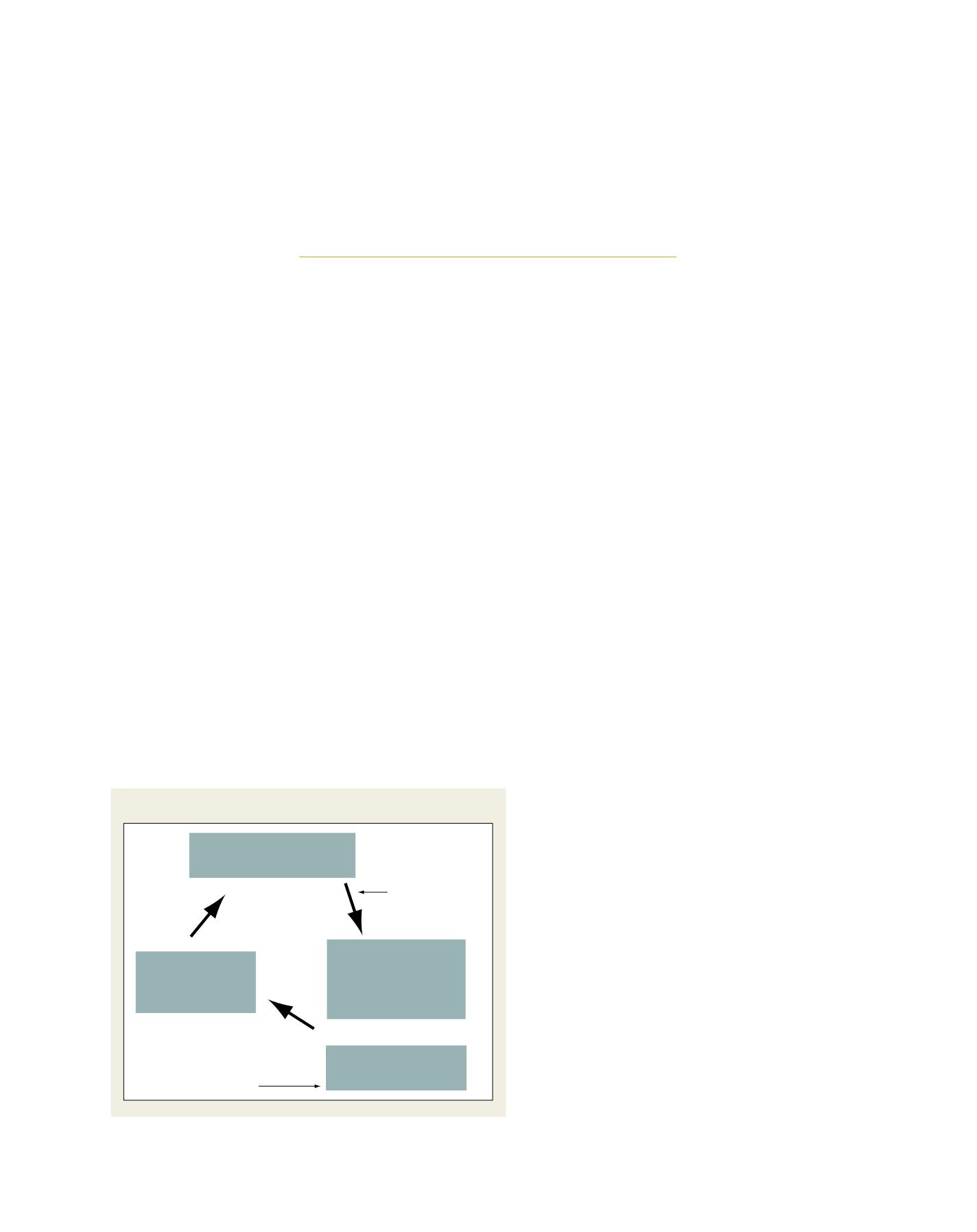
preparedness. This approach seeks to break the vicious
circle in which environmental degradation is a major factor
of increased disaster risk.
The relationship between DRR education and ESD
The arguments presented above posit a clear link between
natural hazards and unsustainable human activities
which can be best addressed by DRR education in the
2030b
The vicious circle of socio-natural hazards
More traditional DRR
education works ‘only’ on
reducing the vulnerability
of communities
Long-term and
holistic ESD
perspective to DRR
education tackles
human lifestyles and
general environmental
degradation
+
Increased environmental
degradation
Increased impact
of hazards on
ecosystems
Increased impact
of hazards on
ecosystems
Increased
vulnerability
© O. Laboulle and M. Richmond, 2011