



 15 / 168

[
] 15
outcomes.
1
Corrective risk management investments
can be very cost-effective if they concentrate on retro-
fitting the most vulnerable and critical facilities, rather
than being spread widely over many risk-prone assets.
Some ex ante budgetary allocation for disaster response
is common. In some countries, this funding takes the
form of more general contingency reserves. In their
2009-2011 HFA monitoring reports, 44 out of 76 coun-
tries reported that they maintain some form of national
contingency funds for disaster response purposes.
Ideally, these resources should at least be sufficient
to meet expected immediate relief needs in a ‘good’ year
of low losses but in a number of countries, even this
minimum level cannot be reached.
Most governments have no prior regular funding
arrangements for post-disaster reconstruction, instead
implicitly relying on reallocations (at national and local
levels), future capital investment budgets and external
assistance, leading to protracted reconstruction efforts
with potentially adverse social and economic implications.
Explicit DRR budgets are very limited and more general
vulnerabilities multiply disaster risks, which can exponentially
magnify impacts.
Trends and patterns in DRR – progress against the HFA
The HFA is a comprehensive set of actions that countries can take to
strengthen their risk governance capacities. By offering a framework
for analysis, it catalyzes both strategic and action-oriented planning.
Good overall progress in disaster management is one of the HFA’s
major achievements, but challenges remain. In particular, low-
income countries find it harder than higher-income countries to
make the investments necessary to reduce urban risk.
Investing today for a safer tomorrow
The decision to invest in DRR is clearly not technical or administra-
tive – it is fundamentally political. In the HFA Progress Review,
less than half of the countries surveyed reported that they had DRR
provisions in their recovery and reconstruction budgets.
When governments are unable to mobilize timely resources for
recovery and reconstruction, the direct costs and impacts of a disas-
ter can cascade into a range of other negative social and economic
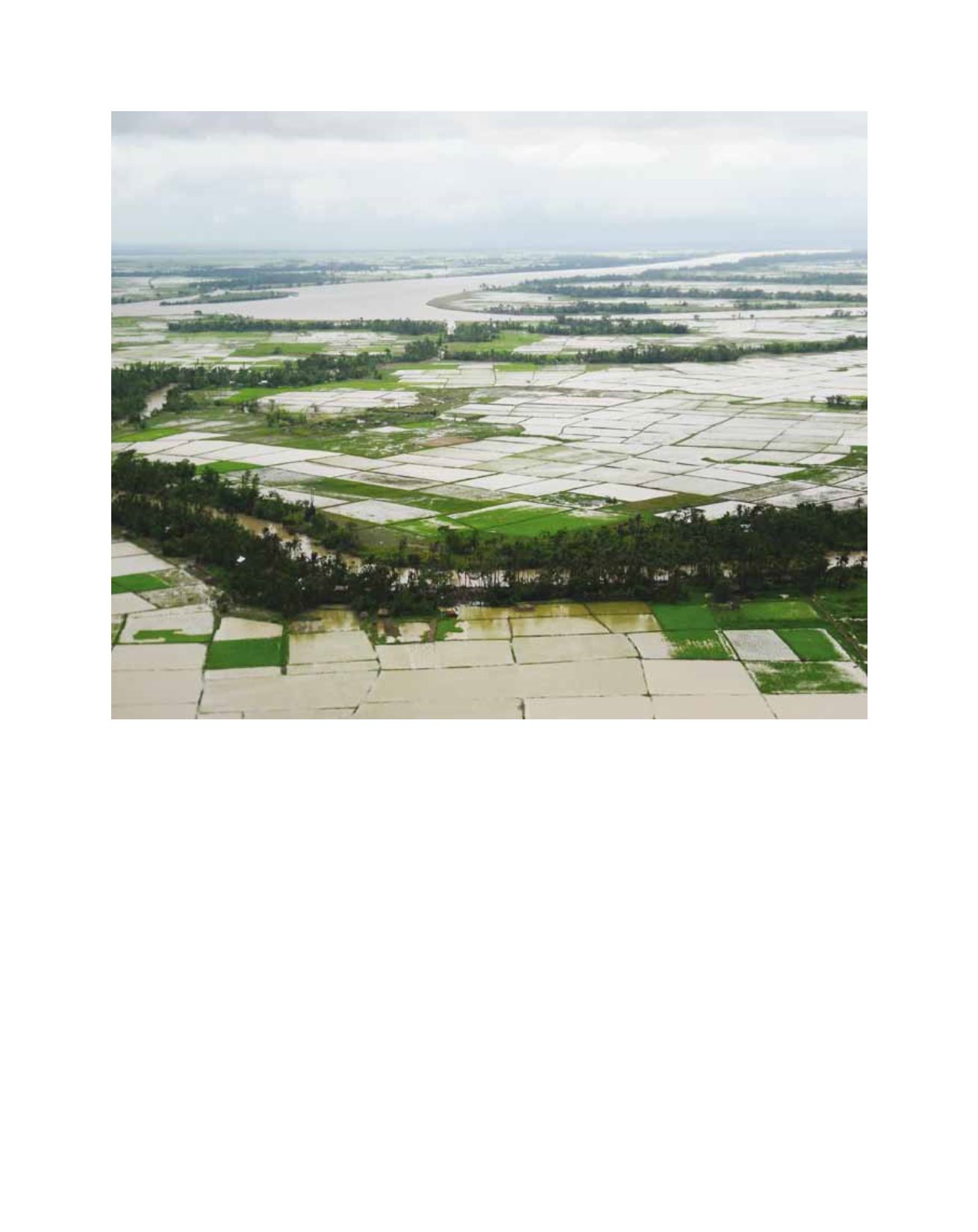
Post-Nargis flooding in Myanmar
Image: Julio Serje