


 18 / 168

[
] 18
to planning, financing and development, allowing a new
perspective on risk governance to open up.
Redefining development: the way forward
Major development investments are needed to assist
countries to address the structural causes of poverty,
upgrade informal settlements, build risk-reducing
infrastructure, improve natural resource management,
and strengthen governance at all levels. Both DRR and
climate change adaptation need to be integrated into
national development planning and investment, and
local governance should be strengthened and partner-
ships with civil society facilitated.
The formulation and adoption of international stand-
ards for disaster loss accounting and risk estimation
may provide additional incentives for countries to take
ownership of their risks. Factoring disaster risk consid-
erations into national planning and public investment
decisions can radically scale up risk reduction.
Acknowledging and understanding risk is the respon-
sibility of every government. The HFA provides a general
roadmap to achieving substantial reductions in disaster
losses, but countries now need to set their own specific
goals and targets. The time for taking serious action is now.
Climate change adaption represents a new opportunity to
advance DRR. In December 2010, for example, the United Nations
Framework Convention on Climate Change (UNFCCC) Parties
agreed to the Cancún Adaptation Framework, which calls for
climate change-related DRR strategies and consideration of the HFA
in particular.
5
Reforming risk governance
Over the past twenty years, many countries have adopted a decen-
tralized approach to DRR. Most DRR functions require local level
planning and implementation, and the HFA itself calls for the
decentralization of authority and resources to promote commu-
nity-level DRR.
DRR needs to be facilitated by appropriate risk governance
arrangements and the role of a national policy cannot be overesti-
mated. It must be clear and comprehensive, yet detailed enough to
define the roles and responsibilities of different actors in develop-
ment sectors as well as local governments.
Scaling up local initiatives therefore requires new capacities and
skills in local and central Government institutions. It also requires a
cultural shift in the attitude of municipal governments, contractors
and non-governmental organizations towards working in partnership
with low-income households and their representative organizations.
Cities are also learning from one another about innovative approaches
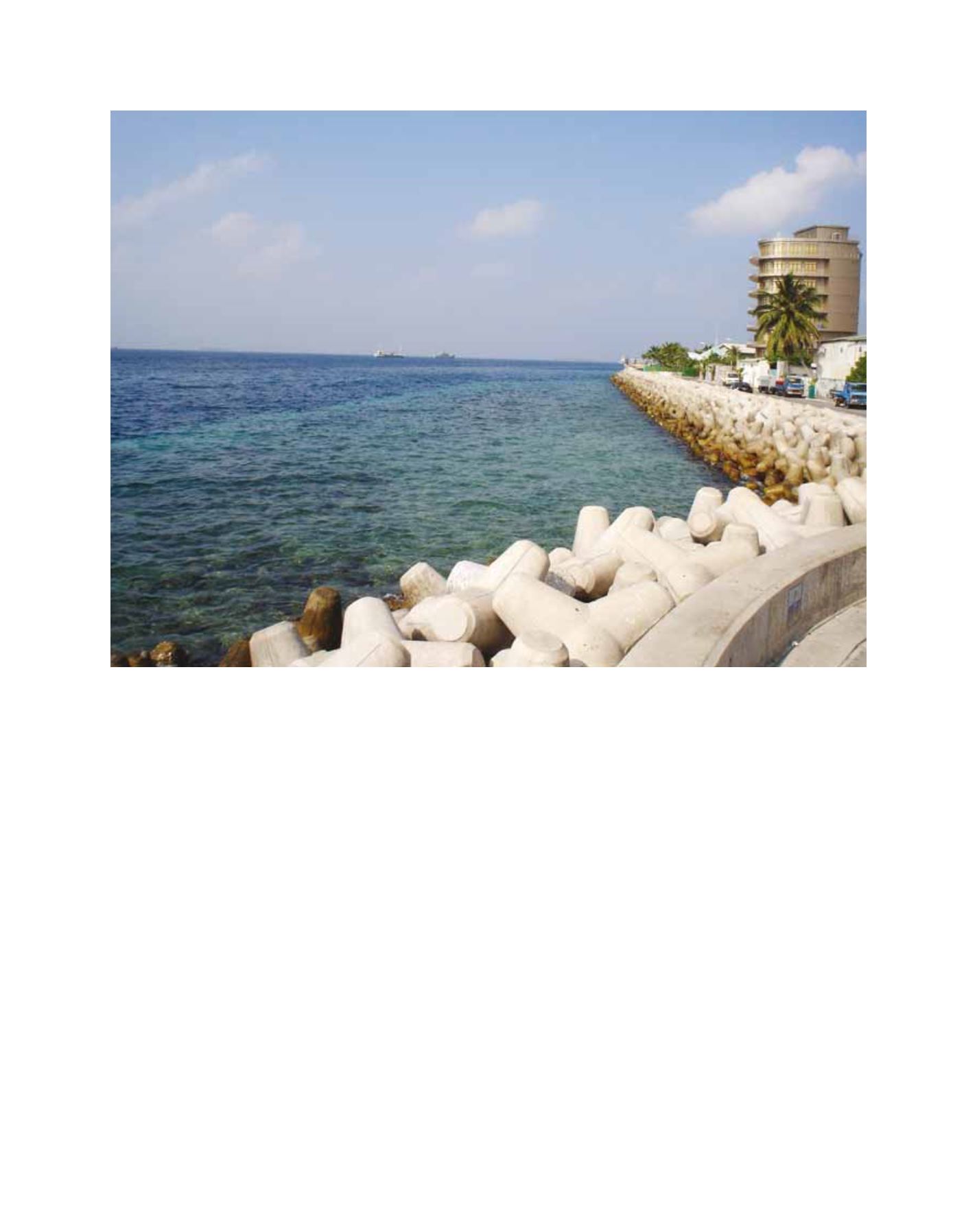
The coastal defence system in Male’, Maldives protected the island capital from the 2004 tsunami.
Image: Julio Serje