


 224 / 280

[
] 224
Development of a global
in situ soil moisture network
Peter J. van Oevelen, International GEWEX Project Office; Thomas J. Jackson, USDA
Hydrology and Remote Sensing Lab; Pedro Viterbo, Instituto de Meteorologia;
Dara Entekhabi, MIT; Yann Kerr, CNES/CESBIO
S
oil moisture observations are critical for understanding the
global water and energy cycles. Availability of better spatial
estimates of surface soil moisture will help, through assim-
ilation into hydrometeorological models for example, to improve
forecasting of precipitation, droughts and floods. It will also
contribute to further the development of other hydrological
applications that can support water resource decision-makers.
Surface soil moisture is a determinant of the partitioning of surface
precipitation into infiltration and runoff. Across many landscapes of
the mid and higher latitudes soil moisture and its freeze/thaw state
control evapotranspiration providing the link between terrestrial
water, energy, and carbon cycles. Based on theory and experiments
to date there is a general agreement that improvements in our under-
standing of the water cycle and our ability to predict short-term
events (hydrometeorology) and long-term patterns (seasonal) are
dependent on developing an integrated global soil moisture observ-
ing system. Improving these global observations is needed on a
priority basis.
The Global Energy and Water Cycle Experiment (GEWEX) of the
World Climate Research Programmeme (WCRP) along with the
Integrated Global Water Cycle Observations (IGWCO) theme of
IGOS-P are contributing, amongst others, to the devel-
opment of a global in-situ soil moisture network. Such
a network is intended to support a global soil moisture
observing system as part of the Global Earth Observation
System of Systems envisaged by GEO. The practical
coordination and implementation is done through the
International Soil Moisture Working Group with addi-
tional financial support from the European Space
Agency (ESA) to develop a soil moisture data hosting
centre by the Instituto de Meteorologia in Portugal.
The upcoming launch in 2008 of the Soil Moisture
and Ocean Salinity Mission by ESA has given a strong
impetus to the establishment of the in situ soil moisture
network. The global network will help in validating and
calibration of the SMOS data products. Also existing
sensors such as ASCAT on METOP or AMSR-E can
profit from the established network.
However, the network will not only serve as a satellite
validation tool, as the in-situ soil moisture data has value
by itself in other applications, such as in irrigation prac-
tices. The community perspective on soil moisture
observations parallels that described in Leese et al.
1
This
included in situ measurements, satellite observations,
and modelling that must all be developed and integrated,
primarily through a data assimilation framework.
Modelling and data assimilation are already integral
components of national and international weather and
climate forecast programmes.
2
To reach the goal of an integrated global soil moisture
observing system it will be necessary to establish,
expand and improve current soil moisture observations
both in situ and remotely sensed. For the in situ part
this involves global network establishment, enhance-
ment by expansion and standardization, improved
coordination of soil moisture data network planning,
observing standards, and data exchange.
The establishment of a soil moisture data hosting
centre to act as a focal point is crucial in reaching many
of the objectives. Key to the growth of these efforts is
the recognition by international organizations and agen-
cies that soil moisture is an important climate variable
and that committed support is needed. Ultimately we
hope to find a sponsoring agency that will commit to
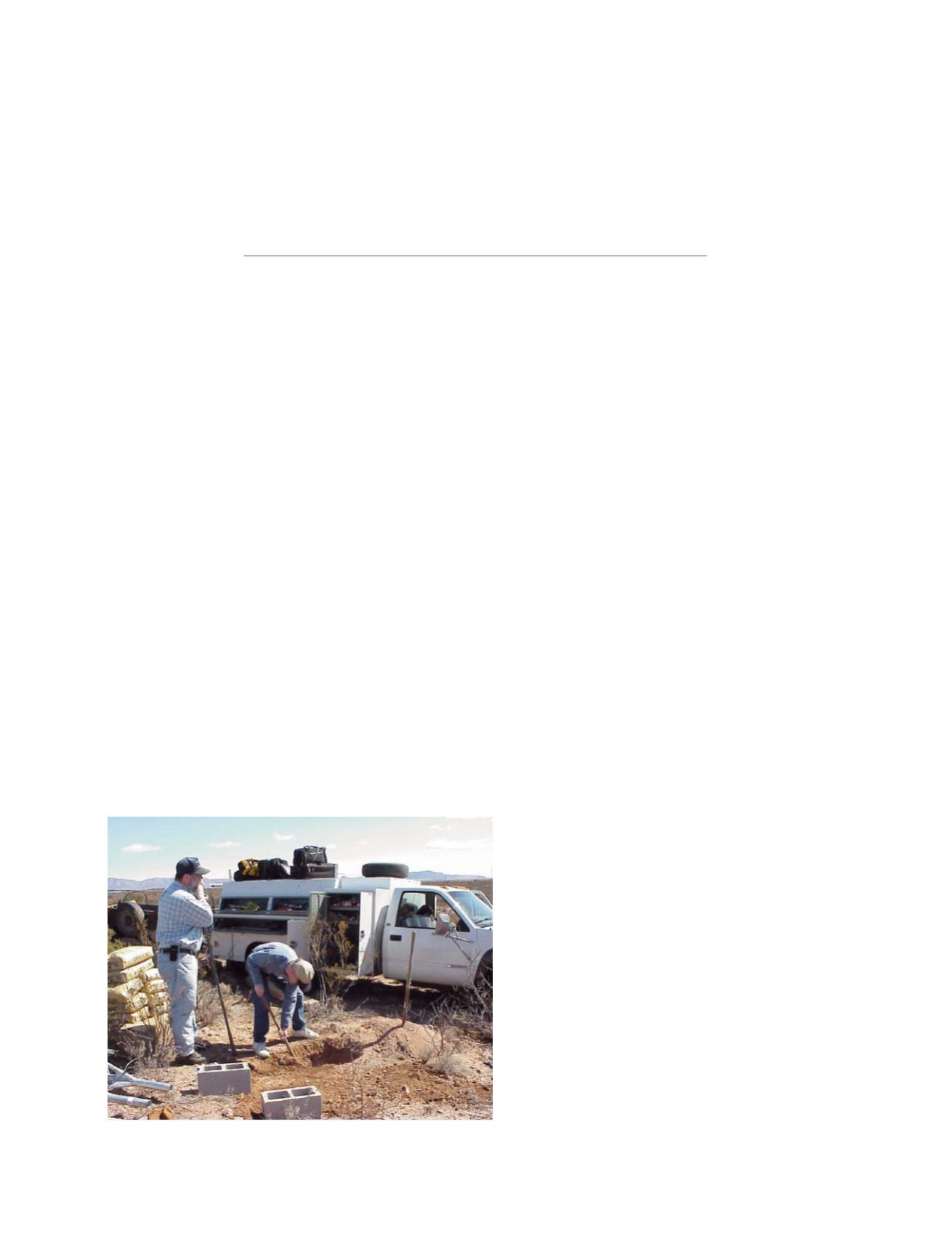
Photo: Tom Jackson & Gary Schaeffer
Installation of SCAN station in Arizona
S
OCIETAL
B
ENEFIT
A
REAS
– W
ATER