


 264 / 287

[
] 265
A
dAptAtion
And
M
itigAtion
S
trAtegieS
As timeframes become longer, there is increased uncertainty
about how human and environmental systems will interact and
change, and how the relationships between various components
of risk will shift. Nonetheless, as we improve our understanding of
these relationships and the physical and social sciences of climate
change and variability, we can act to build flexibility and strength.
We can also familiarize people with the sources and uses of climate
data, and we can mainstream disaster risk reduction – climate-
related and otherwise – into policy and everyday practice. We can
build on existing initiatives and strengths to integrate near-term
and long-term approaches into a single framework.
A new risk reduction approach
Traditional disaster risk reduction (DRR) efforts are intended to
modify near-term risk in one of three ways: altering the environ-
mental and social conditions in which hazard events occur, altering
event properties in a particular place (thereby, often shifting risk
elsewhere), and/or building the capacity to respond to and recover
from impacts. Efforts related to climate change mitigation and adap-
tation do the same. The aim is to change social and environmental
conditions in such a way that future hazard events do not overwhelm
human systems.
Since hazard characteristics and conditions are more uncertain,
we must encourage flexibility by maximizing our ability to access,
synthesize, and enact creative solutions. We must do what we can
to minimize potential exposure, as well.
Approaches focused on building long-term adap-
tive capacity will contribute to near-term reductions
in vulnerability and increases in coping capacity; while
near-term actions will set the stage for longer-term
conditions and options. Both timescales need to be
considered when integrating DRR activities with policy
and planning.
Both traditional near-term DRR activities and efforts
focused on adaptation to climate change and variabil-
ity encounter impediments to implementation. The
challenges fall into three major categories: technical
data issues of resolution, collection, management, and
sharing; issues of collaboration and coordination; and
difficulties in meaningfully integrating science and
practice.
Needed spatial data can be difficult to obtain, and its
analysis and use may require specialized resources. In
fact, specific skills and technologies are required even
for sharing many data types.
Disaster and risk are multi-faceted, multi-secto-
ral, and multi-disciplinary, however, the emergent
nature of disasters, competing resources and goals,
historical mistrust, and institutional practices can
discourage collaboration and coordination. Finally,
scientists, practitioners and the public often operate
in different worlds, and speak different languages. So,
creating bridges and operationally meaningful ways
of framing, analysing, and communicating hazard
and risk information is critical to effective decision
making, and to facilitating DRR activities and DRR
‘mainstreaming.’
Addressing these challenges in the more common
context of DRR and near-term risk builds and exercises
some of the basic structures necessary to address them
within the context of climate change and variability
and longer-term risk, fostering resilience in individu-
als, institutions and communities.
Meeting DRR challenges
Within the context of building resilience and facilitat-
ing DRR, the Pacific Disaster Center (PDC) has helped
address these challenges by: assisting communities of
interest and fostering collaboration among stakehold-
ers; by building relationships with local authorities,
national governments, regional organizations, inter-
national organizations, military groups, and academia;
and by participating in data collection activities directly
related to local emergency management. PDC develops
and implements decision support systems for emer-
gency management and DRR activities that integrate
dynamic and static data and do not require users to
have sophisticated technology. While facilitating early
warning for sudden hazards, PDC products and services
also reduce the difficulties of data collection, manage-
ment, and sharing, thus supporting long-term security.
PDC capabilities and experience include performing
risk and vulnerability assessments at multiple scales
using numerical modelling, loss estimation, and
complex indicator approaches; and performing techni-
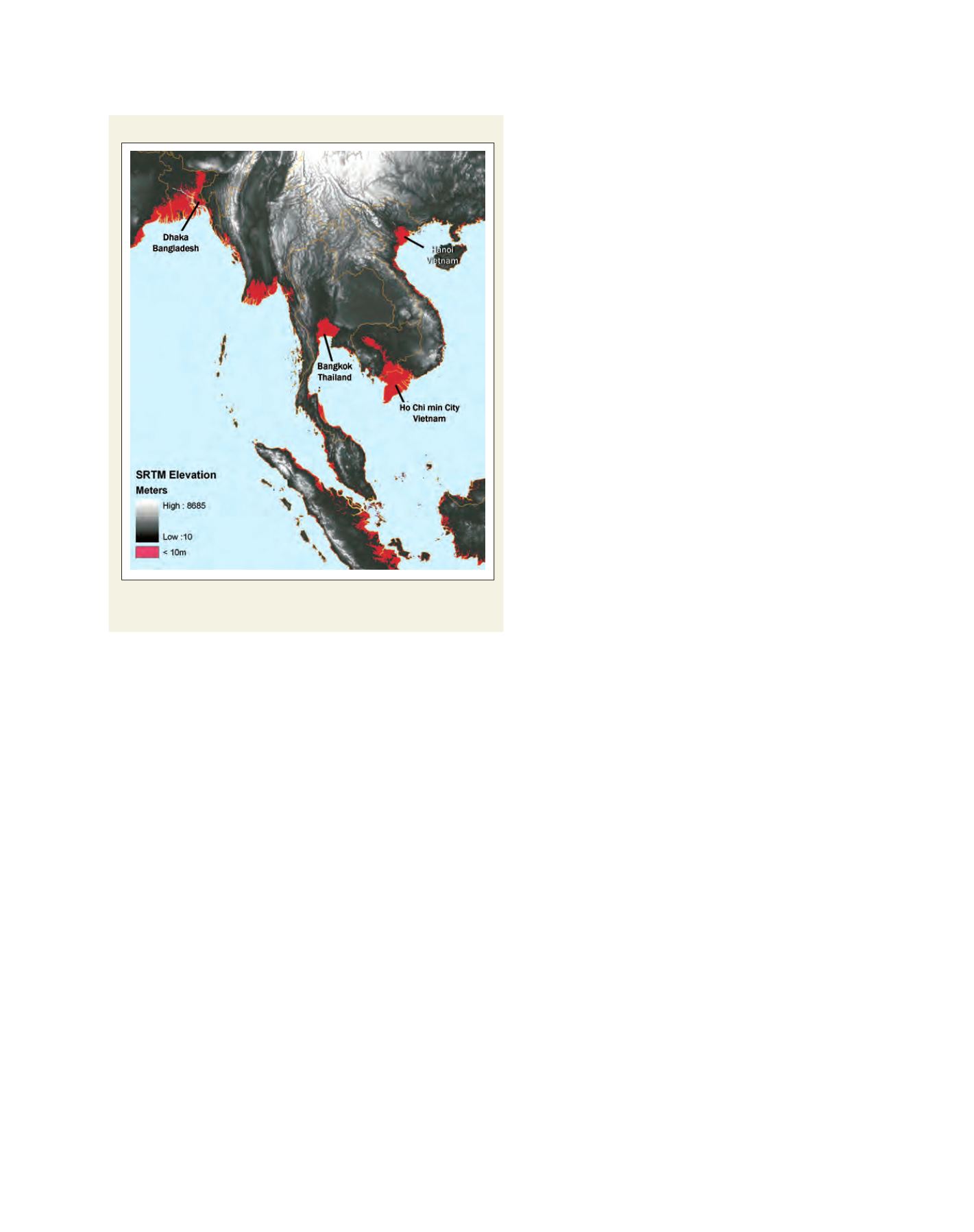
Rising sea levels in East Asia
Much of Bangladesh, as well as Hanoi and Ho Chi Minh City in Vietnam, and
Bangkok, Thailand, are at risk as sea levels rise
Source: PDC using data from 2007 LandScan and NASA SRTM