



 42 / 218

In addition to these services, all other necessary and appro-
priate meteorological reports are made available on the
broadcast systems and volume meteorological (VOLMET)
centres through designated radio frequencies and data links.
Dissemination of routine METARs and TAFs
Bahrain has been designated one of the main collection and
distribution centres in the Middle East region within the
International Civil Aviation Organization (ICAO) regional
Operational Meteorological (OPMET) bulletin exchange
scheme. All aviation routine weather report (METAR, from the
French) and terminal aerodrome forecast (TAF) issues are sent
though a data link to the Bahrain Aeronautical Fixed
Telecommunication Network/Common ICAO Data Interchange
Network (AFTN/CIDIN) centre for onward transmission in
accordance with predefined address lists.
Services to the media
BMS has for many years provided services to the press, radio
and television:
Radio
– Live radio broadcasts are made to the Bahrain
Radio and Television Company several times each day in the
Arabic language. These broadcasts are immensely popular
with the general public and very often lead to lively discus-
sions regarding the weather. Regular feedback is generally
very positive.
Press
– Forecasts are made to all published newspapers in
the Kingdom of Bahrain, both English and Arabic-speaking.
Feedback is positive and any letters to the press regarding
weather phenomena are answered fully and promptly.
Television
– BMS has for many years provided both the
English-speaking station and the Arabic-speaking station with
written forecast scripts. In 2002, a TV graphics system was
purchased to enable a comprehensive broadcast to Bahrain tele-
vision. This service appeared to be popular with the viewing
public, but unfortunately staffing difficulties necessitated its
suspension in 2005. BMS recently upgraded the TV graphics
system, and after successful negotiation with Bahrain TV, the
service is due to resume in the near future.
All of these media services can be used to issue urgent messages
of highly inclement weather that could endanger or inconve-
nience government services and the general public.
Flight safety
It is clear that weather phenomena have a significant impact on
flight safety, even allowing for major improvements in aircraft
construction and onboard instrumentation. BMS will continue
to provide all the necessary resources within its budget to main-
tain and improve its contribution to flight safety and
convenience of delivery.
To this end, it has recently installed the latest forecaster
workstation system incorporating the Meteosat second-gener-
ation satellite receiving system. It will continue to review all
major developments in equipment and techniques for provid-
ing the best and safest possible service.
Forward planning
Planning for the short and long-term future of meteorological
services is a vital part of BMS’s strategy in conjunction with
the Deputy Prime Minister responsible for Meteorology. We
are confident that this policy will continue to flourish.
With this in mind we have appointed specialists within
BMS to constantly review and inform the Assistant Under-
Secretary for Meteorology of all developments and revised
techniques in providing the best services possible to the avia-
tion sector.
Our in-house specialists will advise on:
• Developments in computing equipment and services
relevant to meteorological services
• Developments in satellite reception and analysis
• Climate change and research
• Developments in communication and dissemination
techniques.
Staffing
Many of the current BMS staff members are graduates at BSc or
MSc level. Those who are not graduates are at senior staff levels,
persons of long experience in operational forecasting. Such
staff members have undertaken postgraduate courses relating
to meteorology. They have also attended courses in numerous
countries on disciplines such as satellite meteorology, agricul-
tural meteorology, remote sensing and marine meteorology.
BMS management intends to replace these experienced
members of senior staff, upon their retirement, with graduates.
Future recruitment of junior-level operational forecasting,
climatology, computing and research staff will be at graduate
level. In addition, support staff are being encouraged to under-
take graduate training.
BMS wishes to express its gratitude to the individuals and
organisations that have contributed to its success and devel-
opment over recent years.
[
] 42
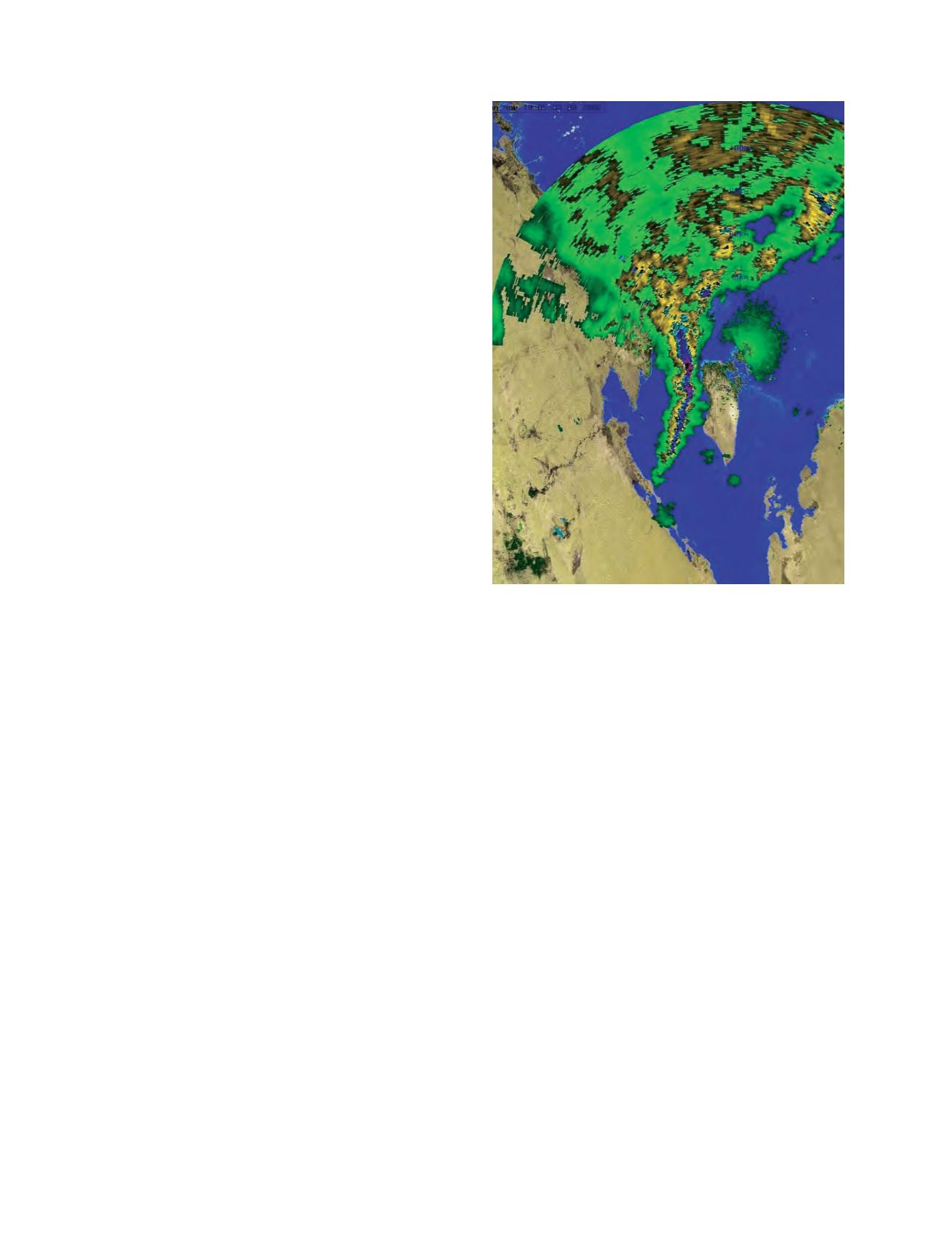
BMS weather radar image, 19 Nov 2000
Photo: BMS