


 37 / 218

[
] 37
reasonable to argue that such voluntary contributions are not
‘aid’ but investments in global public good through delivery of
the observations which primarily benefit the developed coun-
tries. This is an imperfect method of achieving an equitable
provision of global public goods, because the voluntary nature
does not fit with long-term planning. On the other hand, the
‘club’ nature of the partners to WMO VCP means that there is
a high degree of understanding, and therefore efficiency in the
detail. In the future, it may be that a coordinated mechanism
will be realized to fund global observations, in much the same
way as Europe has developed its own.
The VCP partners are not only concerned with the global
supply of meteorological and hydrological observations, but
also work with other development agencies, and therefore also
consider aims including the Millennium Development Goals
and natural disaster mitigation.
Extending this analysis, the NMHS of developing countries
need to be sustainable organizations, and therefore they must
deliver effective and sustainable services to the public in their
countries. These will include services as part of their national
disaster plan, and their national development strategy. Such
services will include statistical information using current and
past data, forecasting on a range from a few hours to seasonal,
and the setting of all this into the context of climate change
impacts. The VCP donors appreciate the need for the NMHS
of developing countries to be effective and sustainable, and
therefore support projects across this range of services. Recent
VCP projects include the provision of Numerical Weather
Prediction products specifically for the developing countries,
systems for communication such as satellite and the Internet,
workstations for forecasters to visualize the weather and
produce forecasts with, systems for climatology databases and
assessing regional climate change impacts, and equipment
for delivering services to the public. Sustainable organiza-
tions need people trained as effective practitioners, and here
the VCP donors also help by supporting a range of training
and professional development.
Examples of projects supported through WMO VCP
Training and fellowships
Training and fellowships form an important component of the
VCP Programme. Whilst almost all VCP Projects have some
form of training associated with them, there is a need to
develop the basic and specialist skills of personnel within
NMHSs. The aim is to build a “critical mass” of people who
can manage and nurture the services provided by an NMHS,
from observations through to forecasting and understanding
the likely impacts of climate change. Traditionally this has
been achieved by offering a range of fellowships for short- and
long-term courses hosted by other NMHSs, WMO designated
Regional Training Centres and universities around the world.
Much of this is coordinated by the WMO Education and
Training Department.
Recent projects have explored the benefits of using e-learn-
ing techniques to improve the efficiency, quality and
accessibility of this training. One example is the Statistics in
Applied Climatology Programme (SIAC). The “e-SIAC” was
developed by a team from Reading University in the UK, with
support primarily from UK VCP. The e-SIAC teaches partici-
pants how to analyse climatic data and produce simple
products that are useful primarily in the agricultural sector,
but also to those working in health, food security, construc-
tion and tourism. These products are becoming increasingly
important as it is widely recognised that knowledge of climate
variability is key to understanding the likely impacts of climate
change. The e-SIAC has so far successfully engaged over 100-
participants from more than 20 Countries in Africa and is also
proving popular in other regions. For further details visit:
www.met-elearning.org/moodle.RANET
RANET is an international collaboration to make weather,
climate, and related information more accessible to remote and
resource poor populations. RANET undertakes this mission in
order to aid day-to-day resource decisions and preparedness
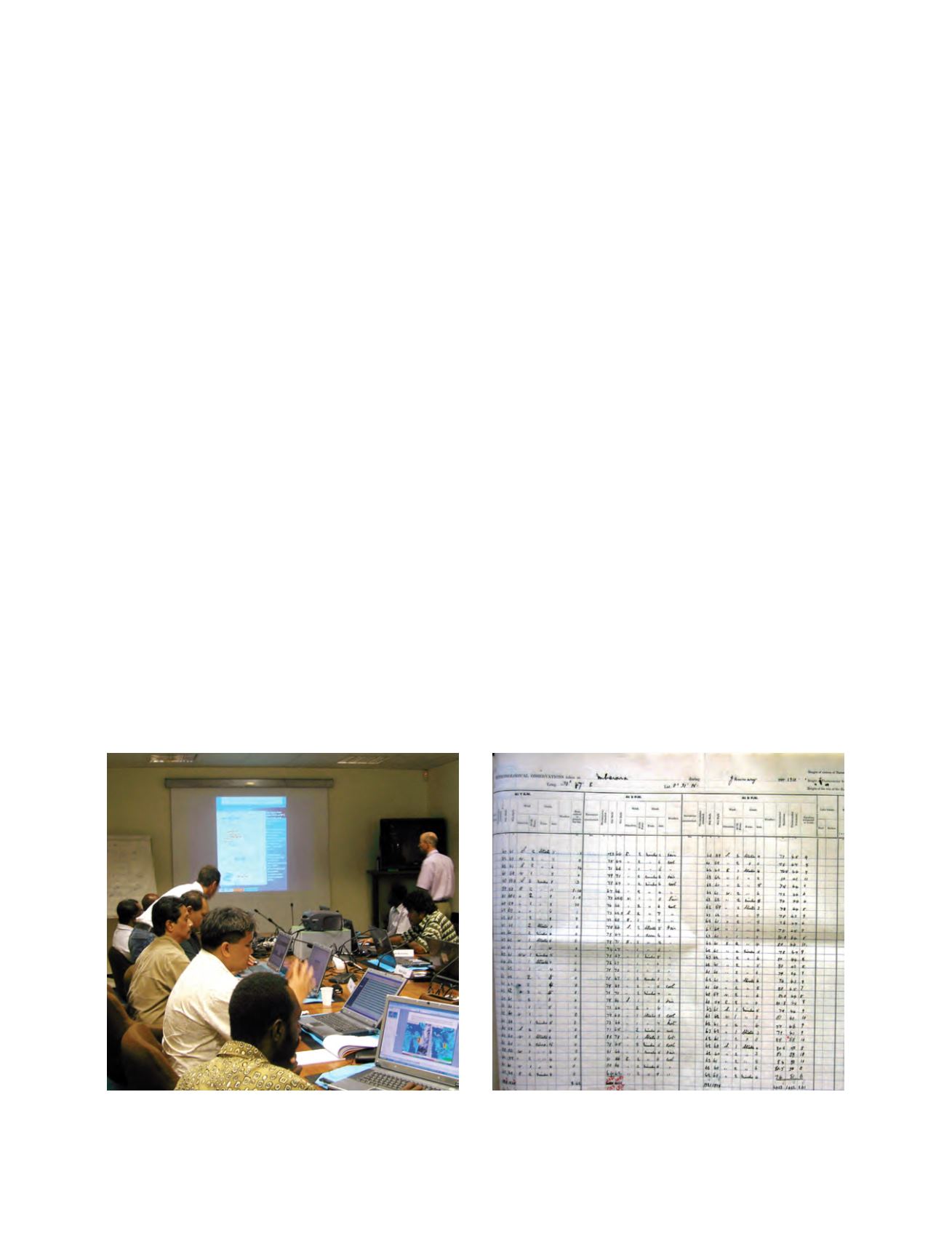
A training workshop for several South Pacific countries held by
Météo-France in Noumea on ensemble forecasts and application to
monthly and seasonal forecasts
Photo: Météo-France
A monthly observations sheet for Mbarara, Uganda in January 1910.
Digital photos of paper archives are easy to share and can be digitised
to add to climatology databases
Photo: Met Office, UK