



 32 / 218

[
] 32
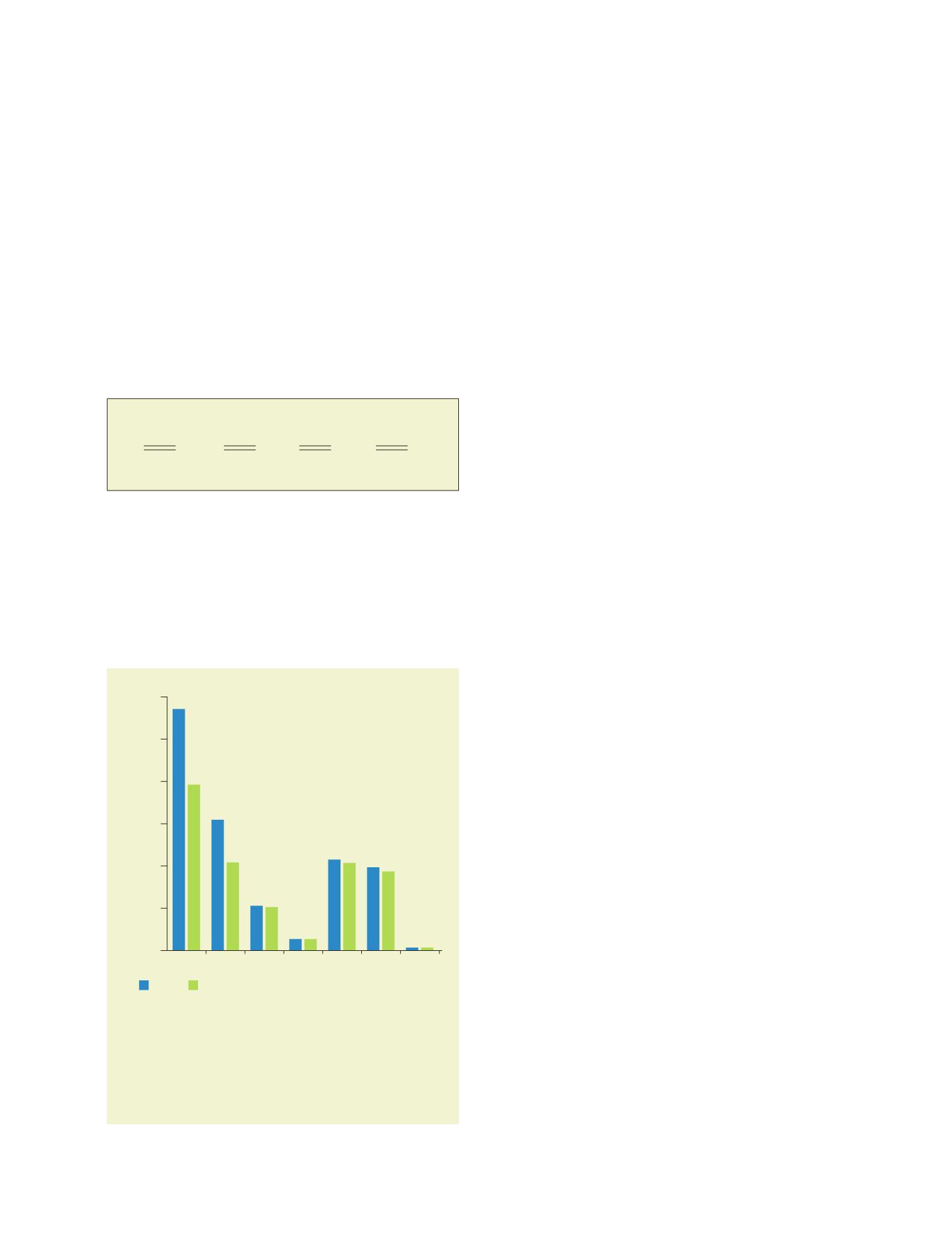
tively few areas. The majority of the gaps relate to these cate-
gories (where 70 per cent and 71 per cent respectively of the
cases were predicted). New approaches are therefore needed
for forecasting regional synoptic processes, their energy
concentration, cyclogenetic activity, and other manifestations
of processes on the synoptic scale.
The variability of weather conditions is defined as the
climatic characteristic of non-periodic variation in weather
conditions in a given territory. The extent to which extreme
values vary (deviate) from mean values of the main meteoro-
logical variables was selected to depict that characteristic. In
order to assess variability, a corpus of daily meteorological data
for the period 1991 to 2004 was selected: minimum tempera-
ture (Tmin), maximum temperature (Tmax), precipitation (P)
and maximum wind speed (Wmax) observed during a 24-hour
observation period. Calculations are done according to the
formula.
Where Y is the dimensionless indicator of the variability of
weather conditions;
T
max
, T
min
, P
max
and W
max
– signifying the absolute extremes
of maximum temperature (the highest air temperature
observed during the given period), the minimum temperature
1
2
3
4
5
6
7
0
20
40
60
80
100
120
1. Wind, hurricane, tornado, dust storm
2. Rain, heavy rain, hail, thunderstorm
3. Snow, sleet, snowstorm, ice-cover, snow drifts
4. Frost, hot weather, sharp rise (fall) in temperature
5. Flooding (including high river levels, flash floods,
snowmelt, combined phenomena), ice break-offs, mudflows
6. Avalanche risks
7. Fog.
Total
Predicted
Number of cases
Distribution of cases of adverse and hazardous weather conditions
(by type of phenomenon) that led to loss of human life or social and
economic losses for the population between 1991 and 2006
(the lowest observed during the given period), the maximum
daily total of precipitation (the highest quantity of daily precip-
itation observed during a given period), the maximum wind
speed (the highest wind or gust speed observed during a given
period) – have been chosen from the statistical distributions
of meteorological variables being examined in a selected region;
T
max
, T
min
, P
max
and W
max
are the average climatic values of
meteorological variables being examined – are calculated
according to statistical distributions.
Fi is the average annual recurrence (frequency) of extreme
values for meteorological variables. The maximum and
minimum temperatures and maximum wind speed are calcu-
lated as the number of cases, within a 5 per cent range, divided
by the number of years in the sample. The maximum daily
total of precipitation is the number of cases, within a 10 per
cent range, divided by the number of years in the sample. This
is done in order to minimize the influence of the span of the
sample on the size of the indicator of the variability of the
weather conditions in a given territory.
The maps below show an example of the variability of
weather conditions in a territory in the central and southern
part of European Territory of Russia. It is clear from the inte-
gral variability coefficient Y, the 40 federal subjects being
studied from the point of view of extreme phenomena possess
territorial particularities. In the warm period, a smooth tran-
sition from north to the south is observed in the increase in
variability of weather conditions. The greatest variability can
be seen in the Volgograd and Saratov oblasts. In the cold
period, variation is more diverse, but there is still an increase
towards the south. This indicates the high level of meteoro-
logical vulnerability of federal subjects in the southern part of
the European Territory of Russia, from the point of view of the
impact of hazardous hydrometeorological conditions and
adverse weather conditions on the economy.
In terms of the increased severity of effects of the natural
environment on society and industrial and economic installa-
tions users of hydrometeorological information, particularly
forecasts have to adopt a policy of optimal adaptation (tech-
nical, technological and informational) to current and expected
weather conditions. Optimal adaptation – meaning optimal
(economically effective) use of hydrometeorological informa-
tion – allows maximum reduction of vulnerability.
It must be pointed out that the effects of weather conditions
may be long-lasting, reflecting the adverse effects of many years
of climatic variability. Climate trends of a meteorological
dimension that are shaped by this variability give rise to inte-
gral climatic costs (economic losses) in sectors of the economy,
which can be obtained on the basis of statistical reports at local
and federal level. The costs of this kind show the climatic
vulnerability of individual types of industrial activity in the
economic sphere. Knowledge of climatic vulnerability calls for
the amendment of statistical evaluations, prospects, and trends
in economic development.
The atmosphere, along with other components of the envi-
ronment, will also be resource-loaded. As was the case
historically, and remains so today, meteorological resources can
be used for supporting life. Forecasting and giving warnings
of hazardous weather conditions are fundamental meteoro-
logical resources.
Various sectors of the economy use daily information about
expected weather conditions and timely warnings of hazardous
weather conditions provided by the forecasting division of
T
max
Y =
T
max
T
min
• F
1
+
T
min
P
max
• F
2
+
P
max
W
max
• F
3
+ • F
4
W
max
Source: A. I. Bedritsky