


 35 / 218

[
] 35
W
EATHER
,
CLIMATE AND
water cross all national
boundaries, and affect every aspect of life. Over the
last 150 years, scientists have been sharing their
observations and information about weather, climate, water
and the environment, and using the best available communi-
cation and scientific tools in order to produce useful weather
and climate forecasts, and other knowledge-based products
and services. Monitoring and predicting our weather and
climate and how they affect the Earth’s environment and society
requires international cooperation. However, in developing
countries, limited resources and lack of human capacity
prevent them from producing and applying information for
the benefit of their own communities, as well inhibiting the
dissemination of data to other centres.
The World Meteorological Organization recognized this
problem, and set up the Voluntary Cooperation Programme
(VCP).
2
The aim is to link the needs of National
Meteorological and Hydrological Services (NMHS) of devel-
oping countries with the technical ability and funding
available in developed countries. The VCP provides a mech-
anism through which the NMHS of developing countries can
request assistance in terms of equipment, expert services,
training and education, in order for them to be able to partic-
ipate in the programmes of WMO. These programmes cover
the role of NMHS in taking observations, communicating
them to stakeholders, archiving them for climatology studies,
and in producing forecasts and warnings for their users. There
are various types of end-user services, but first among these
is ensuring the safety and well being of their nations’ citizens.
NMHS are responsible for monitoring weather, climate and
the natural environment, and for giving public warnings and
information in a timely, reliable and comprehensive manner.
Each NMHS has links through its government to national
disaster prevention and risk management authorities. They
also have knowledge of the local environment in order to
assess potential impacts, as well as an awareness of culture
and languages, so as to be able to communicate directly to
the people, particularly at the local community level. The
forecasts and other information on weather- and climate-
related events that the NMHS provide are a vital component
in the decision making processes for many weather-sensitive
sectors.
Developing countries are often the most vulnerable to
natural disasters, because they are located in regions prone to
Technical cooperation for weather, water
and climate services in developing countries
Steve Palmer, UK Met Office
1
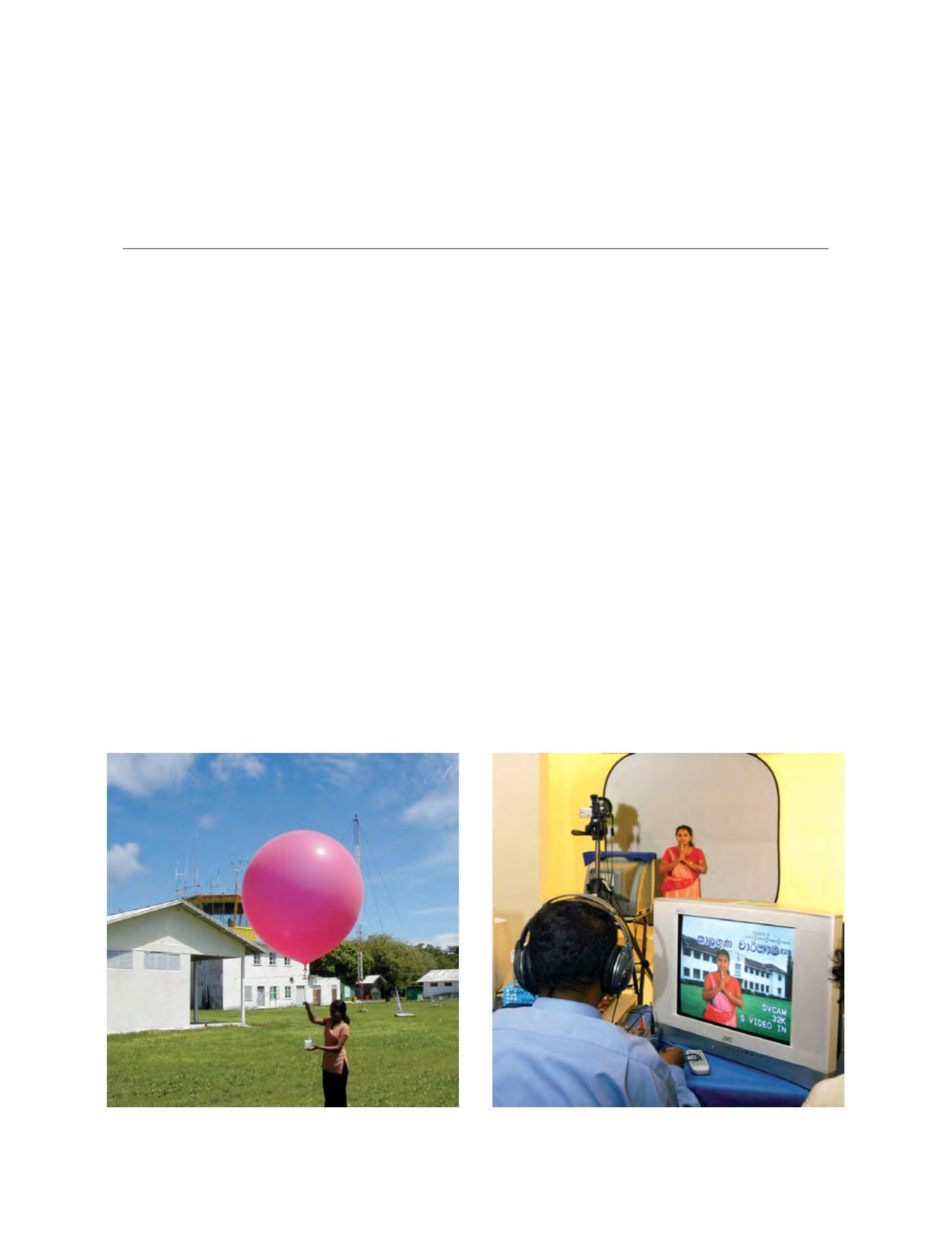
Launching a radio-sonde at Gan, Maldives after the station was
re-equipped by USA and UK VCP contributions
Photo: Met Office, UK
A forecaster in Sri Lanka finishes her weather presentation for broadcast
on the national TV company using equipment provided by UK VCP
Photo: Synergy Media Services