



 34 / 218

[
] 34
Third issue
– Interdepartmental assessment of the reliability
and economic usefulness of hydrometeorological forecasts,
which requires perfection of the technology for collecting,
collating and analysing information, particularly about
economic losses.
The issues presented above must be highlighted and their
sector-specific solutions given as part of the
‘
Hydrometeorological passportization
’ project developed in
conjunction with users. It is a substantial task of federal signif-
icance, which must be put into practice in Roshydromet’s
territorial Administrations on the basis of a conceptual
programme. The programme is determined by the fact that
alongside the nationwide problems of economic development
remains the problem of ensuring the daily hydrometeorologi-
cal safety of the population and economic practices. The user
must learn to understand the economic content of the meteo-
rological environment, its natural indifference, and its dangers,
and by means of a mechanism such as the optimal use of fore-
casts, know how to preserve its beneficial effects, reduce
meteorological losses, and develop economic gains.
Thus, it is glaringly obvious that the hydrometeorological
vulnerability of the economy and the social and economic
sustainability of society share a common cause-and-effect rela-
tionship: namely the need to reduce meteorological losses,
ensure hydrometeorological safety and therfore contribute to
sustainable social and economic development.
At the present time, the country has an industrial infrastruc-
ture adapted to previous climatic conditions, although these
are now changing. However, climatic changes that are taking
place at global and regional level, particularly their extreme
manifestation beyond the usual level of intensity, can give rise
to catastrophic damage in economic and social spheres. In this
connection, the battle to reduce economic and social losses will
never be won if they are not taken into account at State level.
This is particularly important for minimizing the losses, which
leads to a reduction in meteorological vulnerability.
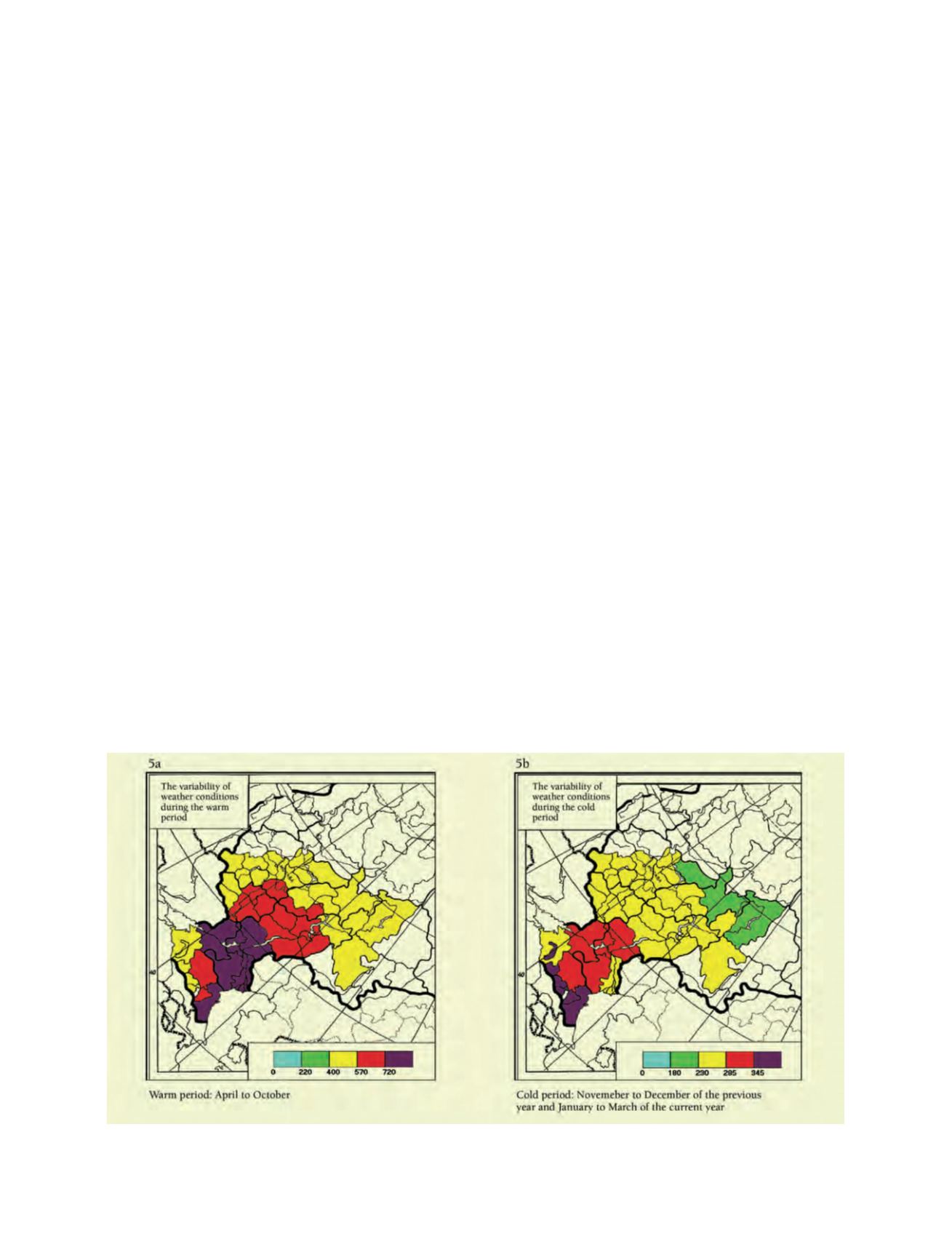
The variability of weather conditions in the territories of the federal subjects of the central and southern part of the European Territory of Russia
Taking into account these losses at State level and their mini-
mization requires ministries and departments to develop of
common interdepartmental procedures for evaluating the
damage caused by extreme natural events and for classifying
and taking stock of these extreme situations. Interdepartmental
procedures are needed for evaluating the losses that were
avoided by using of hydrometeorological information and
taking protective measures.
The development of interdepartmental procedures for evaluat-
ing the prevented losses, taking stock of and analysing these losses
enables ministries and departments to develop guidelines for
taking the optimal decisions regarding weather and the economy
that are required for implementing the essential rational protec-
tive measures that lead to a maximum reduction in losses.
In carrying out national and sectoral assessments of the
effects of weather conditions and meteorological vulnerability,
Roshydromet has had to develop and supplement on a regular
basis databases on adverse weather conditions, hazardous
hydrometeorological phenomena and extreme manifestations
of climate change, which ought to help reduce the losses expe-
rienced by the population and economy of federal subjects.
These assessments are important for planning current activities
and for the development of a State “reaction” strategy, needed
for coping with future extreme phenomena.
A permanent archive is required, to be created using the
aforementioned databases. This is because comparative analy-
sis of the negative consequences of adverse weather conditions
and hazardous hydrometeorological phenomena enables more
precise procedures for forecasting the effects on humanity of
hazardous phenomena, and weather as a whole, to be devel-
oped, and measures for anticipating them to be formulated. It
is also required for perfecting standard forecasts and forecasts
about hazardous hydrometeorological phenomena, particularly
difficult to forecast convective phenomena, and for perfecting
systems for effectively conveying those forecasts to the people
making decisions about the protective measures to be taken.
1
Source: A. I. Bedritsky