



 29 / 218

[
] 29
Ocean data and products provide substantial improvements to
the operational decisions made in crisis management. If such
data and products are fully integrated into the existing response
tools and procedures, effective reaction time is much improved.
Accessibility, reliability and timeliness are vital to the success
of such strategies. Crisis management operations require rele-
vant information as soon as possible if they are to implement
effective responses to, for example, a search and rescue oper-
ation or a major oil spill. In order to improve services and crisis
response, operational agencies are working with direct end
users and ‘middle users’ in the private sector, to adapt prod-
ucts and information to meet the specific requirements of
different crisis situations.
Risk management
–
industry, engineering, defence and other
at-sea operations
– Risk management is a key issue for all
industries operating within the marine environment. They
require dependable, accurate information to develop appro-
priate strategies and plans for efficient and effective modes of
operation. Such information is often gathered as it is needed by
the specific sector or by individual operators. However, this is
often not adequate in accuracy or scope. As a result, and due
to the recognized importance of risk management data and
products to marine industries, such services are frequently
provided by private and/or public companies (middle users)
that specialize in the provision of such information.
Climate: assessment and prediction of climate variability and
change
– Climate and climate change are prominent issues for
both the developed and developing communities. Knowledge
of the ocean is needed for initialisation and verification of
predictions, as well as for assessing and understanding climate
variations and change. Operational ocean products are most
frequently used as the basis for research into understanding
the long-term variability of the ocean and for defining the
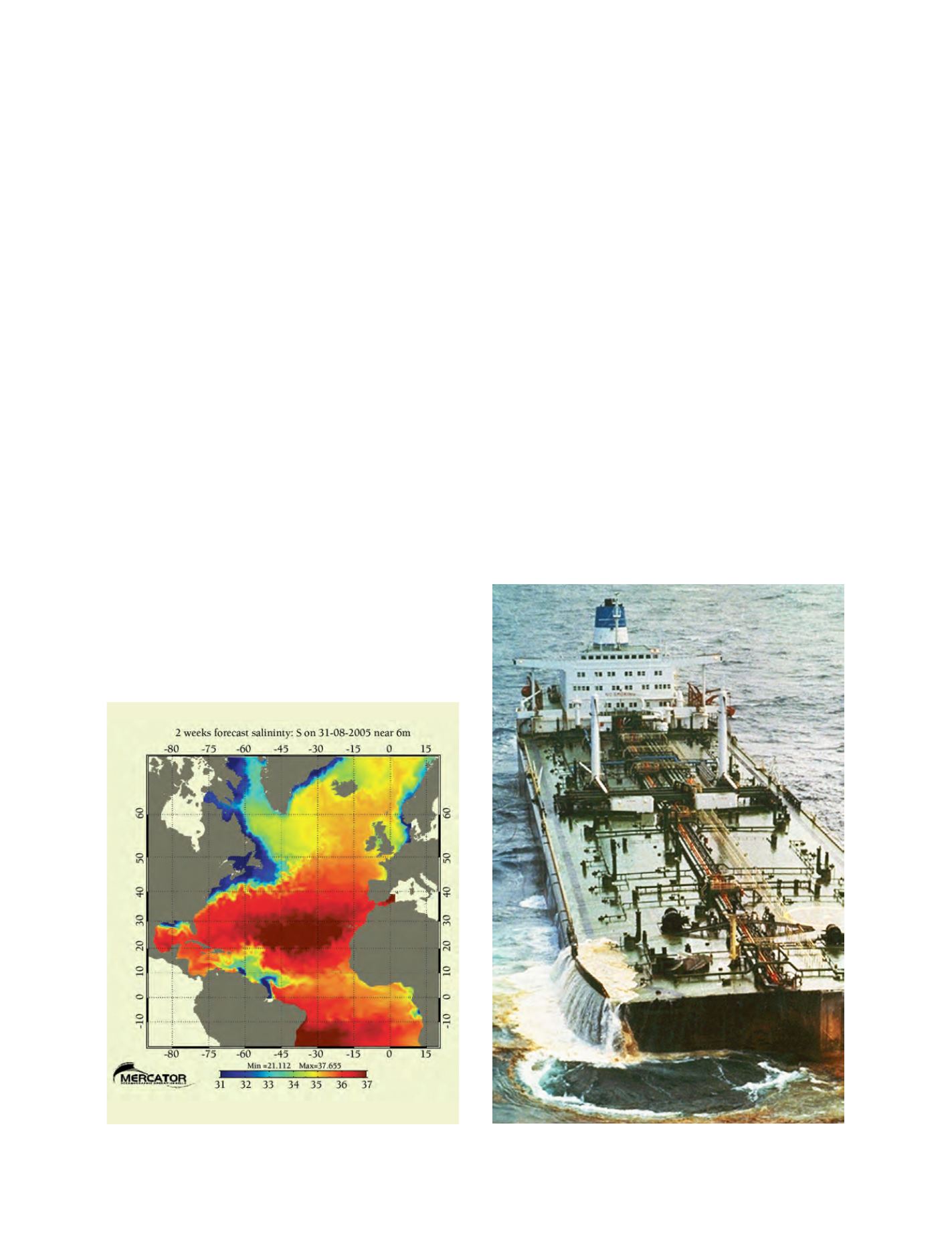
Photo: Australian Maritime Safety Authority
A case for crisis management
Two-week salinity forecast, North Atlantic
Source: Mercator Project, France
requirements and strategy for an ocean observing system for
climate monitoring.
Ocean monitoring and prediction for society
Our ability to measure and monitor the oceans, and our under-
standing of ocean processes and behaviour, is growing rapidly.
The future of human society, and of the very planet and its life
forms is, and will increasingly be, dependent on our under-
standing of the oceans, on predicting their future states, and on
applying this knowledge in the service of society and the global
environment. This can only be realistically viable through long-
term and sustained ocean monitoring – in effect, taking the
pulse of the planet’s lifeblood.
JCOMM has, as its primary mandates:
• The further development of observing networks in the
world’s oceans and seas
• The implementation of data management systems to meet
the needs of real-time operational services and global
observing systems
• The delivery of products and services needed by both
operational and scientific user communities.
Thus WMO and IOC, working through JCOMM as a primary
coordination mechanism, stand at the forefront of our efforts
to understand, harness and responsibly manage the oceans and
their resources in the interests of humanity and the future of
the earth.
1