



 27 / 218

[
] 27
S
TRICTLY SPEAKING
, Planet Earth should more properly be
known as Planet Water, or Planet Ocean. Monitoring and
forecasting the behaviour of the ocean is a major chal-
lenge for the 21st century, as it equates to the sustainable
development of economic activities in the open sea and in
coastal areas, and to the implementation of global climate
monitoring and prediction systems.
Real-time operational data, information, products and
predictions will increasingly be used in support of a large and
expanding range of societal applications and benefits.
Undeniably then, the oceans constitute a critical component
of the lifeblood of our society – thus monitoring, in order to
understand and manage them, is vital.
The observing system
Delivery of effective ocean products and services requires long-
term and reliable access to global data of guaranteed quality.
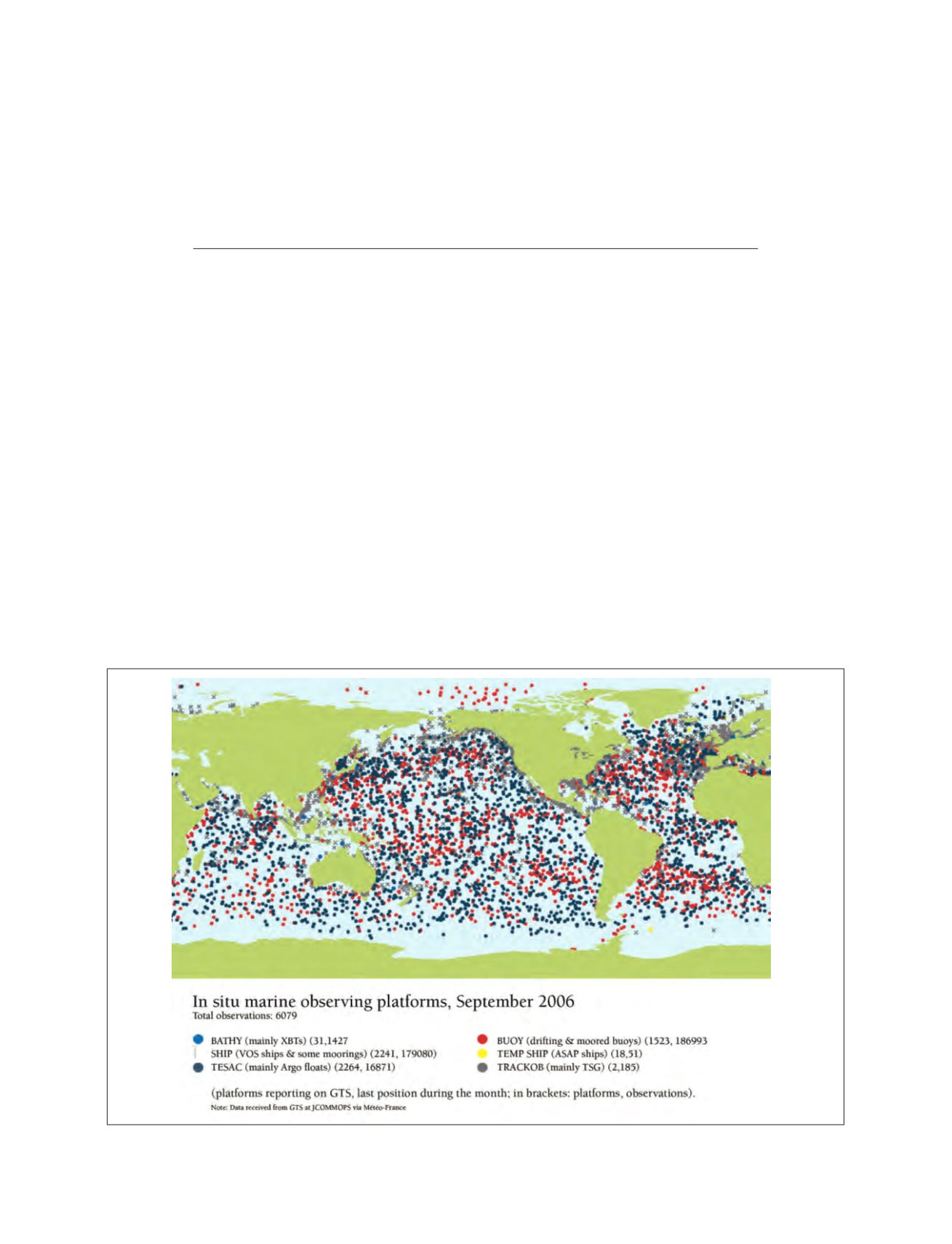
The Global Climate Observing System’s second report gives a
summary of the capability of the present observing system to
address large-scale climate requirements, and recommends the
implementation of the initial global ocean observing system.
This strategy will, in practice, support a full range of diverse
user requirements, including numerical weather prediction,
marine hazard warning and mitigation, and marine environ-
mental monitoring and management.
Ocean observations are currently collected entirely on an inde-
pendent, national basis. In the interest of greater range, accuracy
Ocean data, information, products and
predictions in the service of society
Dr Peter Dexter, Co-president, JCOMM, Melbourne
Johannes Guddal, past Co-President, JCOMM, Bergen
Candyce Clark, Intergovernmental Oceanographic Commission (IOC) Secretariat, Paris
In situ ocean observing system status, September 2006 (JCOMMOPS)
Source: JCOMMOPS