



 22 / 218

[
] 22
(UIC) is to ‘promote rail transport in order to meet the chal-
lenges of mobility and sustainable development.’
Climate change and transport – cause and effect
Global warming is becoming more visibly evident, and with
this revelation, climate change is receiving increased global
attention. The pressure is on governments and individuals to
learn more about the cause and the effects of global warming,
and how to deal with it.
However, while we have a decent understanding of the likely
causes of climate change, the consequences advance quickly and
are hard to predict. Observable effects vary from region to region,
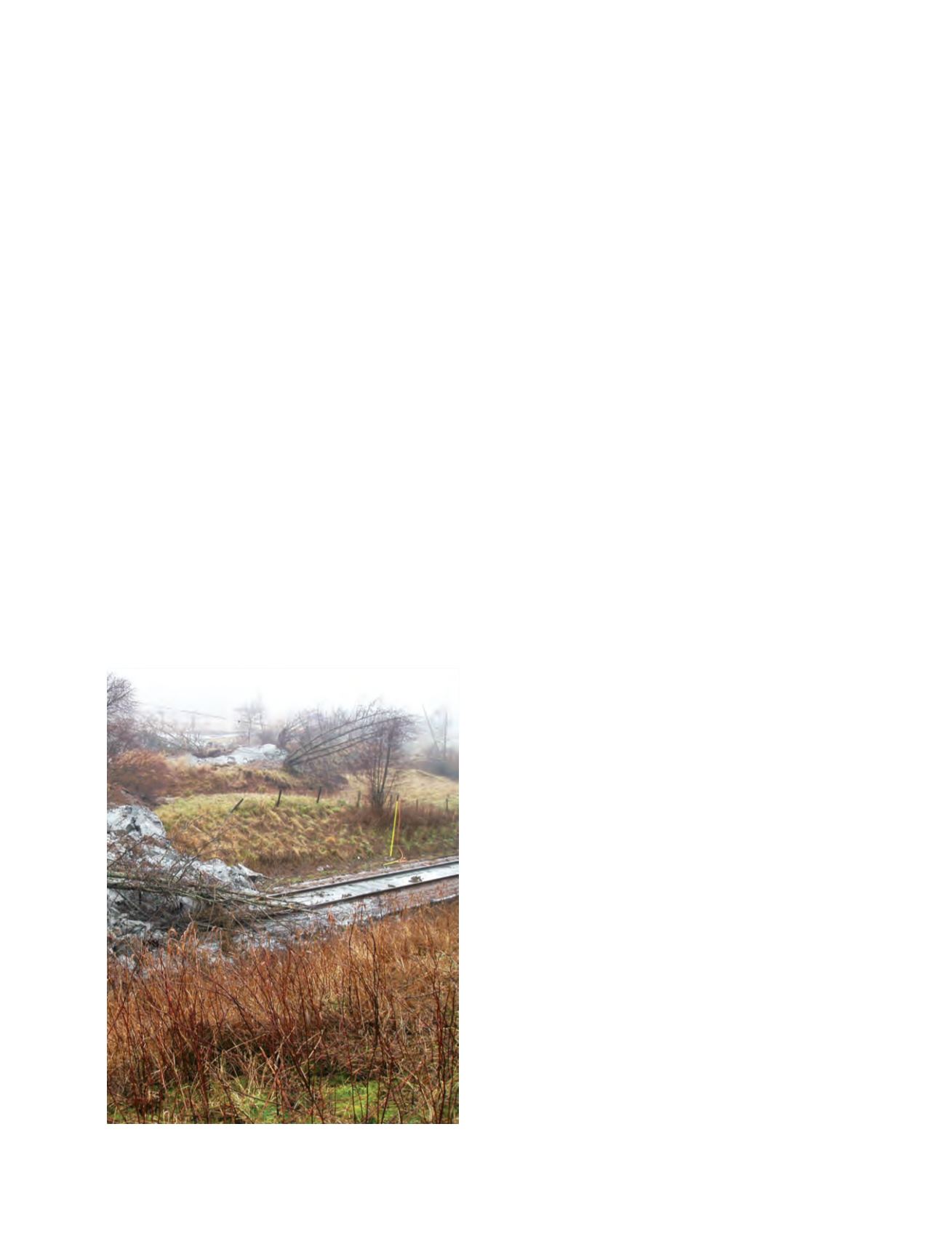
and include track buckling, heavy rain, storms, flooding, land-
slides and avalanches, and catastrophic scenarios such as
hurricanes and tsunamis. These threats represent huge poten-
tial damage to transport infrastructure, and demand new
attitudes toward its planning, construction and maintenance.
It is important to differentiate between natural hazards and
the effects of climate change. While the appearance of the two
is often similar, the causes and consequences are significantly
different.
Traditionally, the threat of natural hazards has been an inte-
grated element in the planning and construction of rail
infrastructure. For example, Swedish construction of roads and
tracks incorporates specific dimensioning in order to cope with
the ‘50 years deluge’. However, much international rail infra-
structure was constructed more than 100 years ago, and in
many places rail tracks have suffered from lack of proper main-
tenance, due primarily to company cutbacks.
The increased occurrence of extreme weather events
demands a re-evaluation of how we design and maintain our
transport systems. Policymakers, planners and constructors
will have to work harder and with greater innovation to ensure
transport safety, availability and quality.
The consequences of extreme weather differ according to
factors such as geography, topography, geology and population
density. For example, the effects of heavy rain on a landscape
will differ depending on the porosity of the soil. Trends in
society, such as the urbanization process, are also influential.
For example, asphalt and clear-felled areas increase the inten-
sity of flooding.
More specifically for the rail services, extreme weather can
lead to actual damage of the tracks, signals, etc. This can cause
further damage to trains, staff, passengers and property. In addi-
tion, such damage can lead to extended suspension of service.
In a vulnerable society where transport and economy are
closely linked, this will lead to major costs.
There is also the potential that technical aspects of the train,
designed for a certain environment, might not function as
expected when the context changes. A rail fleet is normally
designed to last 30 years. Thus, changes in the natural envi-
ronment represent a challenge for the future design of trains.
For example, disruptions in UK rail services have been put
down to the ‘wrong’ type of leaves causing wheel slip, or even
the ‘wrong’ type of snow resisting rail clearance procedures.
To reduce and avoid such weaknesses in planning and
construction, closer cooperation with local climatologists,
meteorologists and hydrologists is necessary.
Another practical difficulty resulting from global warming
relates to the prediction of soil structure. In particular the
impact on mountainous, coastal and riverine regions has been
well documented. In Tibet, the enormous railway project to
link the area with the rest of China has been dogged by envi-
ronmental concerns. With the loss of permafrost as a direct
consequence of climate change, the long-term sustainability
of the project is severely weakened. Similarly, increased rain-
fall in areas of Asia prone to landslips (Philippines and
Indonesia in particular) will prove dangerous to fixed land
infrastructure in the future. Early consultation with climatol-
ogists can highlight regions of increased disaster probability,
and ensure that the tracks are built in more sustainable areas.
The study of the consequences of global warming on transport
and rail infrastructure is in continuous development; increased
observations, studies and data are required to cope with this
advancement.
Rail infrastructure: a UIC study
Recently, UIC launched its first study into the effects of
climate change on rail infrastructure in Alpine regions, in flat
regions near the coast and near rivers in central Europe. The
aim of the project is to examine the rise in temperature and
its consequences for permafrost areas in the Alpine regions,
as well as considering the necessity for early detection of
risks, and the securing of tracks. Specific cases for investiga-
tion include:
• Hydroelectric power plants as a secure power supply for
railways
• Simultaneous melting of snow in the Alps and in the low
mountain ranges, and how this will affect seasonal river
flow
• Effects of sea-level rise on track safety
• Effects of heavy storms on power supply, tracks (fallen
trees) and the driving dynamics related to cross winds and
wind shear.
Rail tracks in tough weather
Photo: Jan Skoglund