



 28 / 218

[
] 28
• High-resolution hydrodynamic models for coastal navi-
gation and hazard reduction
• Sediment transport and turbidity
• Advance warning of environmental impacts/events.
Marine ecosystems management: fisheries and biogeochemistry
–
Maritime nations share the challenge of managing and sustain-
ing the oceans’ living and non-living marine resources for
present and future generations. This requires an integrated
ecosystems approach. Such strategies are characterized by accu-
rate knowledge of the factors that affect the oceans, and
estimates and predictions of circulation and biogeochemical
interactions and cycles. These issues are a major focus of Global
Ocean Observing System’s coastal ocean observing system
design and implementation plans.
There is a growing need for oceanographic information of
various timescales in order to support the monitoring, and
sustainable management of fisheries. The most important infor-
mation relates to extreme ecosystem events, since these will
have the greatest impact on the largest number of people.
Extreme weather predictions can be used effectively in predict-
ing, and thus mitigating the effects of global problems such as
coral bleaching, HABs, river pollutant pulses and mass extinc-
tion due to ecosystem imbalance.
Crisis management: search and rescue, and marine emergency
response
– In what is generally termed ‘public good services’,
ocean data, products and predictions are made available for a
range of activities and operations which take place in the public
domain, or for which governments have a direct responsibility.
There are two types of applications:
1. Data and products used in an immediate and disposable
fashion to mitigate or alleviate the impacts of crises such as
oil spills or search and rescue
2. Data and products that are used regularly in the opera-
tion of a business or service, to manage risk associated
with the marine environment and to enhance efficiency and
effectiveness.
and effectiveness, international coordination and compliance
with agreed standards is necessary. Most in situ ocean observa-
tion activities are currently coordinated by the Joint IOC/WMO
Technical Commission for Oceanography and Marine
Meteorology (JCOMM). However, it is clear that there are few
national commitments for sustained global ocean observations.
Applications and benefits
Natural hazards and coastal impacts
– There is a clear require-
ment for ocean data, information and products to facilitate the
prediction and mitigation of natural hazards, including storms,
tropical cyclones, tsunamis, coral bleaching, climate impacts
(in coastal regions and island states) and harmful algal blooms
HABs).
Integrated coastal management
– Integrated coastal manage-
ment is a prominent theme at regional, national and
international levels. The World Summit on Sustainable
Development, Johannesburg 2002, and the Commission for
Sustainable Development, have both highlighted the impor-
tance of effective integrated coastal area management. These
policies stress the importance of efficient access to ocean
information, to guide the development of management strate-
gies and to contribute to the implementation and sustained
operation of management processes. Coastal management
issues include human habitations, coastal and shoreline
industry and engineering, food production including aqua-
culture, coastal marine ecosystems and marine protected
areas, and the increasingly important marine tourism and
recreation industry.
Issues that are of direct and increasing relevance to coastal
users and applications include:
• Storm surge and wave prediction models
• Linking estuaries to offshore
• Warnings of harmful algal blooms
• Downscaling of the impacts of climate variability and
climate change
• Zooplankton and fish diseases
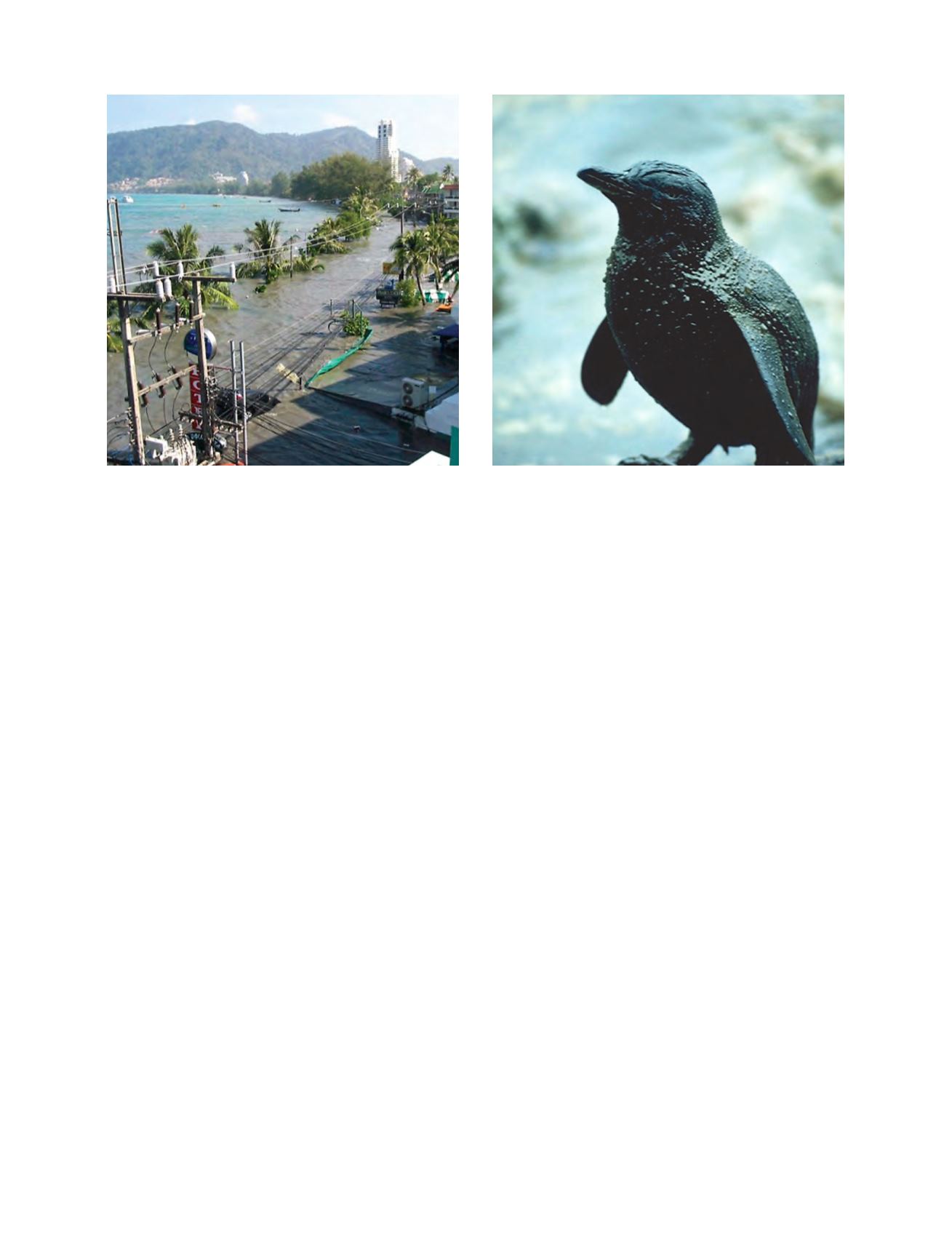
The tsunami at Phuket, Thailand, 26 December 2004
Photo: Trevor Gilbert (Australia)
The future of all species depends on an understanding of the oceans