



 26 / 218

[
] 26
GOME-2’s capacity to significantly extend the long time
series of measurements already gathered by GOME-1 is very
important, as this will significantly impact our capability to
model the climate system, leading to improved medium to
long-term climate forecast capabilities.
Towards operational ocean altimetry – Jason-2
To better understand the forces behind global climate changes
and to predict seasonal anomalies in weather patterns, it is vital
to understand the physics of the ocean. Satellites offer a real-time
global view of the oceans, in addition to sparse in-situ observa-
tions. Radar altimetry can measure the height of the sea surface
and detect the slightest variation in ocean levels to the nearest
centimetre. Using this information to study the growth and evolu-
tion of surface waves in response to winds and tidal forcing will
enable calculations of dynamic topography to derive the posi-
tions and intensities of ocean currents, eddies and thermal fronts.
The Jason mission is built around a series of satellites that will
collect global ocean surface data on a continuous basis for several
decades. EUMETSAT will soon extend its activities and services
into ocean altimetry, with the launch of Jason-2 in 2008. Jointly
developed by NASA and the French space agency, Jason-2 will
be operated by NOAA and EUMETSAT. The satellite will overlap
with the Jason-1 mission to allow more precise cross-calibration
between the two systems, to within a few tenths of millimetres.
Jason-2 is a Low Earth Orbit (LEO) satellite, flying at an alti-
tude of around 1300km. The main instruments on board are a
radar altimeter, a microwave radiometer, and several precise
orbit determination systems. The aim is to measure the global
sea surface height to an accuracy of a few centimetres every
ten days, in order to determine ocean circulation, climate
change and rising sea levels.
These data can be applied in marine meteorology, operational
oceanography, seasonal prediction and climate monitoring. The
information on sea surface height can be assimilated into numer-
ical ocean circulation and wave models, and in combination with
in-situ measurements it will provide vastly improved ocean fore-
casts, both for shorter and longer timescales.
Jason-2 is expected to provide an important contribution to
EUMETSAT’s future activities in the field of oceanography,
serving the marine core services of the Global Monitoring for
Environment and Security initiative (GMES).
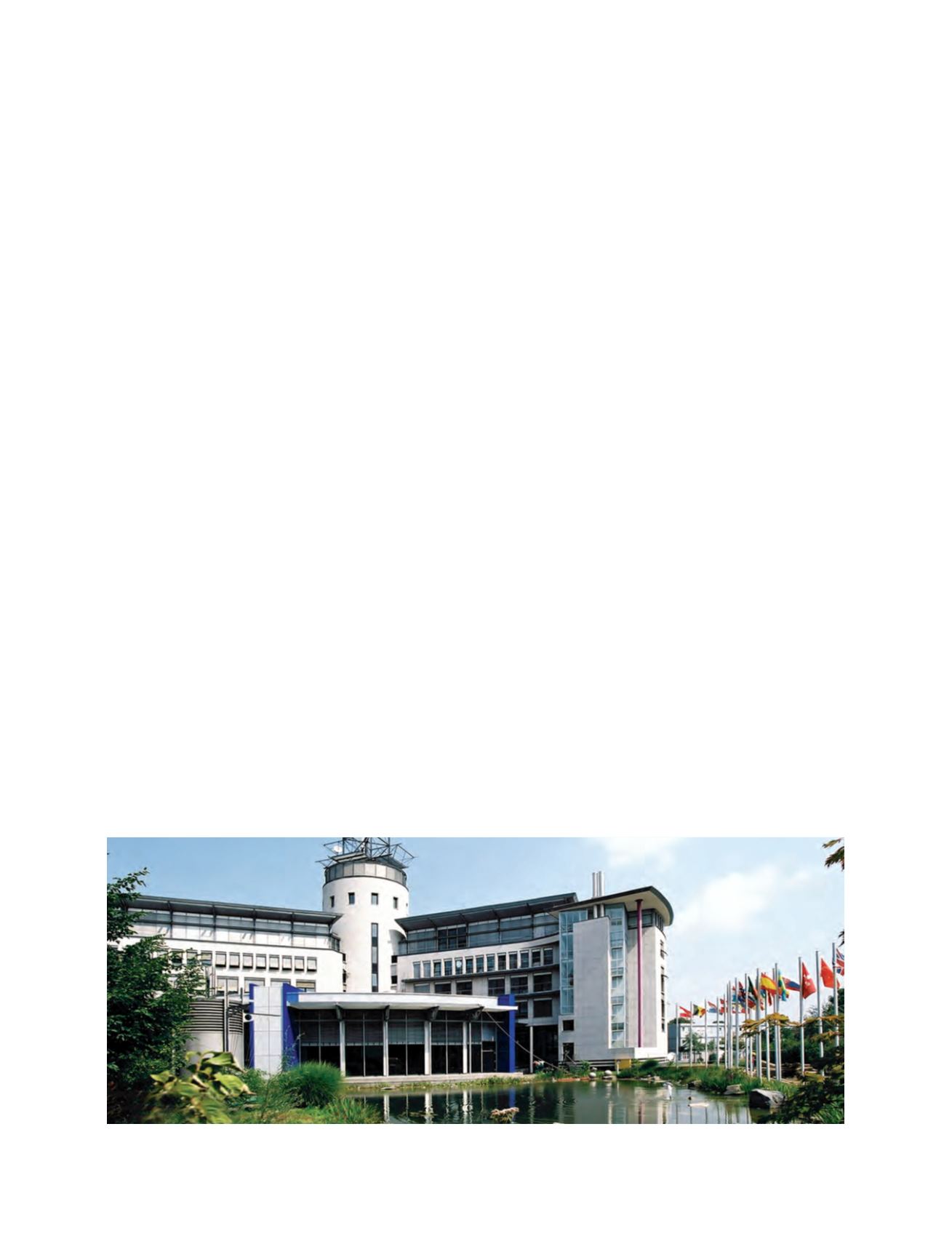
View of EUMETSAT headquarters at Darmstadt, Germany
Photo: Copyright EUMETSAT
Global Monitoring for Environment and Security
EUMETSAT is working to provide a major contribution to the
GMES initiative, led by the European Commission and ESA.
The initiative is a strategic response to environment and secu-
rity issues, and contributes to the Global Earth Observation
System of Systems.
The goal of GMES is to establish an operational European
capacity for the timely provision of quality ground, air and
space-based data, information and knowledge in support of a
wide range of European policy areas. EUMETSAT’s work as a
provider of timely, high quality near-real-time satellite data on
a continuous basis is crucial to the operational remit of GMES
and constitutes a key element of its operational services.
These services are provided through EUMETSAT’s opera-
tional satellite systems. The latest of these, MSG, will be fully
operational until 2015, and planning is already underway for
Meteosat Third Generation (MTG) satellites to continue the
service beyond this timeframe. EUMETSAT will also be the
operator of the ESA GMES satellites (called “Sentinels”) for
operational oceanography and atmosphere monitoring.
High-capacity data distribution
EUMETSAT’s unique high-capacity data distribution system,
EUMETCast, has already demonstrated its ability to deliver a
wide variety of data gathered by its own and other satellite
networks, all of which are potential sources of data for GMES.
Any EUMETCast user station can provide end-users with rapid,
with rapid, low cost operational access to global data and
imagery in near real time, 24 hours a day, every day of the year.
Among its many uses, EUMETCast supplies continuous
satellite data and products free of charge for the African
Monitoring of the Environment for Sustainable Development
Initiative, in which EUMETSAT plays a key role. The service
is also set to play a significant role in the future of global
climate monitoring.
In the longer term, EUMETSAT has the capability to become
the satellite operator for selected future GMES missions. The
organization plans to achieve this through the operation and
management of satellite and ground systems, as well as
onboard instruments on behalf of the EC, and by facilitating
opportunities for EC-sponsored instruments to be carried on
the satellites of EUMETSAT’s international partners.