



 23 / 218

These expected climate change effects, along with the increased
demand for rail transport, strongly emphasise the need for
environmentally aware rail transport programmes.
Strengthened international and inter-regional cooperation is
another evident consequence of global warming. It is essential
that this unification be channelled towards the planning and
construction of transport infrastructure. Regions that are famil-
iar with extreme climate conditions will have valuable
experience to share with less experienced regions. For example,
Canadian and Alaskan railway operators are experienced at
preparing for, and reducing the effects of landslips on their
service. This technology and experience could be transferred
to railway infrastructures in less developed economies that are
beginning to experience similar problems.
UIC will be at the forefront of international development in
the rail sector. For example, the findings and results of the first
UIC project regarding climate change effects on rail infra-
structure will be transferred to UIC members all over the world.
It is important to bear in mind that in developing countries
the consequences of climate change on transport and rail
infrastructure have an extra dimension. Transportation repre-
sents access to food, medicines, education and employment;
everything that represents human well-being and economic
growth. More specifically, infrastructure development plays an
essential role in the reduction of rural poverty because of its
importance to agriculture. Electricity and irrigation are both
initially possible only through the advances of transport
systems. Furthermore, effective transport is needed to sell
agricultural products to the relevant distributors and
consumers.
Therefore, new thinking is required when it comes to trans-
port in developed countries and in emerging economies. A
smart and sustainable, unified transport system is necessary to
[
] 23
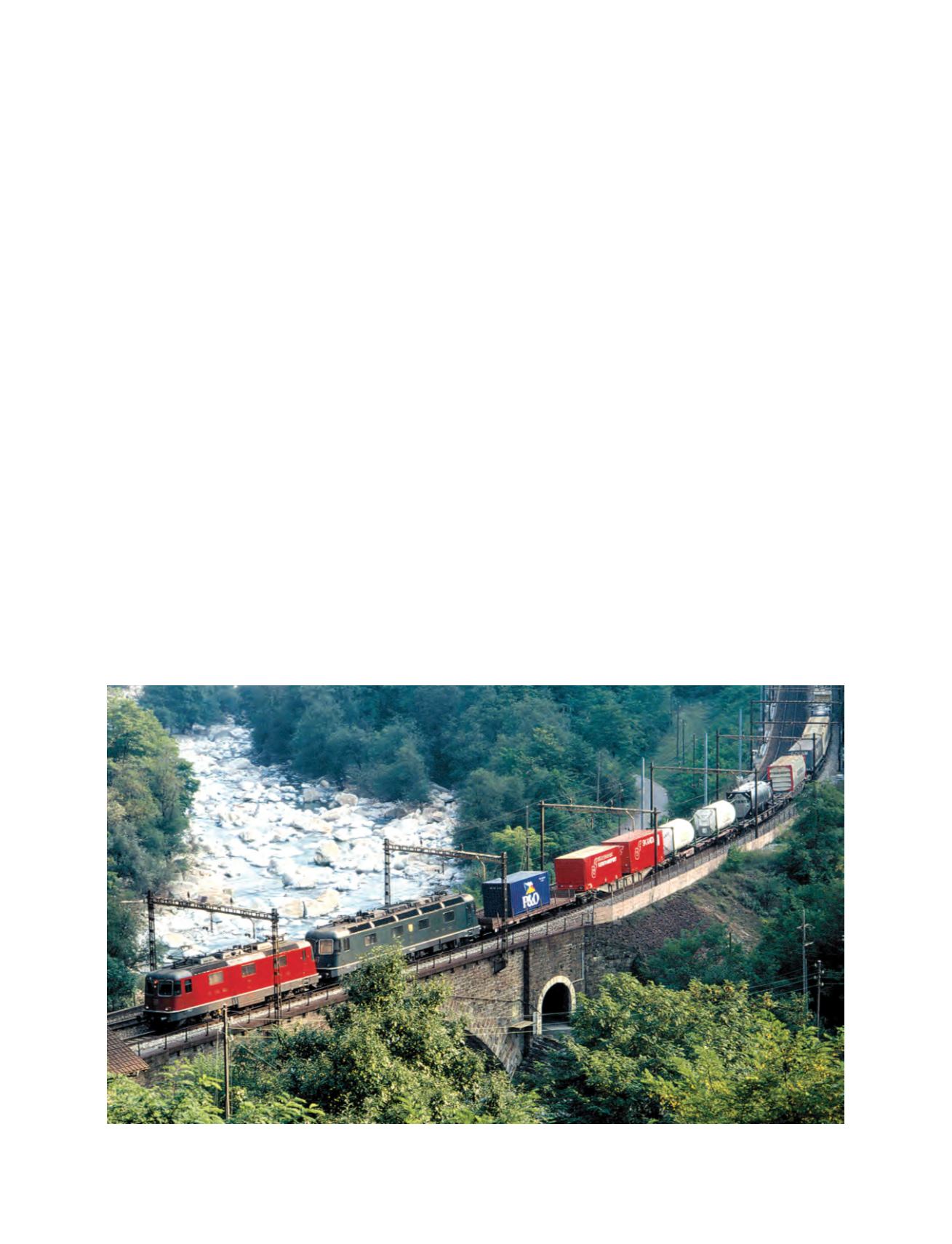
Freight transport offers a more sustainable alternative particuarly in terms of safety, landtake and energy efficiency
Photo: UIC
reduce human and economic costs. Social and environmental
effects of climate change need to be included into cost-benefit
analyses and decision-making. Governments must support the
development of sustainable mobility by educating the public
about the effects of conventional transport on the environment,
and by giving the market economic incentives to facilitate the
needed modal shift. This should also include incentives for
people to make more sustainable transport choices.
What needs to be done
To be prepared for the increasing consequences of global
warming to its infrastructure the rail sector is addressing both
the causes and the effects of climate change – firstly, by offer-
ing a service that causes fewer emissions than its alternatives,
and secondly, by expanding its existing expertise to minimise
the effects of climate change on rail infrastructure, and thus
reducing the damages and costs these effects imply for society.
Such expansion of knowledge and its application will not
come easily. New thinking and non-traditional cooperation
across sectors and professional areas will be necessary. For
example, despite much practical experience, the transport
system could benefit from working more closely with meteo-
rologists and climatologists to predict, and mitigate the effects
of extreme weather. This technology transfer will lead to new
expertise and generate greater ‘preparedness’.
Since climate change represents a uniform, international
threat, the cooperative process can then be applied to the global
stage. This strategy should also include the development of
smart, sound and sustainable transport systems in all parts of
the world. The advantages of rail recommend it as the ideal
backbone for such a system. It promises greater safety,
improved access and reduced emissions; in short, a higher
quality of mobility, and a higher quality of life.