



 17 / 218

[
] 17
and that enhanced services should be offered to its users. It is
therefore trying to improve its channels for communication
with society and to increase its visibility. This is being achieved
through better product adaptation, constant presence in the
media, a variety of publications and open days.
Despite its myriad achievements, the INM still faces many
challenges. Some result from environmental trends and others
from changes in Spanish society. On one hand, the process of
climate change and the appearance in recent years of many
adverse phenomena relating to temperature, rainfall, wind, etc.
require a new strategy for observation and monitoring of vari-
ables. There is also a need for new studies to document the
occurrence of such changes and help design policies for adap-
tation to change. In addition, Spain’s marked economic growth
and fast-changing society is constantly demanding better and
more extensive meteorological coverage. This is leading to the
development of improved products and forms of communica-
tion, and to effective collaboration between the INM and the
various Spanish autonomous communities.
In order to meet these challenges, the Institute must adapt
and function in a more flexible way to tie in better with the needs
of society. Over the next few months, it is to adopt a new orga-
nizational and administrative structure as a State Meteorology
Agency. It is hoped that, under the new structure, the national
weather service will continue to act as a meteorological land-
mark for all Spanish citizens and will serve as a venue for
collaborative international activities in the field of meteorology.
Finally, it is vital that meteorological services are promoted
and consolidated as far as possible. This is the only way in
which we can effectively guarantee the basic infrastructure and
essential meteorological and climatological products that
society needs with increasing urgency. We must ensure that
society views the meteorological services as accessible, useful
and reliable organizations. This will only be possible if we are
fully aware of users’ specific needs and are able to offer quality,
accessibility and reliability.
Spanish meteorological stations, serve a large number of insti-
tutions and private users and form the basis of many studies,
especially in the context of climate change in which the moni-
toring of trends is a top priority.
None of these activities would be possible without the neces-
sary infrastructure. The INM has an extensive observation
network both in real time and of a climatic nature, with almost
300 automatic stations providing real-time and meteorological
information. There is a network with 15 radars and another for
lightning detection, as well as several stations for receiving data
from various meteorological satellites and a large network for
measuring radiation. From the data processing point of view, the
institute has Spain’s second most powerful computer, enabling it
to use the most advanced forecasting and climate trend models.
The INM also has a broad territorial scope, with 15 regional
meteorological centres, most of which have regional forecast-
ing and monitoring groups as well as research, application and
user service units. All of this enables the specific and increas-
ing needs of users in the various autonomous communities of
Spain to be met.
Notwithstanding the above resources, there are few activi-
ties in the world requiring such extensive collaboration as
meteorology. For this purpose, INM collaborates actively
within the World Meteorological Organization (WMO) and
with other European meteorological bodies, such as the
European Centre for Medium Range Weather Forecasts, the
European Meteorological Satellite Agency and The Economic
Interest Grouping of the National Meteorological Services of
the European Economic Area. In fact, INM’s international
responsibility goes beyond this by focusing on collaboration
with Latin America. This has led to bilateral collaboration with
the meteorological services in the different countries and to
common programmes drawn up in coordination meetings held
among their directors. Moreover, many Latin American mete-
orologists have received training within the institute, or thanks
to grants offered annually in collaboration with WMO. Also,
Spanish professionals pay frequent visits to Latin America for
seminars, congresses, or for the purpose of offering technical
assistance.
Another field of international activity in which the Spanish
Institute plays a leading role is in the coordination of research
into the upper atmosphere. This is conducted through the
Izaña Observatory on the island of Tenerife, a centre of inter-
national renown. This observatory carries out measurements
and studies on radiation and environmental pollution in the
framework of national and international scientific projects.
Within Spain, there is ongoing collaboration with the mete-
orological services in the autonomous communities and with
many public and private organizations. Activities are also carried
out with universities in the fields of research and education.
The fact that the institute forms part of the Ministry of the
Environment has led to effective synergies in matters relating
to climate change and adaptation to it with other units and
with the administration in general. This has resulted in a multi-
disciplinary approach, promoting collaboration not only in
Spain but also within the Latin American community among
meteorologists, climatologists and those responsible for envi-
ronmental policies and civil protection.
All these activities have made the INM a paradigm of quality
and generated a close relationship with Spanish society, as well
as providing important support for global meteorology. The
institute is aware, however, that this role must be strengthened
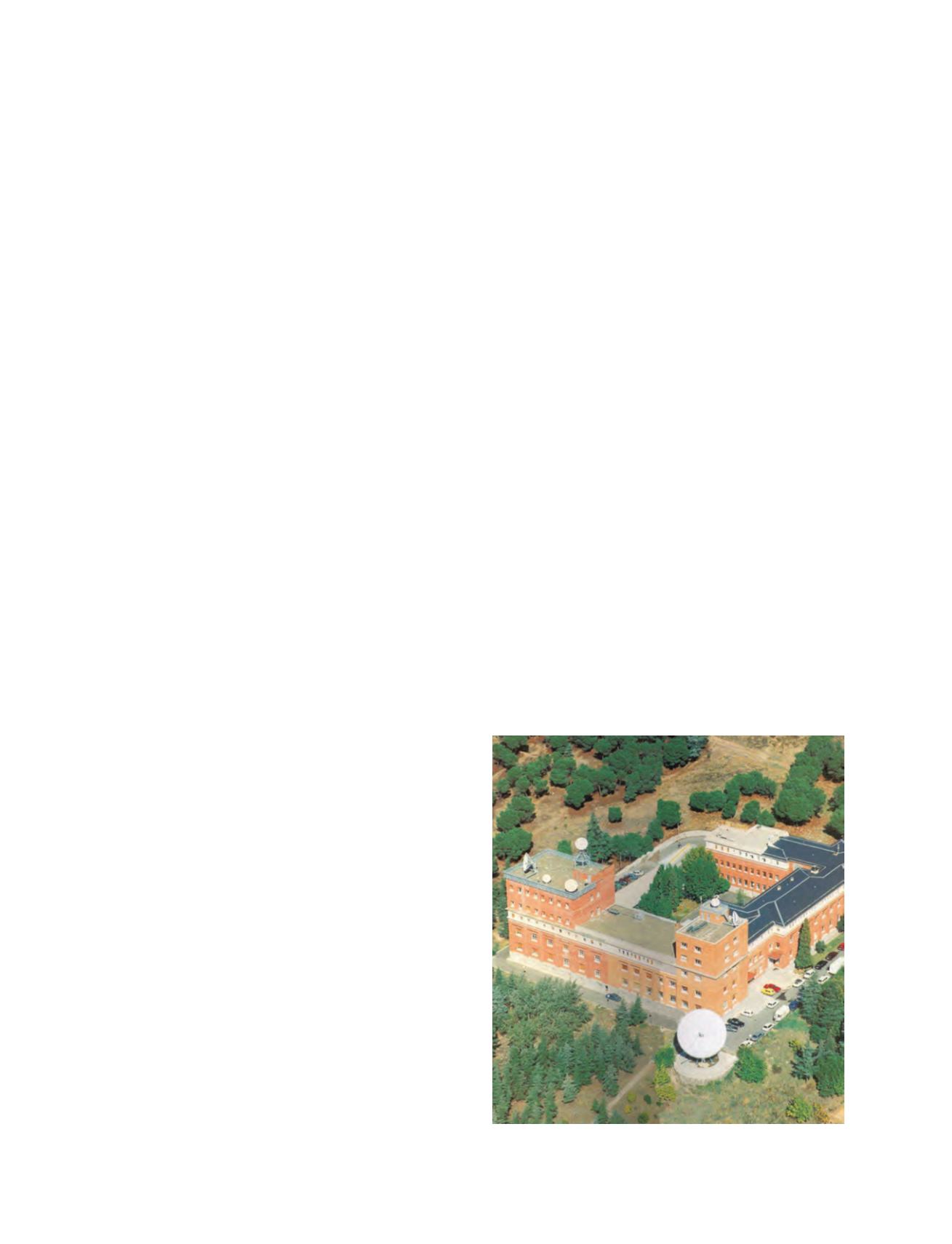
INM headquarters in Madrid