



 36 / 218

[
] 36
natural hazards, and usually lack the resources to invest in
adequate infrastructure. Poverty limits choice, and forces
people to take risks, such as living on land vulnerable to
flooding or landslip. Many humanitarian and environmental
disasters are directly related to weather and water. Some occur
on very short timescales, such as hurricanes and flash floods.
Others, such as droughts and food shortages, can be stretched
over a period of months, or even several years. Even when
not directly involved in a hazard, weather often complicates
attempted relief and rescue operations. In the short term,
disaster warning systems can prevent much loss of life and
livelihood by alerting people to particular threats. Climate
change will alter the incidence of natural disasters, as well as
having impacts on the sustainability of environments and
livelihoods over the coming decades. Because of this, quality
information is vital to prepare people to adapt their liveli-
hoods.
The primary source of funding for NMHS is for the provi-
sion of the public weather service. Thus, validation of this
service has become increasingly important in order to justify
government funding. In developing countries, as a broad gener-
alization, NMHS get very little funding from private-sector
work, even where they are able to exploit commercial oppor-
tunities. Commercial aviation weather services, for those
NMHS which provide them, are a very important part of the
justification argument, since international civil aviation pays
the national authorities in hard currency. Unfortunately, in
many countries this does not translate directly into funds for
the NMHS.
Developing country NMHS have great difficulty with afford-
ing the equipment for observing the environment. This is
particularly the case with the consumables for upper-air
measurement. Each radio-sonde observation costs approxi-
mately USD200. With developments in numerical weather
prediction and satellite capability, as well as the data gath-
ered by Aircraft Meteorological Data Relay (AMDAR)
equipment on civil airline flights, there is no longer scien-
tific justification for upper air observations, as beneficial to
local forecasting. The exceptions are for low-level aviation
forecasting and applications such as tracing pollutants and
disease vectors. Increasingly, the primary requirements for a
network of high-quality upper air observations are to provide
a long-term record for monitoring global climate, and to
provide the baseline calibration for satellite instruments.
Surface observations generally have lower costs. Though the
capital cost of equipment may be significant, the unit cost for
each observation will be made up mainly from staff and
communication expenses. There is also a much stronger argu-
ment for the utility of surface observations in providing local
and national benefit. Surface observations are also commu-
nicated and used globally; under international agreements
through WMO, observations from the Global Climate
Observing System and other networks are freely available
through NMHS and global data centres.
It can be seen that environmental observation data and meta-
data has high costs, but the value of the observation lies in the
use made of it, and not in the observation itself. Hence it is
unrealistic to argue that any individual user of the observation
should pay a particular proportion of the cost. Even if charges
are levied on users for the cost of observations, it is very diffi-
cult to make these equitable, and the result is likely to be that
potential services will be rendered uneconomic. In contrast, it
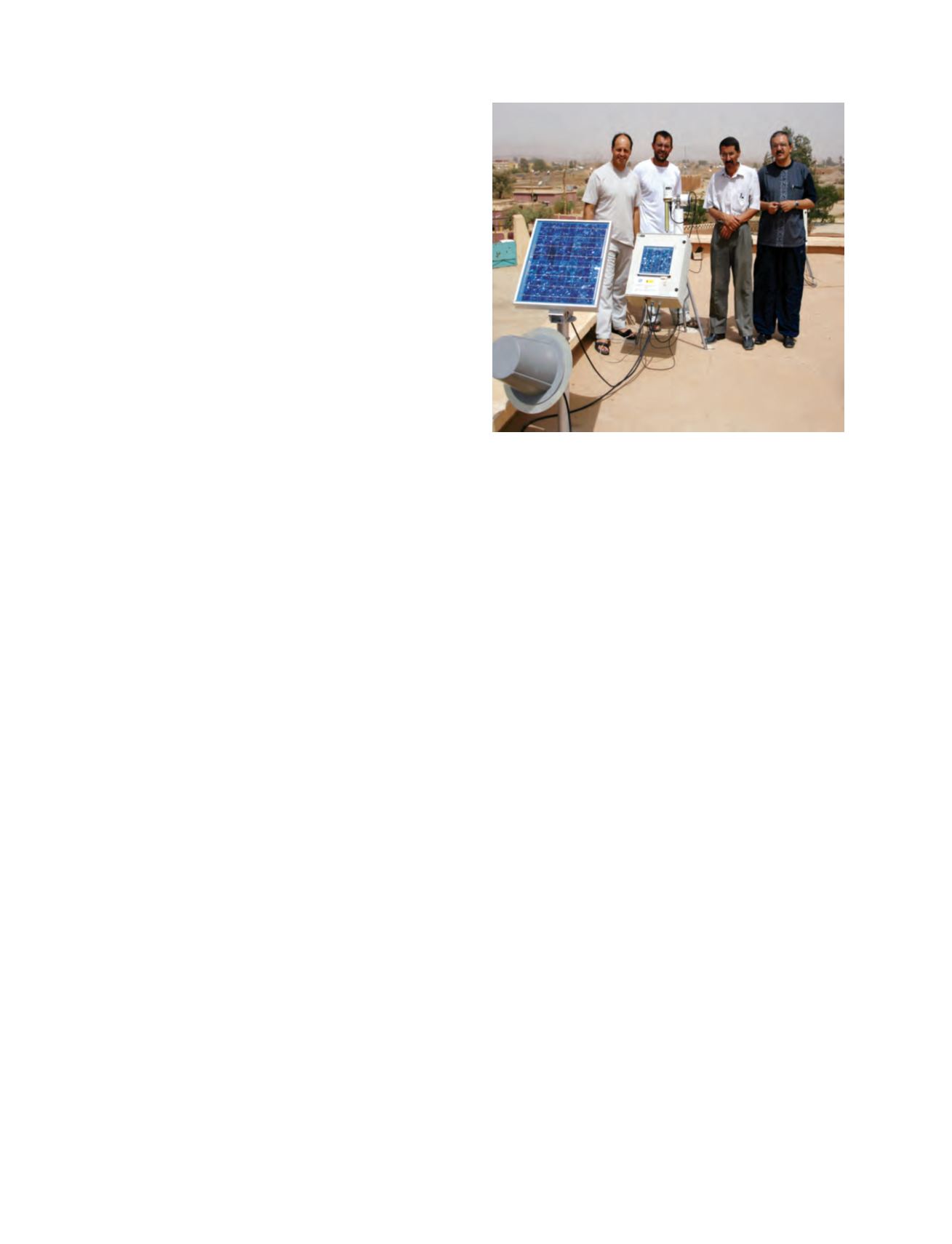
Photo: Instituto Nacional de Meteorologia, Spain
Commissioning a solar photometer at Tamanrasset in Southern Algeria
with support from Spain to monitor aerosols and dust in air masses
over the Sahara desert, especially for early warning of dust clouds
is generally in the interest of NMHS to increase the number
and range of users of their data in order to strengthen their
case for adequate government funding for the public weather
service. Therefore charges for the use of data should reflect the
value added by the information and services derived from said
data.
It is instructive to consider these data using the concept of
‘Global Public Good’
3
where ‘good’ means a thing or condition
(in this case data and the metadata needed to interpret it) but
makes no assumptions about the costs, benefits or valuation
of the good; ‘global’ means spanning all divides and borders;
‘public’ refers to the general population, civil society organi-
zations and corporate citizens; the ‘global public’ includes states
and international organizations. These observations therefore
meet the economists’ definition of ‘public good’ as having both
non-excludable and non-rival benefits, as well as being non-
exclusive. It is worth emphasising the huge potential current
and future benefits of these observations in providing a clima-
tological record during a period of rapid change, in supporting
current forecasting on periods from immediate response to
seasons, and in providing the baseline and future verification
as the climate changes. However, only some of these benefits
will accrue in the countries where the observations are taken,
particularly in the developing countries. Remote islands are
especially important for global observations, and many of these
are in Small Island Developing States. It is likely that the major-
ity of economic benefits of “global public good” observations
will accrue in developed countries, despite the developing
countries suffering most from the social impacts of extreme
events and climate change.
This analysis shows why it is difficult to persuade develop-
ment aid partners, whose interests are primarily to enhance
free trade and economic growth, achieve sustainable develop-
ment, promote good governance and democracy and increase
safety and security, to be interested in funding observations,
particularly of the upper air. For funding by NMHS of devel-
oped countries, including through the WMO VCP, it is