



 44 / 218

[
] 44
tional issues. Through this system of government the provinces
are left to develop emergency preparedness and disaster miti-
gation planning and are responsible for the assessment of
potential impacts of natural disasters within their communities.
As there are no meteorological services at the provincial level,
assessment of natural hazard impact scenarios from both a day-
to-day standpoint and a more long-term planning one is
difficult. With the exception of a few fledgling programmes,
provinces and other stakeholders have been forced to rely on
informal consultative networks with the Meteorological Service
to develop emergency plans.
As the new Emergency Management Act emphasizes federal
involvement in all four pillars of emergency management
including prevention/mitigation, preparedness, response and
recovery, through this proposed legislation federal departments
are tasked with the assessment of risk for hazards within their
jurisdiction. For the Department of the Environment and its
Meteorological Service, this encompasses risks associated with
weather and climate. Assessment of risk has traditionally been
within the provincial jurisdiction, while federal involvement
has been focused on hazard assessment. Although this new
proposed Act does raise some questions related to federal
versus provincial purview, it does show great promise as it
allows for the development of nationally consistent emergency
management policies and programmes including natural
hazard risk assessments.
For the Meteorological Service of Canada, this new Act comes
at a good time since internationally, as well as nationally there
is renewed interest in the services that National Meteorological
and Hydrometeorological Services (NMHS) are able to provide
with respect to the mitigation of natural hazard impacts.
International focus, led by the UN International Strategy for
Disaster Reduction (ISDR) and the World Meteorological
Canada’s Meteorological Service is housed within the
Department of the Environment and, through the Department
of the Environment Act, mandated to provide meteorological
information for all civil and military purposes. This is a broad
mandate but when combined with other federal legislative tools
including the Emergency Preparedness Act, coverage is sufficient.
Emergency management legislation in Canada, as in many
nations, has its origins in political conflict. Not until 1988 was
the antiquated War Measures Act replaced with the
Emergencies Act due to a perceived need for emergency legis-
lation during peacetime. This recognition came about in part
as a result of an effort to manage the impacts of natural hazards
including floods and earthquakes. The Emergencies Act is
rarely invoked and is intended for use only in times of national
crisis, or when national resources are overwhelmed.
A second act, the Emergency Preparedness Act which also
came into force in 1988, outlines the roles and responsibilities
of all the federal departments in relation to preparedness. This
includes the development of effective tools, policies, proce-
dures and plans for how to best manage an actual event. The
Emergency Preparedness Act designates the Meteorological
Service of Canada (as agent of the Minister of the Environment)
as responsible for:
• The identification of environmental hazards and their
associated risk
• Conducting observations and forecasts, and providing
timely warnings to the general public and to emergency
responders with respect to weather, ice and sea-state
• Projecting the dispersion of toxic or polluting substances
in air and water
• Placing under coordinated federal control, where required,
any meteorological, limnological, or hydrological
resources, facilities and services in Canada (except those
operated by the Canadian Forces)
• Providing increased meteorological, limnological or hydro-
logical support to the Canadian Forces.
These activities, though important within the spectrum of
emergency management activity, do not directly address mitiga-
tive strategies for disaster risk reduction. However, emergency
management legislation in Canada is in a state of transition. A
new Emergency Management Act is set to replace the
Emergency Preparedness Act. The intent of this new act is to
better address all aspects of emergency management includ-
ing prevention/mitigation, preparedness, response and recovery,
as well as the respective and often interlinked roles of federal
departments. Proactive measures are emphasized which were
not addressed in the Emergency Preparedness Act. The
Emergency Management Act has now passed a second reading
within parliament, but has not yet been legislated. This act has
significant implications for disaster risk reduction program-
ming on a national level within Canada.
Under the current system of government, responsibility for
emergencies rests primarily with the individual. Different
orders of government intervene only as the individual’s ability
to manage is compromised. If an individual cannot cope,
municipal resources are tapped. Provincial involvement is
restricted only to instances where municipal resources are inad-
equate or intercity/interagency coordination is required.
Federal governments are involved only when aid is formally
requested by the provinces, or when activity is within the
federal purview, as is the case for trans-border and interna-
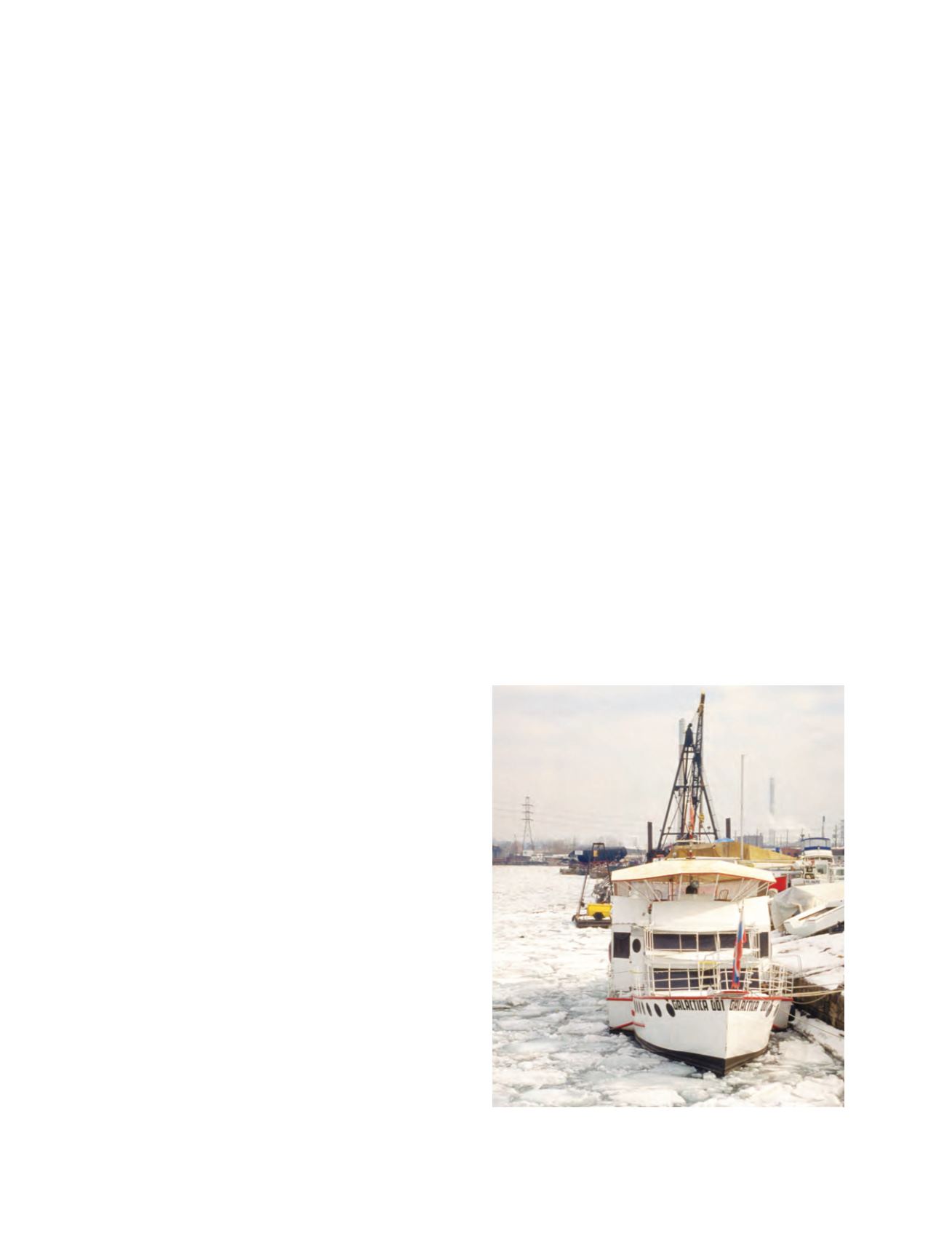
The Canadian Ice Service provides a wide range of products and
services to the navigation sectors
Photo: Corel Corporation 1994