



 50 / 218

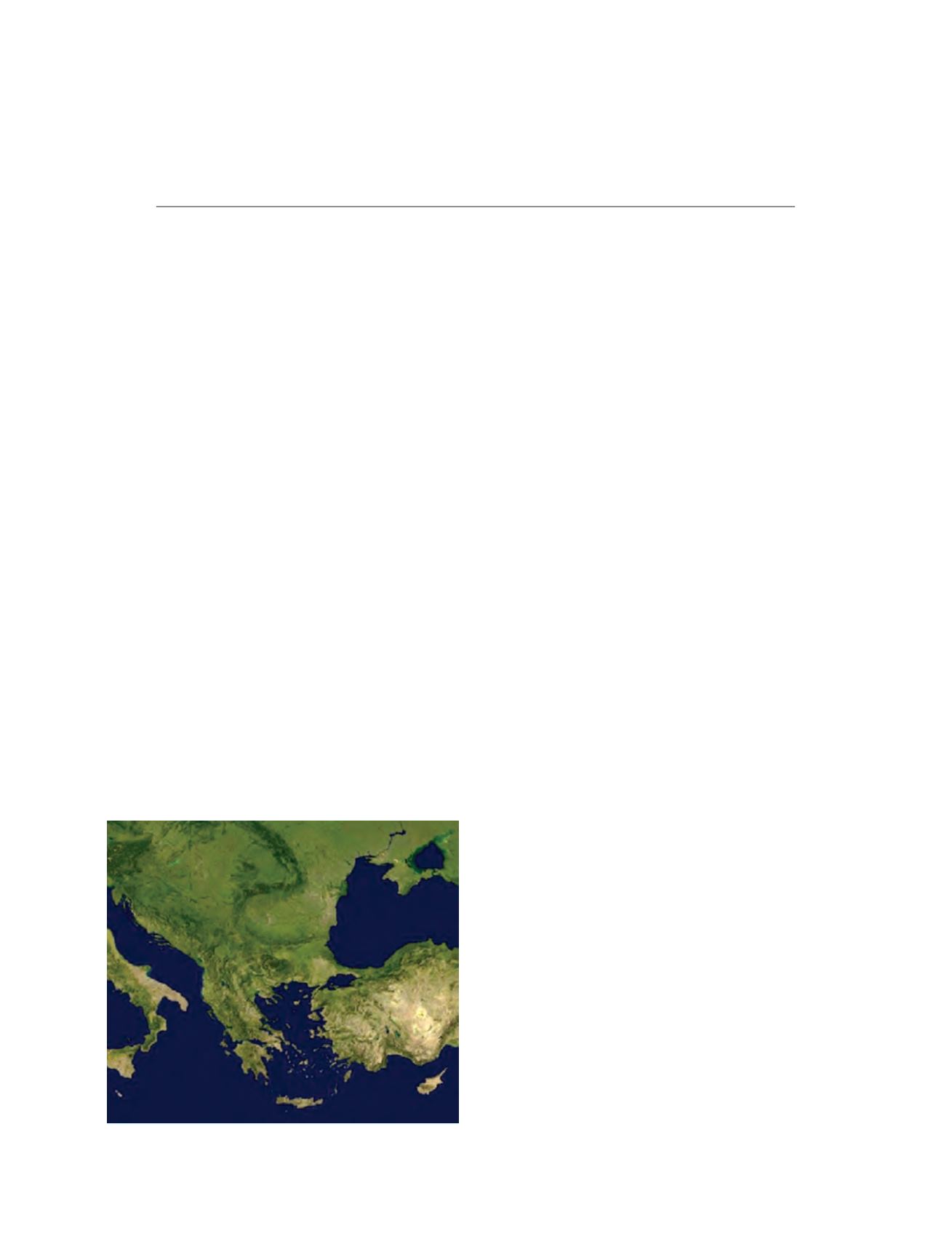
[
] 50
S
OUTH
-
EASTERN
E
UROPE
is surrounded by the Adriatic
and Ionian seas to the west, the Black and Marmara seas
to the east, and the Mediterranean and Aegean seas to
the south. On the northern border it touches the Pannonian
lowland. The southern edges of the Alps, the Carpathians and
the Dinaric Alps indicate the parameters of the area.
According to these various influences, a multitude of climate
types prevail, including continental, mountainous and
maritime (Mediterranean). This in turn results in a broad
range of recorded temperature and precipitation. The annual
average precipitation ranges from 500 millimetres in the east
lowland up to 5,000 millimetres in the West Mountains. The
highest temperature is above 40 degrees Celsius and the
lowest below –35 degrees Celsius.
The area is frequently subjected to strong winds – for
example, Bora experiences gusts of up to 70 metres per second
along the Eastern Adriatic Coast and through Košava in the
Danube River valley. It is also common to find deep snow in
the mountainous areas during the winter season. Agriculture
suffers every year due to spring and autumn frosts. Heat and
cold waves, landslides, flash floods and droughts represent a
permanent risk to human safety, the environment and the
economy. Severe thunderstorms are frequent in the summer
period, as well as hail, and water and land spouts. More frequent
and severe weather extremes, the visible symptoms of global
climate warming, are also evident. Such occurrences indicate
the necessity for closer collaboration between NMHSs (National
Meteorological and Hydrological Services) in the sub-region.
Countries
South-eastern Europe constitutes a small overall area, but
embraces a plethora of countries each representing a different
culture and a different level of economy. The following are
considered to represent south-eastern Europe: Albania, Bosnia
and Herzegovina, Bulgaria, Croatia, Cyprus, Greece, Hungary,
Israel, the Former Yugoslav Republic of Macedonia, Republic
of Moldova, Montenegro, Romania, Serbia, Slovenia and Turkey.
Recent conflict has detrimentally affected the sustainability
of the area, including the attempts at collaboration over mete-
orological and hydrological policy. This prompted the WMO
to bring back the alliance of the countries, by organizing the
Informal Conference of South-Eastern Europe (ICEED) with
all NMHS Directors invited. The first ICEED meeting held in
Sofia, Bulgaria in 2001 resulted in the attending countries
signing a Memorandum of Understanding. Each successive
ICEED meeting (2002: Geneva, Switzerland; 2003: Athens,
Greece; 2004: Bucharest, Romania; 2005: Sarajevo, Bosnia and
Herzegovina; 2006: Dubrovnik, Croatia) has produced signif-
icant progress in collaboration over ideas and actions. Similar
success is expected of the Belgrade, Serbia meeting in 2007.
Constraints and challenges
In general, the gathering and sharing of meteorological and
hydrological information in South-Eastern Europe is not at a
satisfactory level. Other areas of Europe gather data more thor-
oughly and more frequently, as well disseminating the results
to forecasting centres with speed and reliability.
This important topic was discussed at the Sixth Annual
Meeting of the ICEED held in Dubrovnik, Croatia in May 2006.
The need for sharing data in order to improve the short, medium
and long term accuracy of weather and flood forecasting was
officially recognized. This sharing ideology was envisaged on a
regional level, along with data-sharing protocols and capacity
building for fully operational instrument networks.
The expectation of the ICEED directors is that the feasibility
study will enable them to identify the gaps in their capacity as
well as to improve coordination among the various countries.
Furthermore, the feasibility study could be the basis for a sub-
regional programme supported by the WMO, World Bank,
Finnish Meteorological Institute, and other potential donors.
There are clear advantages of a regional approach to support-
ing the NMHS:
• South-eastern Europe includes many small countries that
lack independent weather and flood forecasting resources,
and thus particularly require the input of other countries
• Implementation of the system will be much cheaper if it
is designed regionally; for example, the number of expen-
sive radars for each country will be reduced significantly.
NMHS Strategy in south-eastern Europe
Ivan
Č
a
č
i
ć
Meteorological and Hydrological Service (DHMZ), Croatia
South Eastern Europe
Photo: Public web