


 51 / 218

[
] 51
By improving regional coordination, the countries will not only
achieve more accurate forecasting, but may also significantly
reduce costs.
A root cause of the under-financing of NMHS is that the bene-
fits of accurate weather and flood forecasting are often
misunderstood by senior government staff. Good forecasting is
important in saving lives as well as in the reduction of the
economic impact of natural disasters. Furthermore, good
weather and flood forecasting is crucial for many sectors of the
economy, including development and implementation of crop,
drought and flood insurance, power generations e.g.
hydropower and wind power plants; municipal services e.g.
snow removal; and preparation and implementation of land-
use plans at the local level. With the aim of securing the
sustainability of NMHS and improving awareness of their poten-
tial value to the national governments – the WMO has
organized a regional conference on the social and economic
benefits of such services in Zagreb, Croatia in February 2007.
Joint actions
Following the WMO Action Plan for Region VI established in
Heidelberg 2005, the ICEED meeting in Dubrovnik agreed on
the strategy for the formation of Sub-Regional Centres of
Excellence. These include the following:
• Instrument Centre
• Drought Management Centre
• GCOS Training Centre for Usage of Satellite Data in
Climate Monitoring
• Marine Meteorological Centres for the Eastern Adriatic
and Black Sea
• Climate Centre
• Hydrology Centre
• Education and Training Centre on NWP
• Agro-meteorology Centre.
With the support of the ICEED countries, Croatia has requested
support and assistance fromWMO in the creation of the Marine
Meteorological Centre for Eastern Adriatic, in Split.
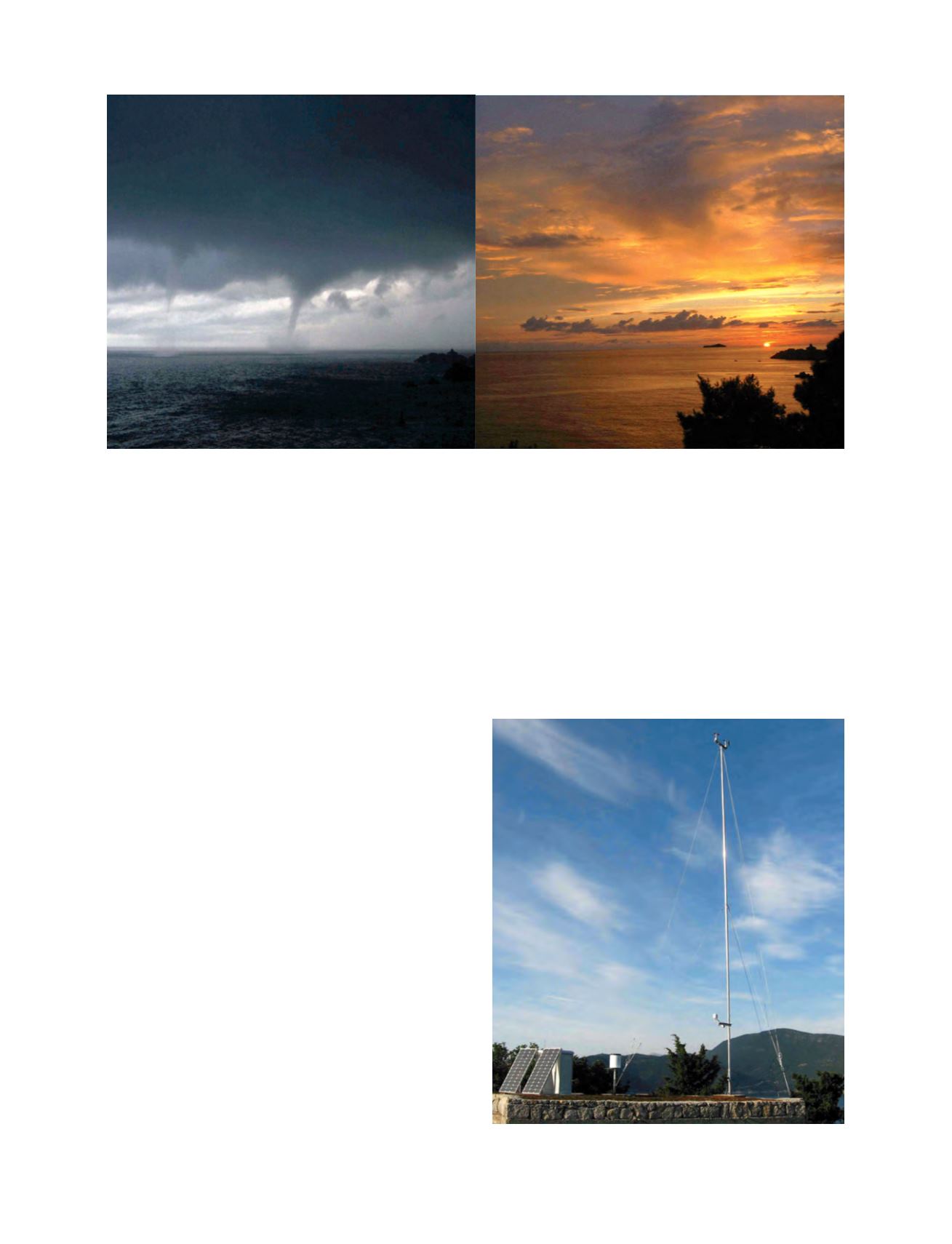
The morning of the Dubrovnik waterspout, and the evening afterwards
Photo: DHMZ
AMS Prevlaka
Photo: DHMZ
ICEED countries are strongly supportive of the cooperative
actions in the Sava River Project, including the collaboration
between the Sava River Commission and the Danube
Commission, as well as projects concerning the exchange of
disaster warnings and capacity building through networking.
Unified official representation has been recognised as crucial
for the visibility and performance of NMHS. Of equal impor-
tance is the formation of relationships with other meteorological
communities such as GEO, EUMETSAT, ECMWF, EUMETNET,
ECOMET and ALADIN/LACE, as well as the promotion of
twinning programmes with EU NMHS’s.