


 201 / 210

[
] 199
E
nsuring
W
ork
-F
amily
B
alance
The average age of people at their first marriage and of the birth
of their first child, two of the main demographic factors affecting
fertility rates, also increased during the same period. As Korean
women stay in education for longer and their career aspirations
have improved, they aremore likely to delaymarriage. The average
age of Koreanwomen at their first marriage was 25.8 years in 1990
and it increased to 29.4 in 2012.
7
Due to delayed marriages, the
average age of women at the birth of their first child increased from
28.3 years old in 2002 to 30.5 in 2012.
8
These prolonged times
for marriage and childbearing follow trends for women in other
OECD countries. However, the share of births out of wedlock has
been around 2 per cent inKorea, which is extremely low compared
with European countries. It implies that even though marital and
childbearing behaviours have changed in Korea, traditional norms
on marriage and legitimate children remain.
The two most distinctive changes in the Korean family are
a decrease in family size and changes in the structure of the
family. Korean families are more likely to have fewer numbers
of children and to form a nuclear family than before. The average
number of people in a household decreased from 5.2 in 1970
to 2.7 in 2010.
9
The proportion of single-person households
increased from 4.2 per cent in 1975 to 23.9 per cent in 2010
10
due to the expanding number of young single households and
the solitary aged.
11
Although the realized actual average number
of children (TFR) was 1.3 in 2012, Koreans reported that the
ideal number of children is 2.01 on average.
12
The gap between
TFR and the ideal number of children suggests that most Korean
families hardly realize the number of children they want to have.
Many married Koreans pointed out that they do not have addi-
tional children because they are unable to afford the child-rearing
and education costs. This implies that as long as relevant condi-
tions are provided, Korean families might have the number of
children they want and the fertility rate of Korea will increase.
Crude divorce rates – the number of divorces each year per
1,000 people – increased from 0.4 in 1970 to two in 1997.
It increased further after the Asian financial crisis and then
decreased to 2.3 in 2011. Among the divorced families, the
proportion of families with children was 52.8 per cent in 2012.
13
This indicates that having children is not such a crucial factor in
the decision to divorce as it was in the past.
Korean families no longer discriminate against girls in favour
of boys in terms of investment for their education.
14
However,
the outcomes for females in the labour market are not in good
shape. Female employment rates have not increased much for
the past two decades: from 50.9 per cent in 1990, the rate had
increased only 7.1 percentage points by 2011.
15
The gender gap
in employment rates remained at around 20 per cent during
the same period.
16
A gender wage gap exists of around 40 per
cent in terms of median earnings for full-time employment.
17
Labour market conditions are not favourable for female workers
in Korea. In 2011 68.5 per cent of female workers worked more
than 40 hours per week.
18
Female part-time employees usually
do simple and low-skilled jobs in poor working conditions.
19
Mothers with young children used to withdraw from the labour
market due to the long working hours and rigid working times,
and graphs of female employment rates by age group still form
an M-shape. This implies that Korean women leave the labour
market at times of marriage and childbearing and re-enter it after
their children have grown up. Most women return to work in
low-paid and under-qualified jobs compared to the jobs they had
before marriage and childbirth.
20
Korean women dedicate more
time to care work at home compared with Korean men. In 2009,
Korean women aged 25-44 years old with one child under school
age spent 16 per cent of their time caring for family members
compared with 3.6 per cent of corresponding Koreanmen. As the
family had more children the disparity further increased: Korean
women with two children under school age spend 19.7 per cent
of their time caring for family members compared with 4.7 per
cent of corresponding Korean men.
21
Before low fertility became an issue, family policy in Korea
focusedmainly on poor families. Since 2005when theGovernment
initiated the Basic Plan on LowFertility and Ageing Society, family
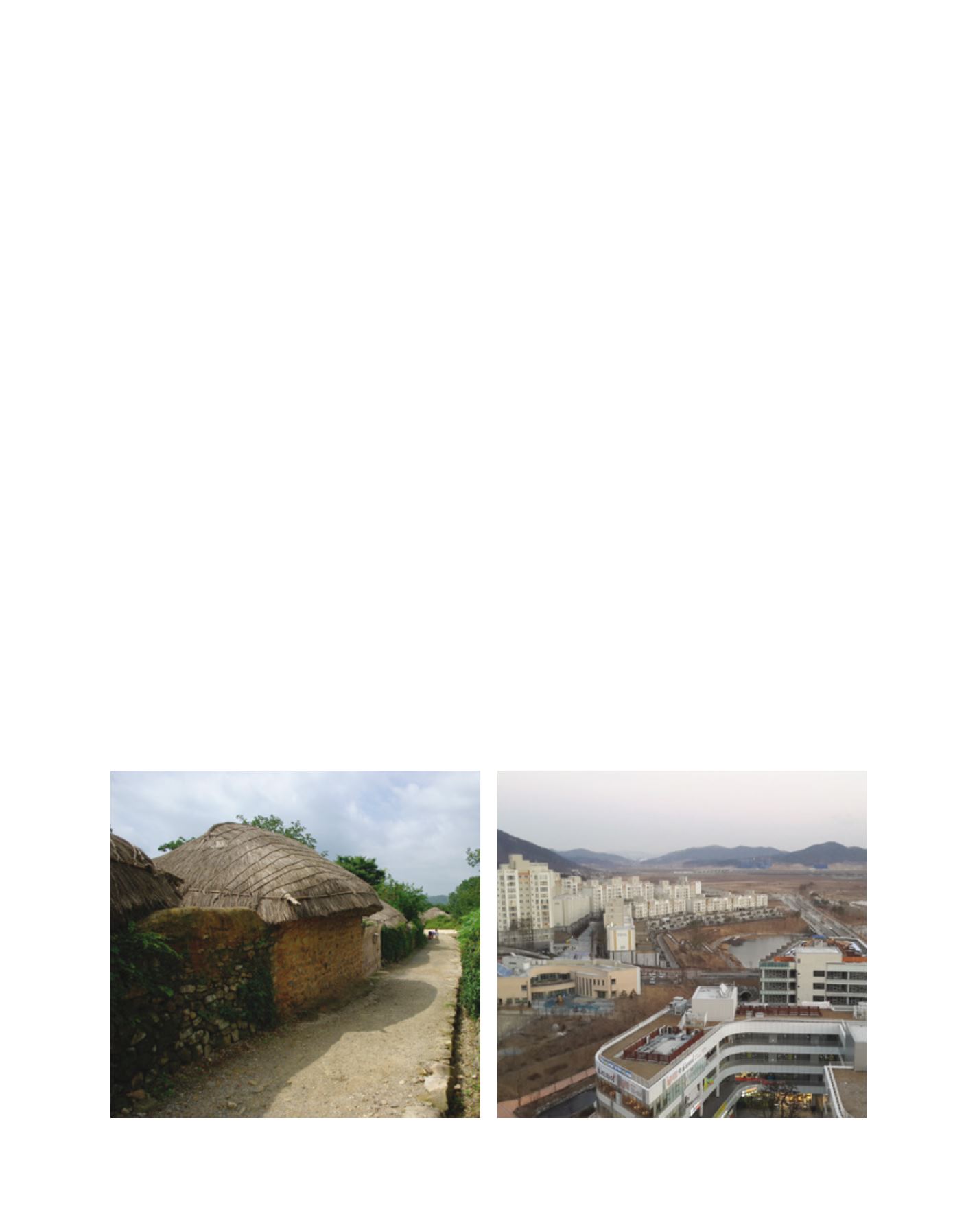
Korea’s rapid economic development can be seen in the contrast between (left) a traditional house and (right) the new Sejong administrative city
Images: Korea Institute for Health and Social Affairs