


 204 / 210

[
] 202
E
nsuring
W
ork
-F
amily
B
alance
retirement. Statistics Canada reports that 12.6 per cent of the
senior population was in the labour force in 2012, a figure that
had almost doubled in the previous 10 years.
Today there are over 9.4 million families in Canada.
Although two thirds of these families include a married
couple, common-law couples are on the rise, now accounting
for 17 per cent of all census families in Canada and 32 per
cent in the province of Québec. Same-sex marriage was legal-
ized across the country in 2005, contributing further to the
diversity of Canadian families.
Parenting and family structure is diverse: most children are
raised by their biological parent(s), but more than 30,000 chil-
dren are being raised by their grandparents. Nearly 30,000 are
being raised by foster families and there are more than 460,000
blended families in Canada. In addition, approximately one in
five Canadians is either adopted, has an adopted sibling or family
member, or is an adoptive parent, birth parent or birth relative.
The average age at first marriage for women was 29.1 in
2008 (up from 26.7 years in 1996), and the average age of
mothers at the birth of their first child was 28.1 in 2008 (up
from 26.5 in 1996). Although family size is shrinking and
women are therefore taking fewer maternity/parental leaves,
men are increasingly likely to report taking paternity/parental
leave (13 per cent), especially in Québec (84 per cent), in part
because two thirds of first-time grandparents are in the paid
labour force and unavailable to provide extended postpartum
care for new mothers and to help provide infant care. The
average age of first-time mothers is increasing, many of whom
have decided to establish careers before having children. The
number of first-time mothers aged 40-44 increased by 155 per
cent between 1994 and 2011.
The proportion of Canadian families with two earners has
been rising steadily. In 1976, dual earners accounted for
approximately one third of couples with dependent children
– this increased to three quarters by 2008.
It is estimated that 18 per cent of dual-earner families
would be living in poverty if not for the contribution of
women’s earnings. In 2012, employed Canadians spent an
average of 36.6 hours per week at work (39.6 hours among
men and 33.2 hours among women). However, managing
work-family responsibilities, obligations and commitments
is more challenging as the rate of working long hours rises.
Researchers Duxbury and Higgins found that 68 per cent of
men and 54 per cent of women in their study worked more
than 45 hours per week, up from 55 per cent and 39 per cent
respectively in 2001.
With such a large geographic area, staying connected is
particularly important. Families stay connected primarily
by phone and over the Internet. According to the Canadian
Radio-television and Telecommunications Commission,
over 99 per cent of Canadian households subscribed to
either a wireless or home telephone service in 2012, includ-
ing 27.9 million Canadian wireless subscribers with an
average of two wireless subscriptions per household. In a
recent survey, 70 per cent of Canadian parents reported that
they depend on technology to keep their families connected.
Families are busy and family members live full and active
lives. In a recent study of more than 25,000 mostly profes-
sional employees, half of the respondents were involved in
four to six different life roles, while one in three participated
in seven to nine roles. Some of these roles could be considered
optional, such as exercise or volunteer work; others are not,
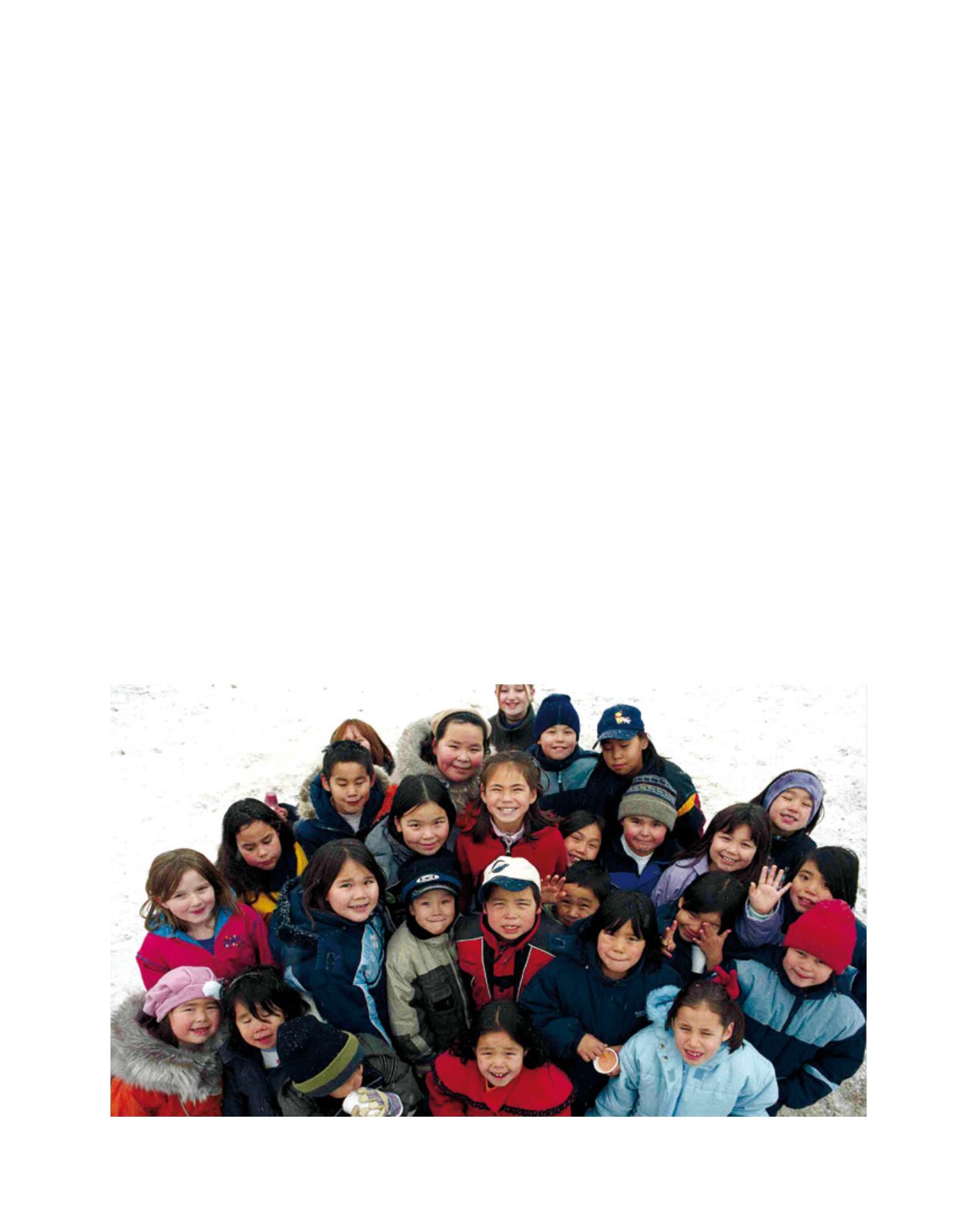
Image: The Vanier Institute of the Family
Canada’s First Nations aboriginal population reached 1.4 million in 2011 and is growing at twice the national rate