


 203 / 210

[
] 201
Families and work in Canada
Nora Spinks, CEO, and Nathan Battams, Researcher, The Vanier Institute of the Family
E
nsuring
W
ork
-F
amily
B
alance
F
amilies in Canada are diverse, complex and
dynamic. Social, economic, environmental and
cultural forces shape the contexts in which families
live and work. The population in Canada is ageing as a
result of increased life expectancy and decreasing fertility
rates. Communities are rich with diversity, immigration
is strong, mobility is common across the country, and
families are constituted in a variety of forms, including
common-law families, skip-generation families, same-sex
families, blended families, foster families, ‘living apart
together’ families, ‘living together apart’ families, inter-
racial families, interreligious families, and more.
What families look like continues to evolve, but time hasn’t
changed what families in Canada do. Families are founded
on relationships, provide care to each other and support one
another. While they adapt and respond to the forces that
shape society, families impact those same forces, and shape
society as well. According to the United Nations Human
Development Index country measure of life expectancy,
literacy, education, standards of living and quality of life,
Canada ranks eleventh worldwide.
Families in Canada continue to find it challenging to
manage their multiple responsibilities at home, at work and
in the community. Public initiatives in Canada to address
this include maternity, parental, paternity adoption and
caregiving leaves and benefits (federal and Quebec govern-
ment), with care and nurturing-related job legislation and
seniority protection legislation (provincial governments).
Employers have been reacting to these new employee/family
realities slowly, have responded inconsistently and rarely
approached them strategically.
Canada is committed to pluralism and is an ethnically
diverse and multicultural nation. Between 2001 and 2006,
Canada’s visible minority population increased by 27 per cent,
or five times faster than the growth rate of the total popula-
tion. Families in Canada reflect that cultural commitment,
with interracial (4 per cent) and interreligious (19 per cent)
unions increasing year over year.
Canada has one of the highest per capita immigration rates in
the world and accepts a large number of refugees, accounting
for over 10 per cent of the annual global refugee resettlement.
Currently, more than one in five Canadians were born outside
the country – the highest proportion among the G8 countries.
Canada is the world’s second-largest country by total area,
with a population of just above 35 million. The number of
people who reported an aboriginal identity (First Nations,
Métis and Inuit) in 2011 reached 1.4 million, and Canada’s
First Nations aboriginal population is growing at twice the
national rate.
Although most people in Canada live within a few hundred
kilometres of the US border (the longest international border
in the world), families also live in small cities and towns, rural
villages and remote communities in the far north.
Overall life expectancy at birth at the International Year of
the Family in 1994 was 78 years in Canada. Two decades later,
that figure has risen to 81 years. And according to the Canadian
Institute of Actuaries, a woman aged 60 in 2013 can expect to
live an additional 29.4 years, while men of this age can expect
to live another 27.3 years (culminating in a projected life expec-
tancy of 89.4 years for women and 87.3 years for men).
In 2011, the total fertility rate in Canada was 1.61 children
per woman, ranging from a high of 2.97 in Nunavut to a
low of 1.42 in British Columbia. This continues a four-year
decline in the total fertility rate, although it is higher than
the 1996-2007 period.
Baby boomers were in their 40s during the International
Year of the Family. Today they are 65, the traditional age for
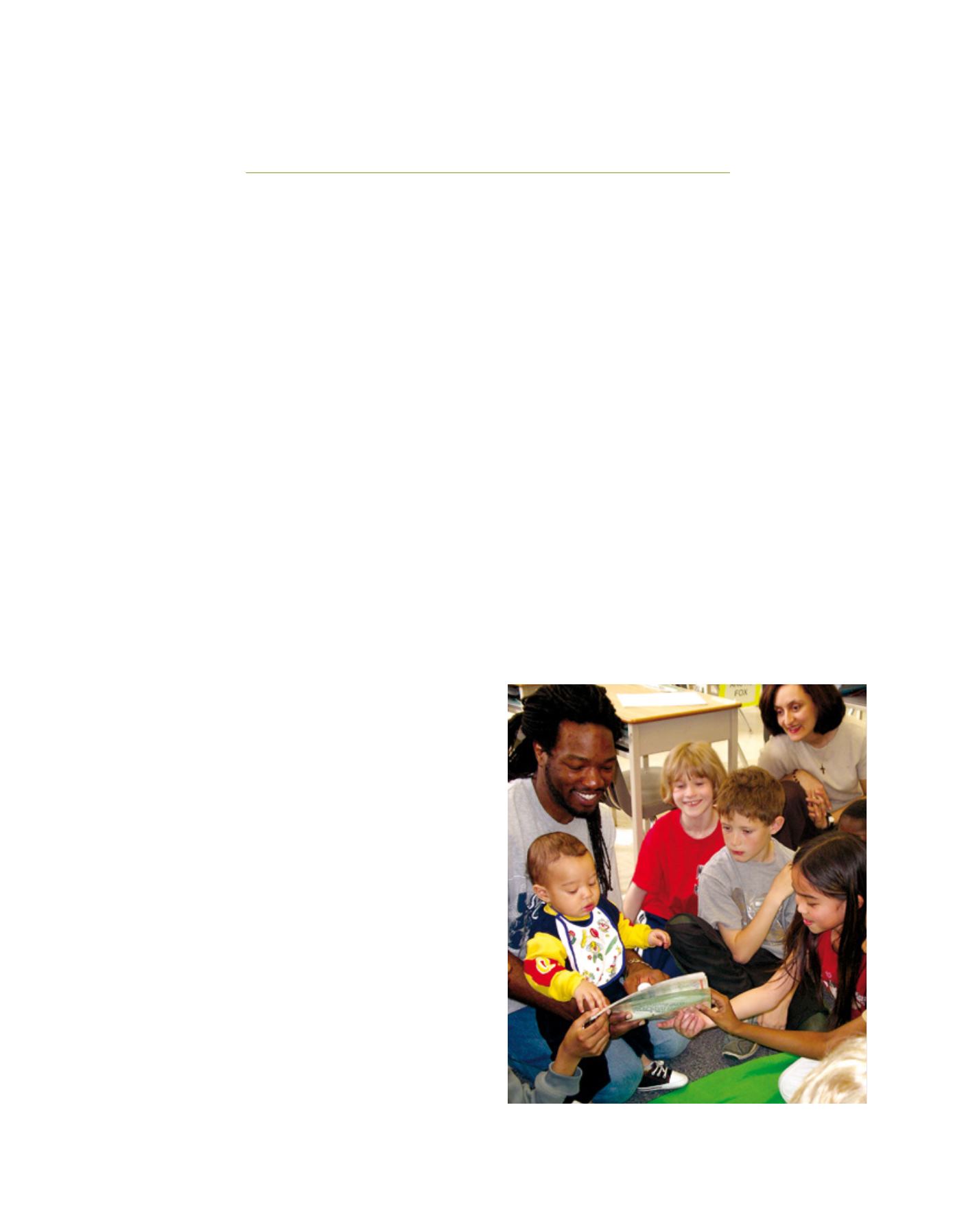
Image: Roots of Empathy
Canada’s families reflect its commitment to an ethnically diverse
and multicultural nation