


 202 / 210

[
] 200
E
nsuring
W
ork
-F
amily
B
alance
policy has changed its direction towards ‘universal coverage’ and
‘more benefits to families with many children’. The initiative
suggested setting a favourable environment for childbearing and
childcare as one of it purposes. There have been many improve-
ments in family policies, especially in terms of the coverage of
childcare subsidies, the level of payment for parental leave and the
introduction of a childcare allowance. The level of payment and
coverage of the childcare subsidy, which had been providedmainly
for poor families, was expanded to include more affluent families.
In 2013 all children from birth to five years old who are cared for
at childcare centres are qualified to receive full rates of childcare
subsidy. Parents who do not use centre-based childcare services
for children of this age are qualified to receive childcare allow-
ances instead of a centre-based childcare subsidy. The parental
leave payment system was changed in 2011 from a fixed amount
to a fixed rate of 40 per cent of normal income, with minimum
and maximum amounts.
22
Through these efforts the enrolments
rates in childcare and pre-schools have significantly increased. In
2012 the enrolment rate was 62 per cent for children aged zero to
two years old and 90 per cent for children aged three to five years
old. These proportions are higher than the average rates for OECD
member countries.
23
The number of people who received parental
leave payments increased from 9,303 in 2004 to 64,071 in 2012.
24
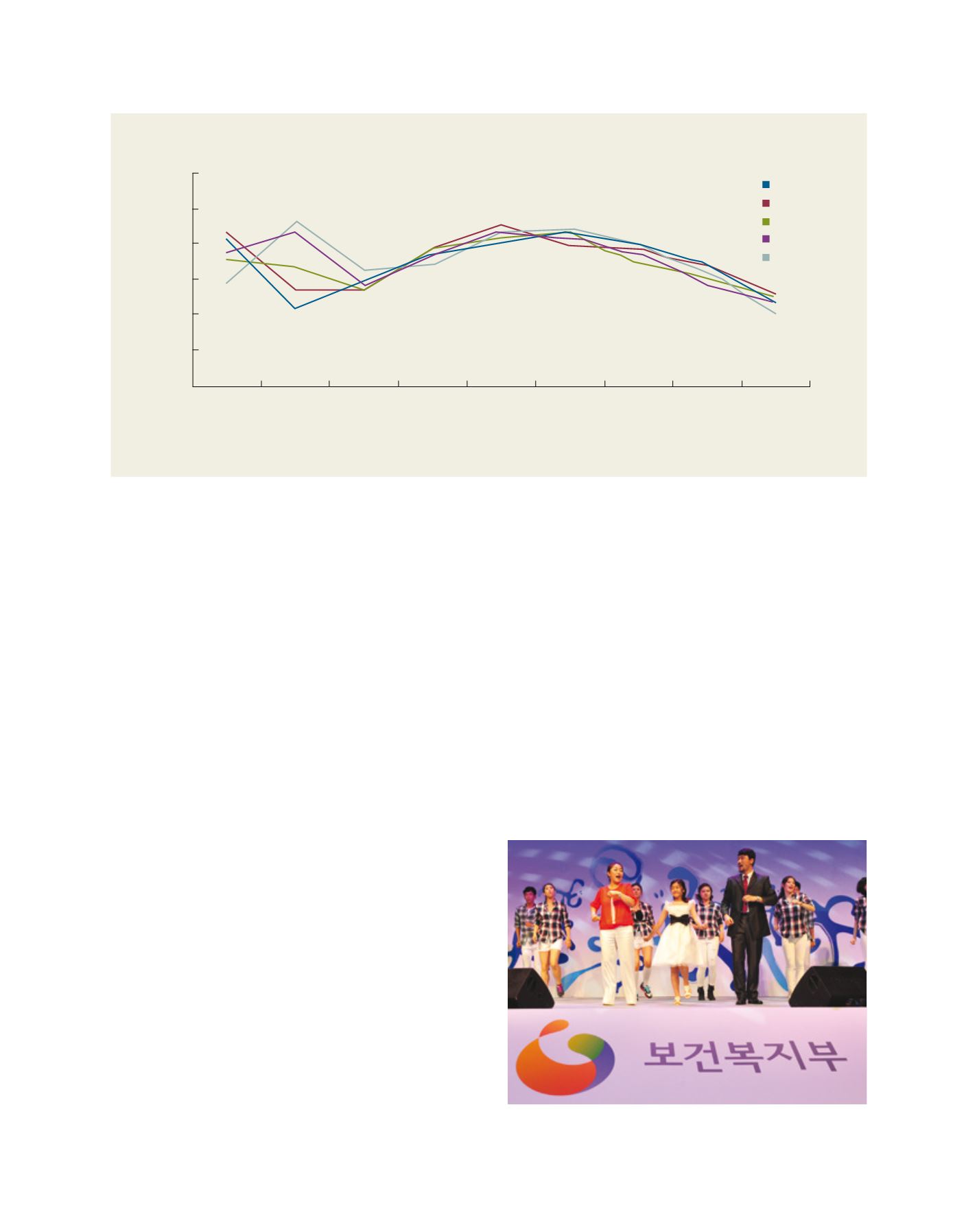
Despite these efforts, the fertility rate and female employment
rate in Korea seem to have remained unchanged. Even with
government subsidies for childcare, parents still spend additional
money for ‘special activities’ in childcare centres. Due to long
working hours and rigid working times, centre-based childcare
services can hardly satisfy the childcare needs of dual working
parents. In addition, Korean parents spend a lot of money on
tutoring at private institutions to prepare their children for
university entrance examinations. Parental leave payments are
provided only for people who are insured by employment insur-
ance. Therefore, part-time workers or irregular workers, who
work in vulnerable conditions and are not covered by employ-
ment insurance, cannot get benefits from the parental leave
system. Even female workers who are covered by employment
insurance hardly take the opportunity of parental leave due to
unfavourable and conservative working environments. Parental
leave take-up rates among men are extremely low, around 3 per
cent in 2012.
25
Most Korean men are breadwinners and will find
it difficult to take leave even when they need it, because their
income replacement ratio is kept at low levels.
Korea faces many challenges in order to recover the fertility
rate and deal with demographic issues. First of all, it is neces-
sary to ameliorate high private costs for child education. The
intensive working environment should be changed to be more
flexible. The traditional role of women at home and work needs
to be reconsidered so that women and men equally share care
and domestic duties at home. Confronted with low fertility and
an ageing society, Korea needs a new development plan, which
should include all agendas such as childcare and education, work
and life balance, gender equality, and social integration.
2000
2005
2010
1995
1990
80
70
60
50
40
30
20
20-24
25-29
30-34
35-39
40-44
Age
45-49
50-54
55-59
60-64
Per cent
Female employment profiles over life course in Korea, 1990-2010
Source: OECD Labour Force Statistics, 2013
The Ministry of Health and Welfare’s population commemoration day, where an
award is presented to the most family-friendly business or public institution
Image: Republic of Korea Ministry of Health and Welfare