


 198 / 210

[
] 196
E
nsuring
W
ork
-F
amily
B
alance
0
10,000
20,000
30,000
40,000
50,000
Total
Men
Women
2002
2003
2004
2005
2006
2007
2008
2009
2010
41,732
34,898
28,790
20,875
13,440
10,492
9,123
6,712
3,685
78
3,763
6,816
9,304
10,700
13,670
21,185
29,145
35,400
41,732
104
181
208
230
310
355
502
819
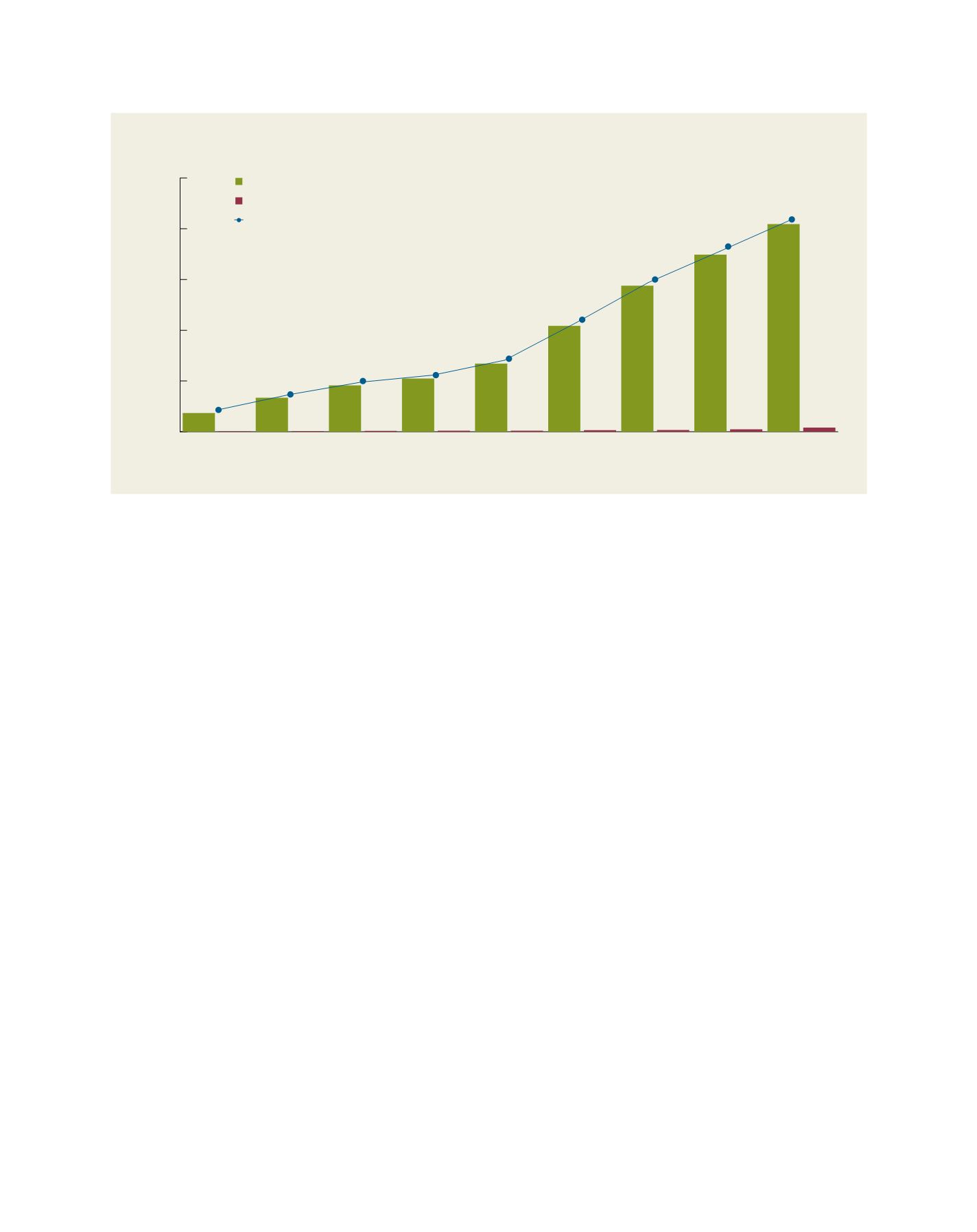
Usage of parental leave by gender
Source: Ministry of Employment and Labor
bility and coverage of the childcare subsidy system. As a result,
in 2012, the bottom 70 per cent of the income group became
beneficiaries of this system. At last, Korea has ‘universal child-
care support’ that provides free childcare services for all children
under school age from 2013. As a result, the number of facili-
ties has rapidly increased, from 22,147 places in 2002 to 43,213
places in 2013. The number of children using the facilities has also
increased, from 800,991 in 2007 to almost 1.4 million in 2013.
The Childcare Allowance for parents not using these facilities
was introduced in 2010. The amount of Childcare Allowance is
10,000-20,000 KRW according to the children’s age.
Female employees in Korea are entitled to a total of 90
consecutive days of maternity leave, before and after child-
birth. The leave benefits are paid by the employer based on
the worker’s ordinary wage. But for the workers of small and
medium-sized firms, the employment insurance scheme pays
for the whole 90 days of leave with employment protection.
In 2007, with the amendment of the Act on Equal Employment
and Support for Work-Family Balance, various efforts were made
to improve the utilization of policymeasures. This law grants flex-
ibility of use and parental choice as a way to encourage men to
take parental leave. Bothmen andwomen are granted rights to use
the leave for up to one year, so that parents can choose when and
who will use the leave and how long they schedule in one period.
Parental leave payment is paid on a pro rata basis at 40 per
cent of the beneficiary’s income (to a maximum of 1 million
KRW). In addition, a recent policy amendment (2014) allows
parents with children under eight years old to use parental
leave. Paternity leave was introduced in 2007, providing five
days of leave (three out of the five days are paid) to fathers
whose partners give birth. Additionally, workers with children
under six years old may request shorter working hours of 15-30
hours per week during the child-rearing period.
Owing to such improvements, the number of employees
taking parental leave is steadily growing. Some 21.2 per cent
of employees took parental leave following maternity leave in
2003; 50.2 per cent did so in 2009 and in 2012, the figure had
grown to 68.6 per cent. The number of leave-takers jumped
from 3,793 people in 2002 to 41,732 in 2010.
Conversely, the use of parental leave among men remains
very low; the gender ratio among parental leave users stands
at 97 per cent women and 3 per cent men. This is due to the
patriarchal values and the culture of long working hours which
prevail in Korean society.
Although flexible working arrangements (FWAs) in Korea
are still in their infancy, research results demonstrate that these
have had positive effects on attaining work-family balance. A
study by the author and other researchers,
3
which surveyed 307
working parents who are using the teleworking system, found
that about 38.4 per cent of respondents said they were able
to spend more time with family, while 43.6 per cent said the
FWAs brought positive changes to their family life. Working
parents who benefit from FWAs are found to have less trouble
with reconciling work and family responsibilities. In particular,
46 per cent of female and 34 per cent of male respondents said
they were able to have more family time.
Lastly, an essential part of Korea’s work-family reconciliation
policy is its family-friendly work culture policy, targeting busi-
nesses and local communities. The Family-Friendly Company
Certification Systemwas adopted particularly to induce participa-
tion and expansion of family-friendly management in businesses.
When it was first introduced in 2008, the Family-Friendly
Company Certification System selected 14 businesses, but as
of 2013 this number has risen to 522 businesses, continuously
expanding the family-friendly work culture among businesses.
Sharing of domestic work and childcare responsibilities is
very important in supporting work-family balance. A survey
was also carried out on how much these responsibilities are
shared between men and women within families. The results
showed that the majority of domestic and childcare tasks are