


 200 / 210

[
] 198
Korea’s family policy challenges
Yoon-Jeong Shin, Research Fellow, Korea Institute for Health and Social Affairs
E
nsuring
W
ork
-F
amily
B
alance
TFR
Per capita GDP (US$)
7.0
25,000
20,000
15,000
10,000
5,000
0
6.0
5.0
4.0
3.0
2.0
1.0
0.0
1960 1963 1966 1969 1972 1975 1978 1981 1984 1987 1990 1993 1996 1999 2002 2005 2008 2011
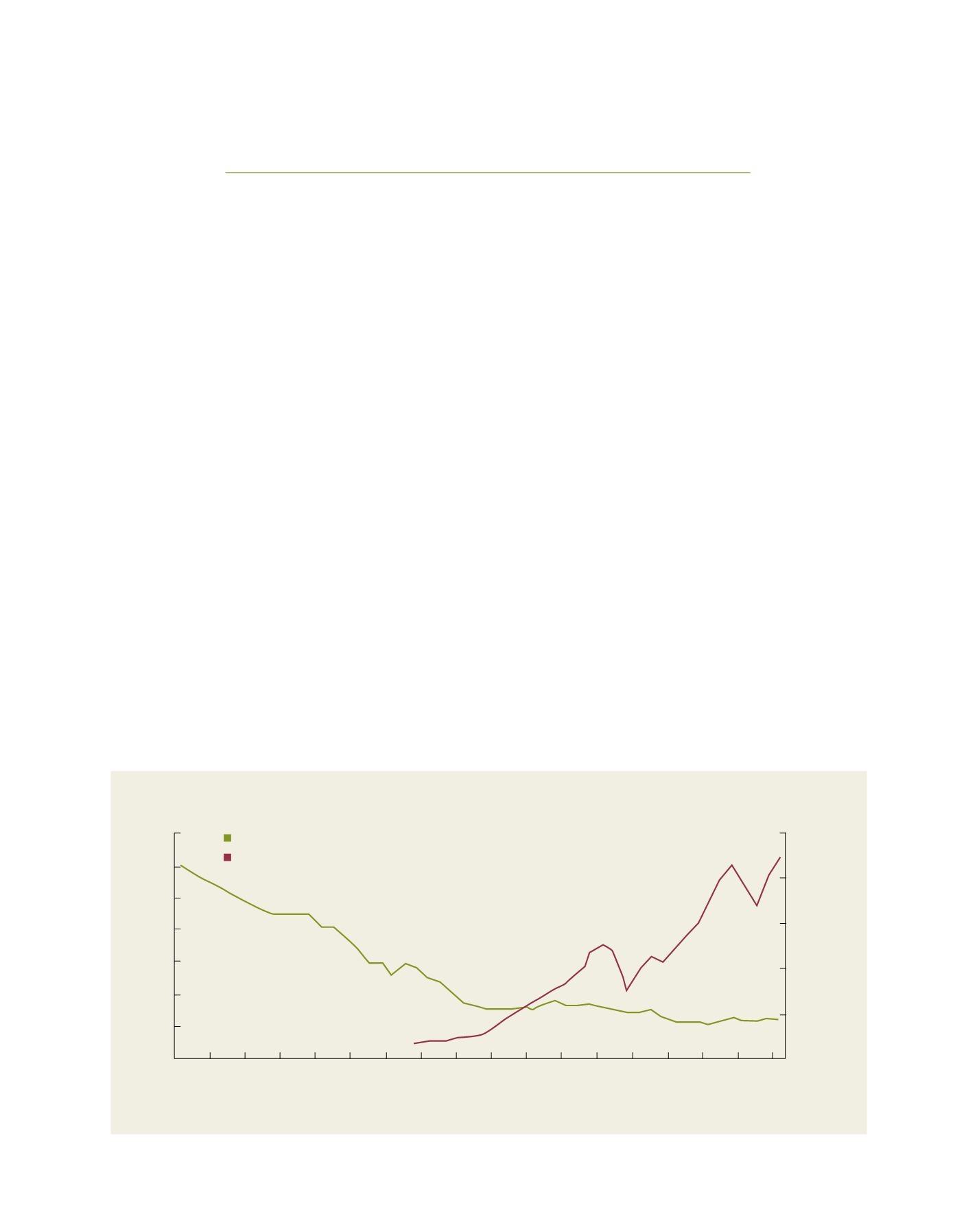
Total fertility rates (TFR) and per capita GDP in Korea, 1960-2011
Source: TFR: OECD Family database 2013: per capita GDP: IMF World Economic Outlook Database, 2013
K
orea has achieved incredible economic develop-
ment in the past decades. During this period, the
country’s total fertility rate (TFR) has declined
significantly to 1.30 in 2012, one of the lowest among all
Organisation for Economic Cooperation and Development
(OECD) countries.
1
This low fertility rate results in an
ageing population: the proportion of people over 65 years
old among the total population was 11.8 per cent in
2011, and it is expected to be 38.2 per cent in 2050.
2
It
is projected that the working population will shrink from
2018 onwards.
3
The decrease of the working population
and an increasingly ageing society will negatively influence
Korea, placing a social burden on the younger generation
and leading to a weakness in manpower. These problems
threaten Korea’s sustainability and further development.
The Korean Government has struggled to overcome the
problem of low fertility with family policy. The coverage and
level of payment of family policy have been expanded, espe-
cially for childcare subsidies and parental leave. However,
despite these efforts, fertility rates have not recovered and
remain among the lowest in the OECD countries. In addition
to fertility rates, there have been many changes in behaviours
related to childbearing, such as the age at which people get
married and the age at which they have their first child. Korean
families have changed and Korean women have new roles at
home and in the labour market compared with previous years.
These factors might affect the timing of childbearing and lead
people to have a smaller number of children. Social norms and
values also play an important role in marriage and childbirth.
Between 1960 and 1980, the Korean Government implemented
a five-year plan for economic development. Concurrently, the
Government enforced strong family planning and invested in
education for children and young people.
4
As a result, per capita
gross domestic product (GDP) increased fromUS$1,689 in 1980
to US$23,838 in 2013 and is expected to be over US$30,000 at
the end of this decade.
5
TFR, which was 6.0 in 1960, decreased
to 2.06 in 1983. Even after TFR decreased to below replacement
level, the Government continuously pursued anti-natal policies.
At that time, the Government’s concern was that the population
was so large as to be a negative influence on the economy. In the
middle of 1990s when TFR declined to around 1.5, the Korean
Government eventually abandoned the anti-natal programme.
After that, Korean population policy shifted its direction towards
improving the quality of the population.
6
In order to cope with the
problem of low fertility, the Low Fertility and an Ageing Society
Act was enacted and the Presidential Committee on Ageing
Society and Population Policy was launched in 2005. In addition,
three phases of the five-year national plan, ‘Basic Plan on Low
Fertility and Ageing Society’ have been implemented since 2006.