


 121 / 208

[
] 121
S
ustainable
agriculture
,
wildlife
,
food
security
,
consumption
and
production
patterns
ing new employment opportunities for marginalized groups, or
working against child labour and inhumane working conditions.
More economically sound aspects are also taken into account, such
as creating a level playing field for enterprises dealing with public
procurement, providing opportunities for small and medium-sized
enterprises or promoting life cycle costing as a means of integrating
(environmental) externalities into the prices of products and services.
The site
10
is a work in progress and is updated on a continuous
basis, taking into account approaches taken in the context of similar
initiatives by European institutions and regional ministries, as well
developments in research and consultations with interest groups.
The quality of the information and its usability within the context
of public procurement therefore differs from product to product and
service to service.
To monitor the actual integration of sustainability criteria into
tender documents, Belgium has set up a national coordination
committee with representatives of all Government levels (federal,
regions, provinces and local communities). The group has collabo-
rated with the European Commission project to monitor the 50 per
cent target for 10 product groups.
Cooperation activities on SCP
In 1992, the United Nations Conference on Environment and
Development intended to reconcile environment and development.
Twenty years later, we must acknowledge that, while most of the
ecological limits have been exceeded, the development gap is still
a reality: over a billion people on this planet are still starving and
around another billion are living in extreme poverty. Moreover, the
economic, social and environmental externalities of the Western way
of life have negative impacts on the inhabitants of Southern countries.
Throughout the world, Belgian NGOs and their local partners are
working to promote more sustainable patterns of production, but
this would not make sense if they did not question the
Western consumption model. This is the reason that
their work in the South is intrinsically linked to their
education and advocacy activities in Europe, with the
overall objective to reconcile environment and develop-
ment.
Over the last 20 years, many initiatives were taken,
both by States and civil society organizations, to tackle
the challenge of reconciling the three dimensions of
sustainable development. More specifically, Belgian
NGOs have been supporting projects in Africa, Asia
and Latin America, aiming at eradicating poverty and
inequalities through economically and environmentally
sustainable patterns.
Protos and Water Committees
In Ecuador, Ghent-based NGO Protos, which special-
izes in providing sustainable solutions to water supply
issues, supported the action of local-based actor CEDIR
to provide water in the Canton of Cañar. In the last 13
years, the percentage of the population having access
to drinking water was raised from 40 per cent to 70 per
cent. But Protos did not only provide the means to reha-
bilitate and develop infrastructures. The whole project
was based on the empowerment of local communi-
ties, through the introduction of ‘Water Committees’,
which participated directly in the rehabilitation and
were trained to progressively take over the manage-
ment. Moreover, the ownership of every single family
has been guaranteed through a monthly participation
of US$0,10. However, as noble as the goal of providing
safe drinking water to all is, it cannot be really sustain-
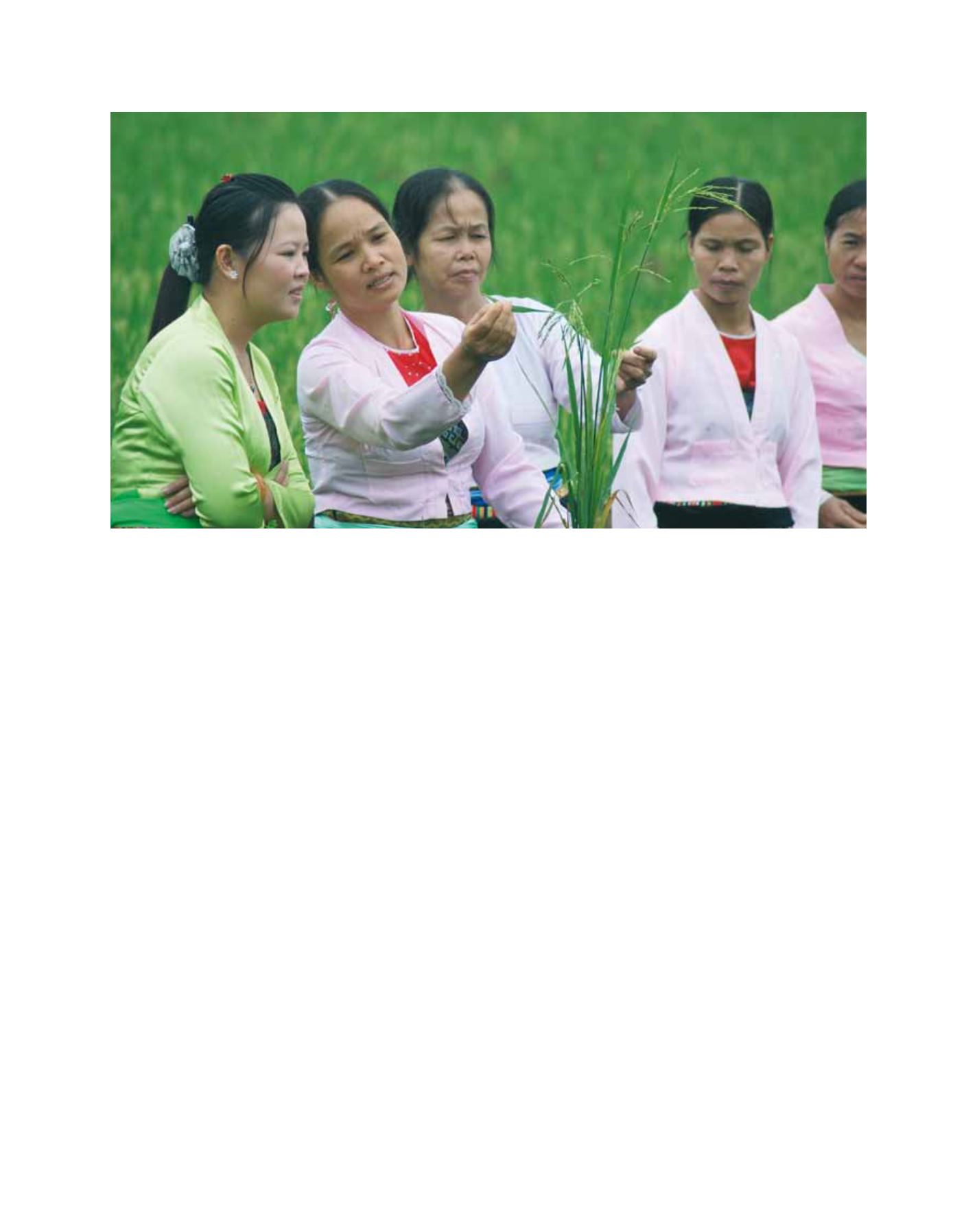
A food production model should not only feed the world, but also the producers of the food
Image: ©Nicolas Van Nuffel, CNCD-11 Nov 2011