


 123 / 208

[
] 123
Qatar’s commitment to sustainable
development: a forward-looking vision
Department of Social Development, General Secretariat for Development Planning, Qatar
Q
atar’s abundant hydrocarbon resources are being lever-
aged to make sustainable development a reality for all
its people. Converting these natural assets into financial
wealth provides a means to invest in world-class infrastructure;
build efficient delivery mechanisms for public services; create
a highly skilled and productive labour force; and support the
development of entrepreneurship and innovation capabilities.
The Qatar National Vision (QNV) 2030 is beginning to transform
Qatar into an advanced country, capable of sustaining its own devel-
opment and providing a high standard of living for all. To help
make that vision a reality, in 2011 Qatar launched its first National
Development Strategy, NDS 2011-2016 – a far-sighted framework
built on the principles of sustainable development and intergenera-
tional equity.
Appeal to long-held values
Qatar’s Government has anchored its plans for environmental
preservation and protection in the core value of intergenerational
justice, recognizing that depleting finite resources without creating
new resources of renewable wealth jeopardizes the rights of future
generations.
Among Qataris, respect for the needs of future
generations is a basic religious and moral value. In
the same spirit as equipping the next generation with
skills for future prosperity through education, Qatar’s
environmental management strategy seeks to preserve
the quality of life for future generations and will put
the country on a path of environmentally sustainable
development.
Growth with balance and sustainability
In 2008, His Highness Sheikh Tamim bin Hamad Al
Thani, Heir Apparent launched QNV 2030, which artic-
ulates the nation’s long-term development goals and
objectives. QNV 2030 is underpinned by four interrelated
pillars: human, social, economic, and environmen-
tal development. It foresees a vibrant and prosperous
future with economic and social justice for all, and where
nature and humanity are in harmony with the principles
of sustainable development.
The environmental pillar of QNV 2030 seeks to
strike a balance between the needs of development and
protecting the environment. It provides the principles
for managing the negative externalities of Qatar’s rapid
economic growth, which saw real Gross Domestic
Product (GDP) rise at an annual average of 13 per cent
between 2000 and 2010.
The environmental challenges facing Qatar include
the impact of diminishing natural water resources,
extremely rapid urbanization and population growth
as a consequence of rapid economic development, the
effects of air pollution and environmental degradation,
and the potential impact of global warming on Qatar’s
water levels and thereby on coastal urban develop-
ment. Assessing the severity of risks and dealing with
anticipated changes require mobilizing capacities and
coordinating efforts to tackle the problems.
NDS 2011-2016 was launched in March 2011. It
explicitly aligns the growth of national prosperity to
the realities of environmental constraints. The strategy
incorporates initiatives that support the foundations of
sustainable prosperity.
Sustainable prosperity can be achieved only if the
value of the nation’s productive base expands – its
constructed capital assets, infrastructure, human and
social capital, natural endowments, technology and
institutions. Growth of Qatar’s productive base will lead
S
ustainability
P
olicies
, P
rogrammes
and
their
E
conomic
I
mpact
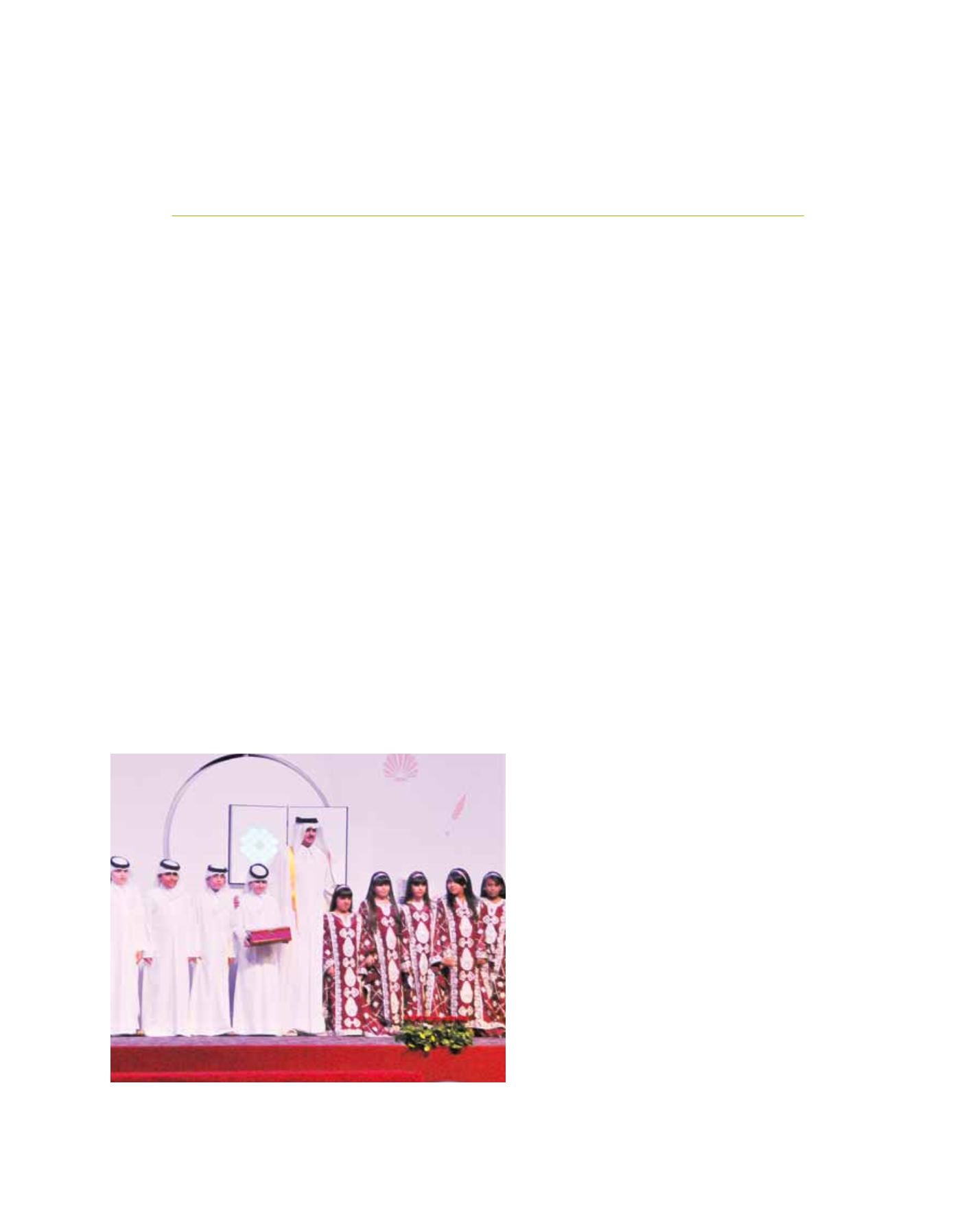
His Highness the Heir Apparent Sheikh Tamim bin Hamad Al Thani with Qatari
children, the beneficiaries and a critical force in shaping national development, at
the launch of Qatar National Development Strategy 2011-2016
Image: GSDP (2011)