


 128 / 208

[
] 128
Building the pillars of life on the road to Rio
Janez Poto
č
nik, European Commissioner for the Environment
T
he European Union (EU) is playing an active and
constructive role in ongoing negotiations regarding the
United Nations Conference on Sustainable Development
(Rio+20) and is determined to help make it a success. We would
measure success in terms of concrete outcomes guaranteeing
long-term sustainable development – delivering global job crea-
tion and eradication of poverty while safeguarding the natural
resource base that the world economy depends on. Our view
is that this would be best achieved by a global roadmap to an
inclusive green economy. We believe this is closely linked to
the emerging discussions on a set of global goals for sustain-
able development. At Rio+20, the EU is fully open to discussing
universal goals and to working with everyone to achieve solid,
measurable goals and milestones that will help us meet the enor-
mous challenges we face together.
Sustainable development means meeting the needs of present gener-
ations without jeopardizing the ability of future generations to meet
their own needs – in other words, a better quality of life for every-
one, now and for generations to come.
Sustainable development will not be brought about by
policies only: it must be taken up by society at large as a
principle guiding the many choices each citizen makes
every day, as well as the big political and economic deci-
sions. This requires profound changes in thinking, in
economic and social structures and in consumption and
production patterns.
Creating opportunities for all
Each one of us will share our small planet with 9 billion
people by 2050. It is predicted that there will already
be 3 billion more middle-class consumers by 2030. We
should rejoice at this prospect of prosperity for so many.
But more middle-class consumers means more demand,
and if this demand is met by the ‘brown’ economy, it
will put immense strain on many resources. The world
will need three times more resources – 140 billion tons
annually – by 2050. That pressure will be the most
significant limiting factor on our ability to grow and
provide higher living standards. The planet’s limits are
S
ustainability
P
olicies
, P
rogrammes
and
their
E
conomic
I
mpact
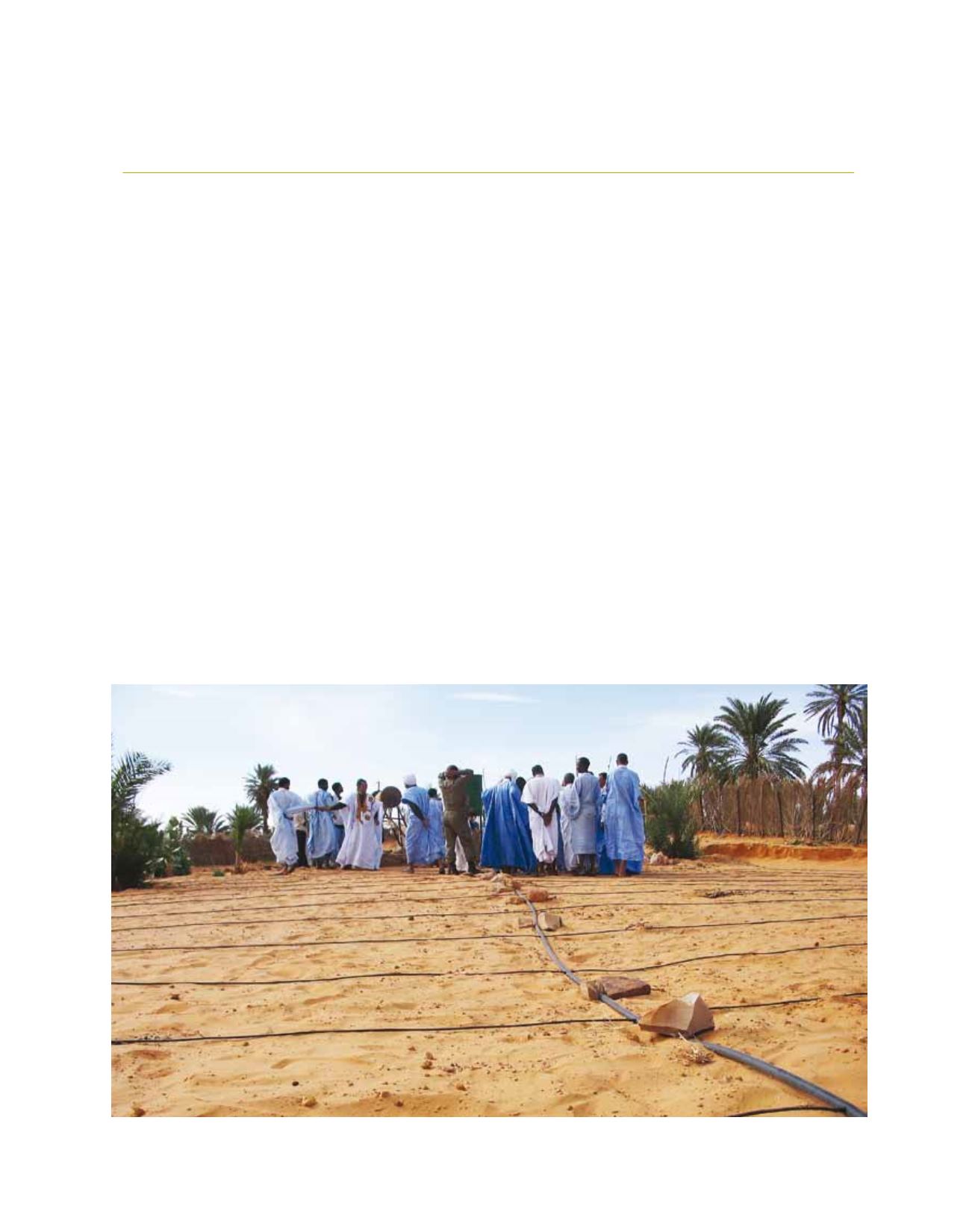
Irrigation system at the region of Ardar in Sahara
Image: Mauritania Delegation