



 130 / 208

[
] 130
S
ustainability
P
olicies
, P
rogrammes
and
their
E
conomic
I
mpact
Building on our experience and expertise, we have focused on all
elements of energy – from electricity, to governance, to technology,
to clean cooking facilities. And we are ensuring that investments and
growth are inclusive, benefiting all citizens while concentrating on
the poorest and most vulnerable.
In order to scale up energy access projects, we have developed
leading innovative financial instruments to pool the EU’s grant
resources with lending from European development finance insti-
tutions. Overall, this instrument already has a potential outreach
of many millions in developing countries. And that’s not all: the
European Investment Bank has been prioritising energy, resulting in
billions of Euros being granted in preferential loans in recent years.
Recently, the European Commission’s Joint Research Centre
published a very interesting report on ‘Renewable Energies in Africa’.
This study provides an analysis and a mapping of the potential and
available resources for solar, wind, biomass and hydropower across
the African continent. Such an overarching approach allows for each
region of Africa to estimate the best choice or mix of renewable
resources, taking fully into account sustainability and environ-
mental criteria. The data available could serve to set up national
renewable energy action plans.
And we are seeking to do more in the coming years. Our 2011
blueprint for higher-impact EU development policy – what we have
called our Agenda for Change – will focus our cooperation on the
most effective drivers of inclusive and sustainable growth. Using
local people and local resources, it is central to providing opportu-
nities for equitable and environmentally friendly economic growth,
education and health, and to helping eradicate poverty.
Around 1.4 billion people, mostly in South Asia and sub-Saharan
Africa, still live in extreme poverty and one-sixth of the world’s popula-
tion is undernourished. Unsustainable economic growth has increased
the stress on the Earth’s limited natural resources and on the carrying
capacity of ecosystems, with 60 per cent of the world’s natural resources
already being used unsustainably or at their limit. Many
environmental problems have not been solved and have
become more acute; and economic, social and environ-
mental problems are closely linked.
If we do not manage our natural assets and resources
in a more sustainable manner, our economies and envi-
ronment will suffer and we cannot alleviate poverty
or achieve more equity. The poorest in our societies
will suffer most if we use our resources unsustainably,
as their lives and livelihoods depend very directly on
water, land, seas, forests and soil.
There is a particular opportunity for those whose
production systems are not yet ‘locked in’ to leapfrog to
efficient technologies and systems that will permit them
to exploit their resources – from forests and biodiver-
sity to land and minerals – in ways that are sustainable
and capable of supporting future increases in consump-
tion, as the world’s population rises. These could include
anything from local renewable energy generation to water
metering, and from satellite monitoring of forests and land
use to development of farmers’ skills in soil maintenance.
However, new technologies alone are not enough. They
must be combined with a drastic change in our consump-
tion patterns, as without rendering these sustainable,
there would be nothing left for us to buy, use and eat.
Working together for Rio+20
The EU is committed to delivering in Rio, but this cannot
be done alone. We fully believe in multilateralism and
hope others will help us to prove we are right. We hope
the outcome of Rio+20 will be an ambitious plan for
the future with concrete, timely and effective follow-up
actions, which can have real impact across the world.
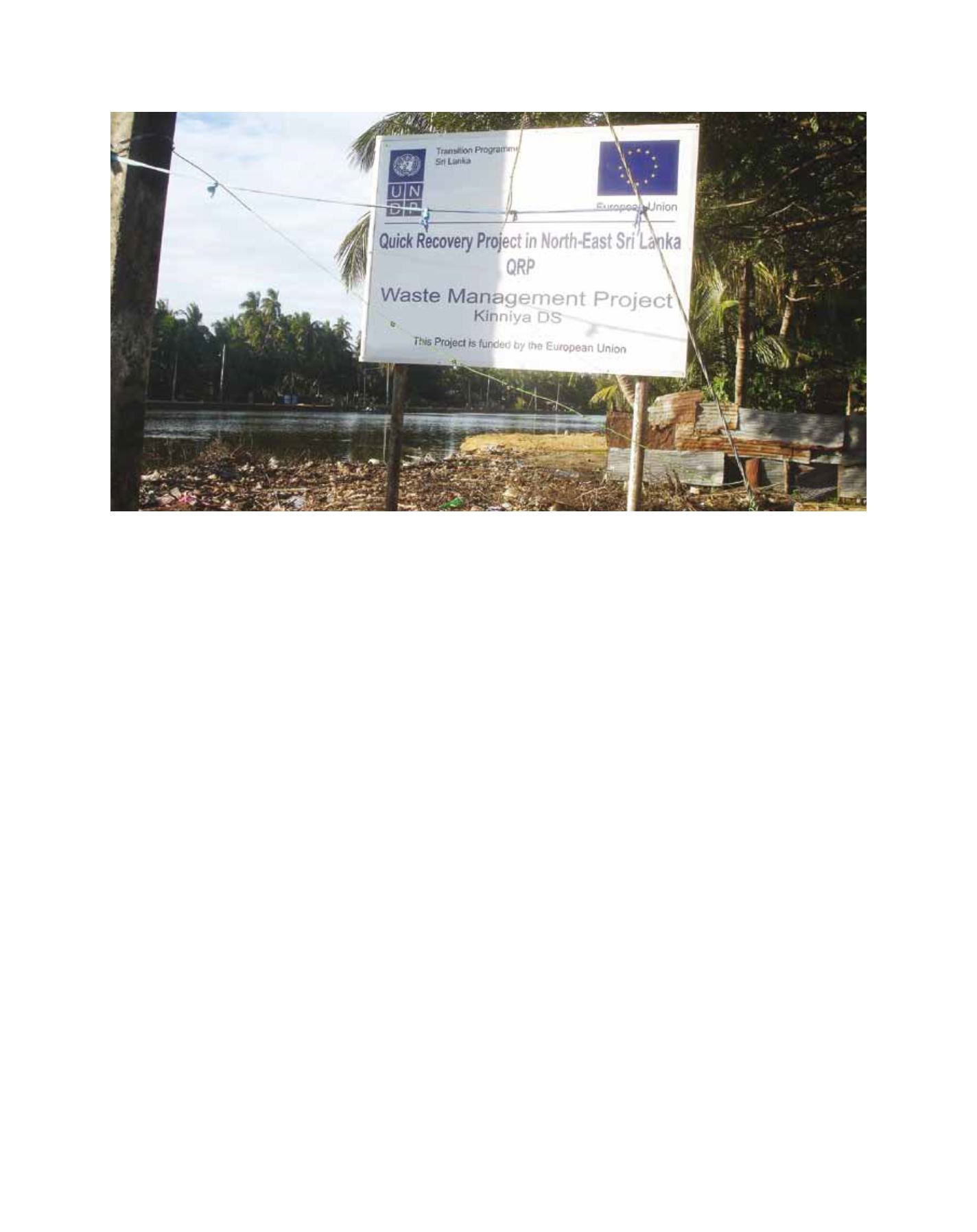
Waste management quick recovery project in north-east Sri Lanka
Image: EC Delegation in Sri Lanka