


 133 / 208

[
] 133
S
ustainability
P
olicies
, P
rogrammes
and
their
E
conomic
I
mpact
growth engines and jobs through green technology and clean energy.
His vision and leadership was a central driver in transforming the ROK
development path into a low-carbon, resource-efficient and green
economy. By extending the country’s ‘Green New Deal’ into a five-year
development road map, President Lee signalled that green growth is a
strategy well beyond current economic recovery efforts and is intended
to fashion a green economic future. This has the potential of starting a
domino effect on the major Asian economies.
Scientific/Technological Achievements in Environment
The Zayed Prize was awarded to the MillenniumEcosystemAssessment
(MA) in 2006, for the work undertaken by 1,360 experts across 95
countries involved in a landmark study on the condition of the world’s
ecosystem services, from fisheries and freshwater systems to the carbon
capture of the global forests. The MA underlines the economic impor-
tance of nature’s capital and demonstrates that the degradation of
ecosystems is progressing at an alarming and unsustainable rate. Indeed,
it estimates that 60 per cent of the ecosystem that supports all life on
Earth is being degraded or used unsustainably. The MA concludes
that these declines are fast becoming barriers to fighting poverty and
meeting the MDGs, while triggering worrying new threats including the
spread of old diseases such as malaria and cholera, as well as increasing
the risk of emerging new diseases. Numerous spin-off reports from the
MA published throughout 2005 are not only a wake-up call to world
leaders, but offer forward-looking proposals on how to reverse the
degradation of ecosystems and the services they provide.
In a statement released in March 2005, Living Beyond Our Means:
Natural Assets and Human Well-being, the MA’s 45-person board
said: “The overriding conclusion… is that it lies within
the power of human societies to ease the strains we are
putting on the nature services of the planet”, adding:
“Achieving this however, will require radical changes in
the way nature is treated at every level of decision-making
and new ways of cooperation between government, busi-
ness and civil society.” In the opinion of the Jury, the
MA is a remarkable scientific achievement. It is also one
that is commanding political attention while shaping the
environmental agenda of the twenty-first century, particu-
larly in the challenging area of ensuring nature’s capital is
valued alongside financial and human capital.
In 2011, this prize was awarded to Sir Partha Dasgupta,
the Frank Ramsey Professor of Economics at Cambridge
University in the United Kingdom. One of the most
outstanding environmental economists of his genera-
tion, he was among the leading economists making the
link between sustainability and economics well before
such work was fashionable or fully understood. Professor
Dasgupta coined the term ‘inclusive wealth’ to spotlight
the way conventional measures of wealth –primarily GDP
– fail to capture natural capital or environmental assets.
Environmental action leading to positive change in society
Dr Badria Al Awadhi, an outstanding lawyer dealing with
environmental issues, was awarded the Zayed Prize in
2004. As well as being a member of a number of interna-
tional organizations such as the International Federation of
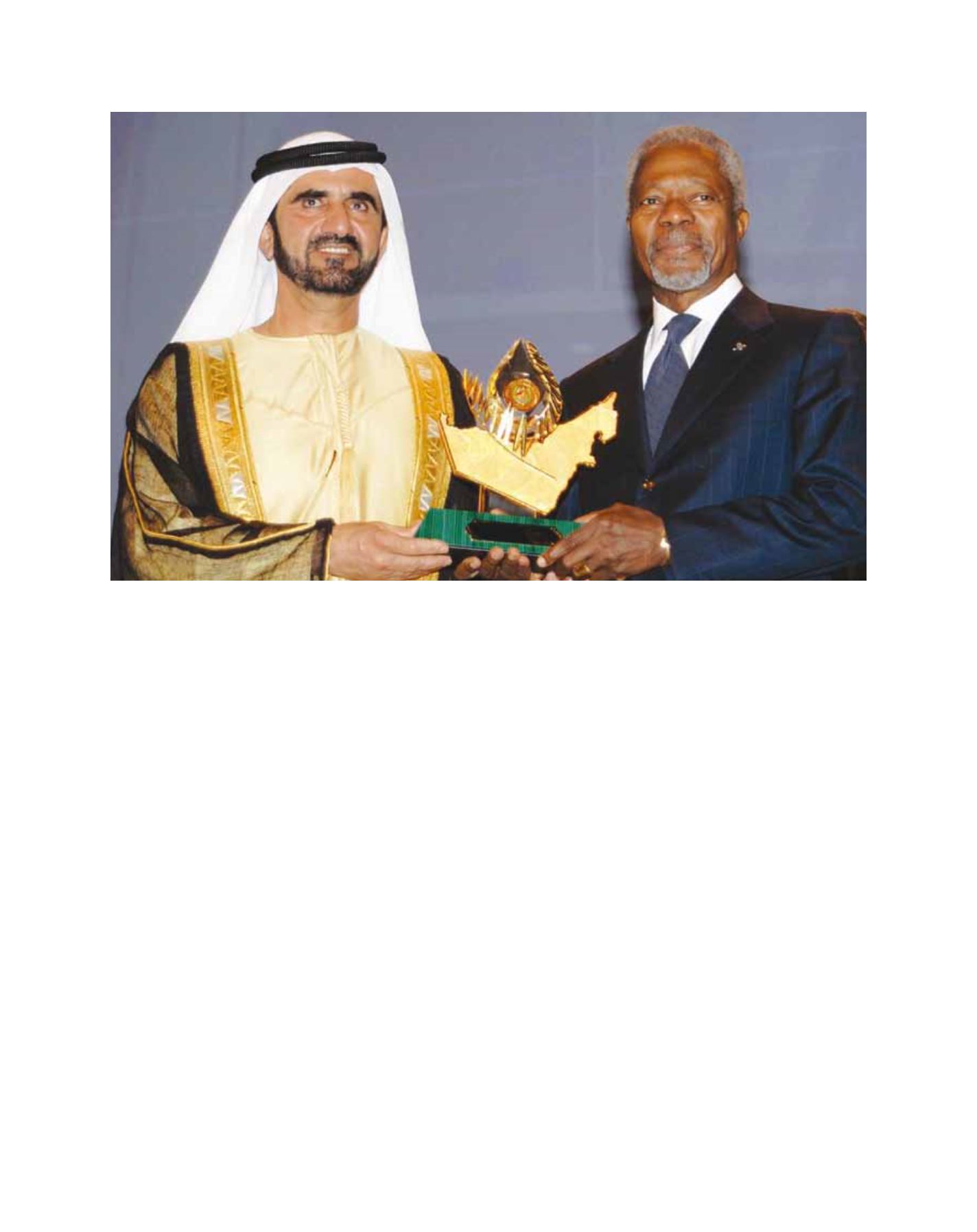
Former United Nations Secretary-General Kofi Annan received an award in 2006 from H.H. Sheikh Mohammad bin Rashid Al Maktoum, for making environmental
understanding central to sustainable development
Image: Zayed International Prize for the Environment