


 139 / 208

[
] 139
Green growth:
necessity or opportunity for Africa?
Frank Sperling, Chief Climate Change Specialist, Department of Energy, Environment and Climate Change
and Alexis Rwabizambuga, Chief Climate Change Officer,
Compliance and Safeguards Division, the African Development Bank
I
n June 2012, the world’s spotlight will again shine on the
city of Rio de Janeiro. Twenty years after the United Nations
Conference on Environment and Development – also known
as the Earth Summit – representatives from government, private
and civil sectors will once more converge in the city to take stock
of the state of the world and try to chart a course for human
development. They will seek to address pressing socioeconomic
and environmental issues for current and future generations – a
daunting task.
The problems are manifold and complex, as short-term and long-
term socioeconomic and environmental issues vie for urgent
attention. Decision makers are confronted with the immediate need
to address the international financial crisis, while also having to
respond to broader shifts in the political and economic landscape.
Meanwhile, an ever-growing body of scientific evidence
shows that the current economic model is unsustain-
able, as environmental changes driven by human
activities are straining the Earth’s life support system.
1,
2
A rapidly growing world population is confronted
with declining land productivity, environmental degra-
dation, air and water pollution and the looming threat
of climate change. In fact, humans are now considered
the dominating force shaping the face of the Earth by
altering key physical and environmental processes on a
local and global scale.
3, 4
Building on the concept of sustainable development,
green growth has been portrayed as the necessary
model for humankind to master these challenges. Like
sustainable development, green growth takes a more
comprehensive approach to development, capturing
its economic, environmental and social dimensions,
while adding an emphasis on growth of a ‘green’
nature. Then there is the concept of a green economy,
which is described by the United Nations Environment
Programme (UNEP) as a mechanism for sustainable
development. But what does the term ‘green’ mean? Are
there shades of green? Will there be green development
projects versus non-green projects? How green should
a developing country’s development be? And can devel-
oping countries afford to be green?
Africa’s changing development context
Over the past decade, the African continent has seen
rapid economic growth, with six of the world’s ten
fastest growing economies. However, while this is
promising, it is also important to recognize that growth
has been uneven across countries and economic sectors.
There have been important advances in macroeconomic
policies, but often growth is driven largely by a single
sector. Despite some progress towards the Millennium
Development Goals, African countries will fall short in
achieving many of the targets.
Furthermore, the positive impact on sub-Saharan
Africans has been limited. The number of people living
on a daily income of less than US$1.25 has decreased
by only 7 percentage points (from 58 to 51 per cent)
between 1990 and 2005.
5
With the exception of a few
positive examples such as Cameroon, Ethiopia, the
S
ustainability
P
olicies
, P
rogrammes
and
their
E
conomic
I
mpact
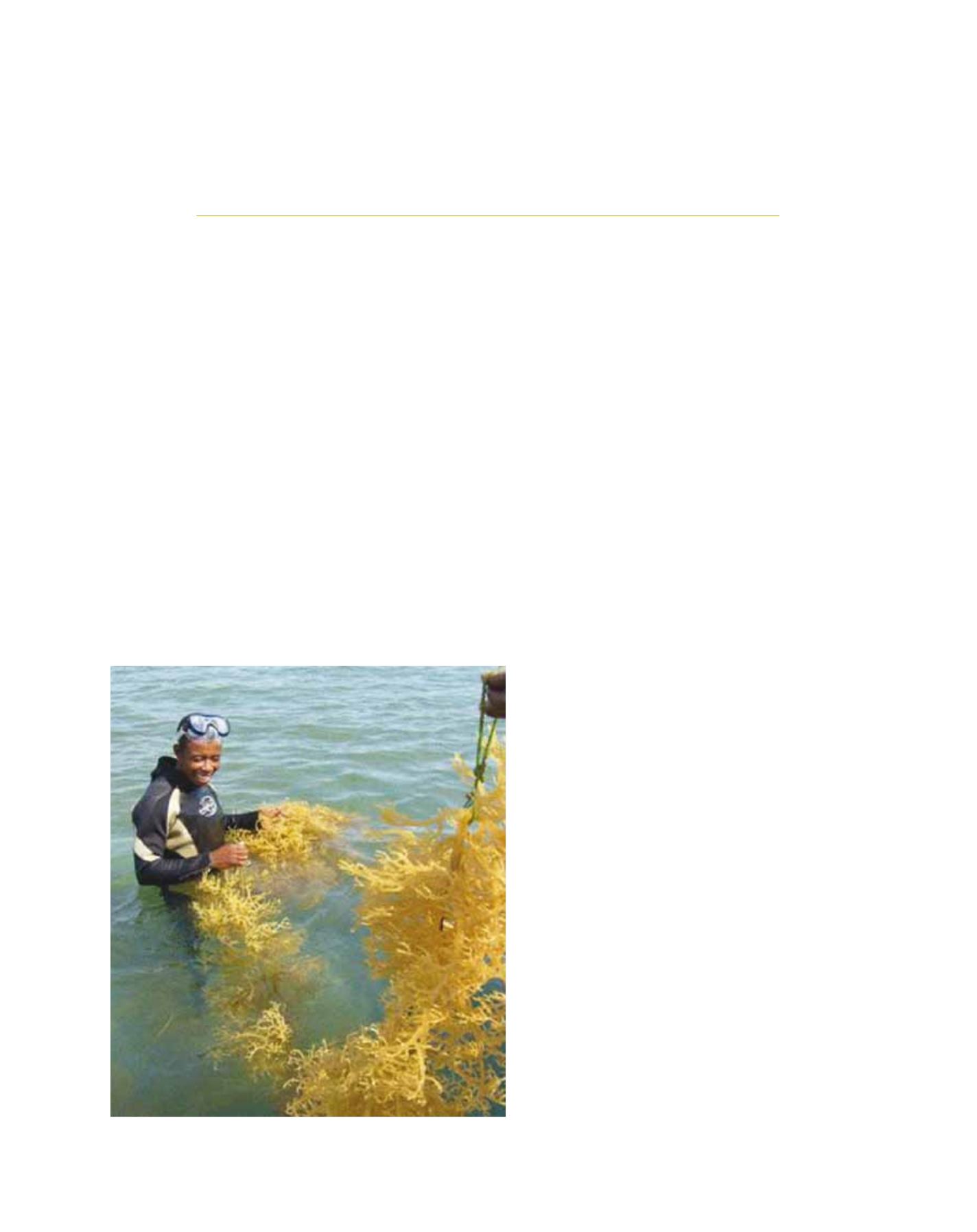
This fisheries project in Madagascar increased shellfish yields sustainably
Image: AfDB