



 143 / 208

[
] 143
Swedish perspectives on sustainable development
Gunilla Carlsson, Minister for International Development Cooperation, Sweden
O
ver the last 30 years, the world has changed dramati-
cally. Globalization and economic growth are enabling
increased trade and mobility. Technical advances and
innovations are helping to solve our common problems and
increasing numbers of people are moving out of poverty and
political oppression. At the same time, we are facing numer-
ous challenges and crises, such as climate change, depletion
of biological diversity, threatened ecosystems and a vulnerable
situation regarding food security.
Sustainable development presupposes democracy, respect for
human rights institutions that enable transparency and account-
ability, free access to information and gender equality. Women’s
economic and political participation are necessary conditions, not
only for equality, but also for economic growth alongside equita-
ble and sustainable development. Market economy and free trade,
alongside innovation, research and technical progress, are crucial
instruments for long-term and inclusive welfare. Efforts to achieve
sustainable development must focus on creating conditions and
opportunities for individuals to control their own
lives. Shifts towards economically and environmen-
tally sustainable forms of production and consumption
require trust in the institutions and authorities that
lead the way.
When people have the necessary knowledge and
insights about the need for sustainability, change is
possible at local, national and global levels. However,
there is a particular need to reform and strengthen
international structures and frameworks to better inte-
grate the three dimensions of sustainability – economic,
social and environmental – across all levels. To deal
with the crises as well as manage the opportunities
facing decision makers, collaboration between a wide
spectrum of actors is needed, from civil society organi-
zations and the private sector to local and national
governments.
Important issues in the development of sustainability
policies include:
• Access to, and sustainable use of, energy, water
and sanitation for all people, particularly women
and children. The way these resources are used is a
major determinant of people’s health, access to food,
agriculture and, more widely, the private sector, as
well as inclusive growth and development
• Sustainable urbanization – more than half the
world’s population already lives in cities and
urbanization is set to continue. This requires a
holistic perspective, including integrated planning,
energy- and resource-efficient techniques, and
participation, employment and access to welfare
services for poor people
• Correct pricing and valuation of ecosystem
services – there is need for economic incentives to
make the polluter pay, as well as for phasing out
environmentally harmful subsidies. The validation
of ecosystem services in national accounts and
in business plans is an important step towards
shaping economic incentives for the conservation
of biodiversity. New indicators for measuring
sustainable development that complement the
growth of Gross Domestic Product are also needed
• Sustainable agriculture, forestry and fishing – the
role of these sectors in the shift to a green economy
should be highlighted, alongside their importance
in improving people’s living conditions. Nature’s
resources must be used in a responsible and
sustainable manner
S
ustainability
P
olicies
, P
rogrammes
and
their
E
conomic
I
mpact
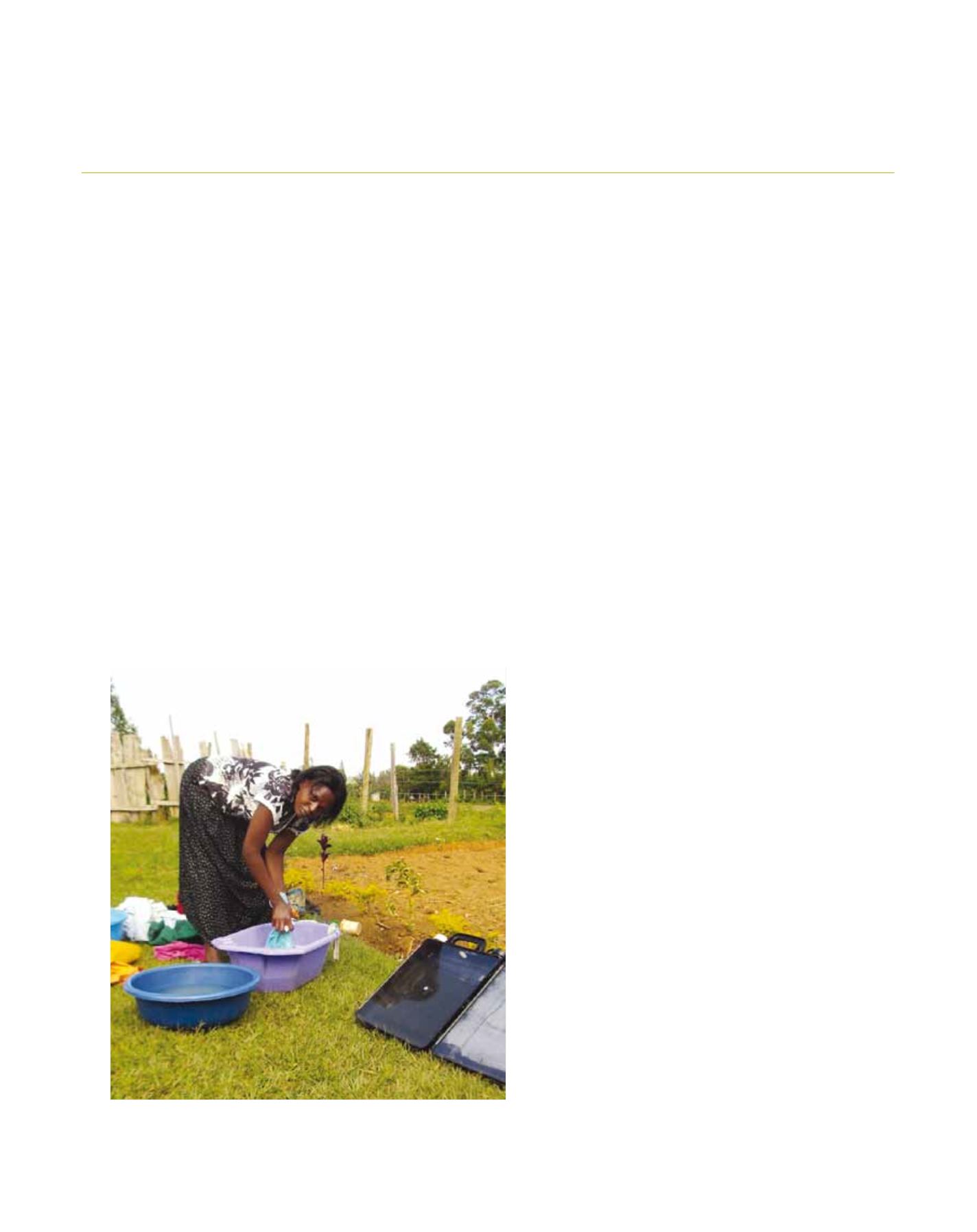
The Swedish ‘Solvatten’ purifies water by exposing it to sunlight through the foldable
container/purifier. This is an example of Swedish green technology being exported
Image: Solvatten