



 145 / 208

[
] 145
S
ustainability
P
olicies
, P
rogrammes
and
their
E
conomic
I
mpact
times of increased human influence and the growing need for drink-
ing water, prudent water management is essential, together with
technical innovations.
Sweden takes an integrated approach to water management,
beginning with the movement of the water through the landscape
and on to the drainage area. In 2011, a new Agency for Marine
and Water Management was established. Its objective is to further
integrate marine water management, allowing better conditions for
sustainable water use. The serious environmental conditions in the
sea surrounding Sweden are a Government priority.
Sweden has a long coastline and this is a great responsibility
for marine environments. When increasing numbers of offshore
facilities for wind and wave energy are added to fishing and trans-
portation, the need for marine resource planning and management
becomes more urgent. Marine planning allows for use – without
misuse – of sensitive seas. Such work is jointly undertaken with
neighbouring countries. For example, in the Baltic Sea, Sweden and
Finland are collaborating in the Plan Bothnia project, which is aimed
at ecosystem-based marine planning.
There is also wider collaboration around the Baltic Sea, where
132 pollution hotspots were identified in the 1990s within the
framework of the Helsinki Commission. The Swedish International
Development Cooperation Agency and its partners in various coun-
tries have been involved in about 40 water and wastewater projects,
resulting in a 40 per cent reduction in nitrogen and phosphorus
discharges over a ten-year period. This translates into a total reduc-
tion of 3,500 tons of phosphorus into the Baltic Sea each year, which
is more than the total national discharges of Sweden.
Courses and training sessions are undertaken in Sweden and
abroad with the purpose of enhancing capacity in this field. One
example is the Swedish support given to the Indian
organization Tarun Bharat Sangh, which is active
in more than 1,000 villages in Rajasthan. Improved
management has resulted in raised water tables,
increased access to water and higher agricultural yields,
which in turn has contributed to improved incomes and
reduced poverty.
Sweden is host to two important international
resource centres in the field of water management,
the Global Water Partnership and the Stockholm
International Water Institute. The latter hosts the
largest annual international water conference – World
Water Week – and has emerged in recent years as an
international knowledge and capacity centre for water
issues.
Sustainable cities
More than half the world’s population lives in cities, and
urbanization continues at a rapid pace. Urbanization is
inherent in economic and cultural development and
these trends are universal. Life chances and economic
opportunities are often better in cities, even for the
many poor and disadvantaged.
How urban growth is managed has enormous impli-
cations for whether the potentially disastrous impact
of climate change can be avoided. A number of envi-
ronmental problems – many of them related to climate
change – must be dealt with in cities. Large-scale urban
growth, particularly in parts of Asia and Africa, has
created a pressing need for more holistic planning and
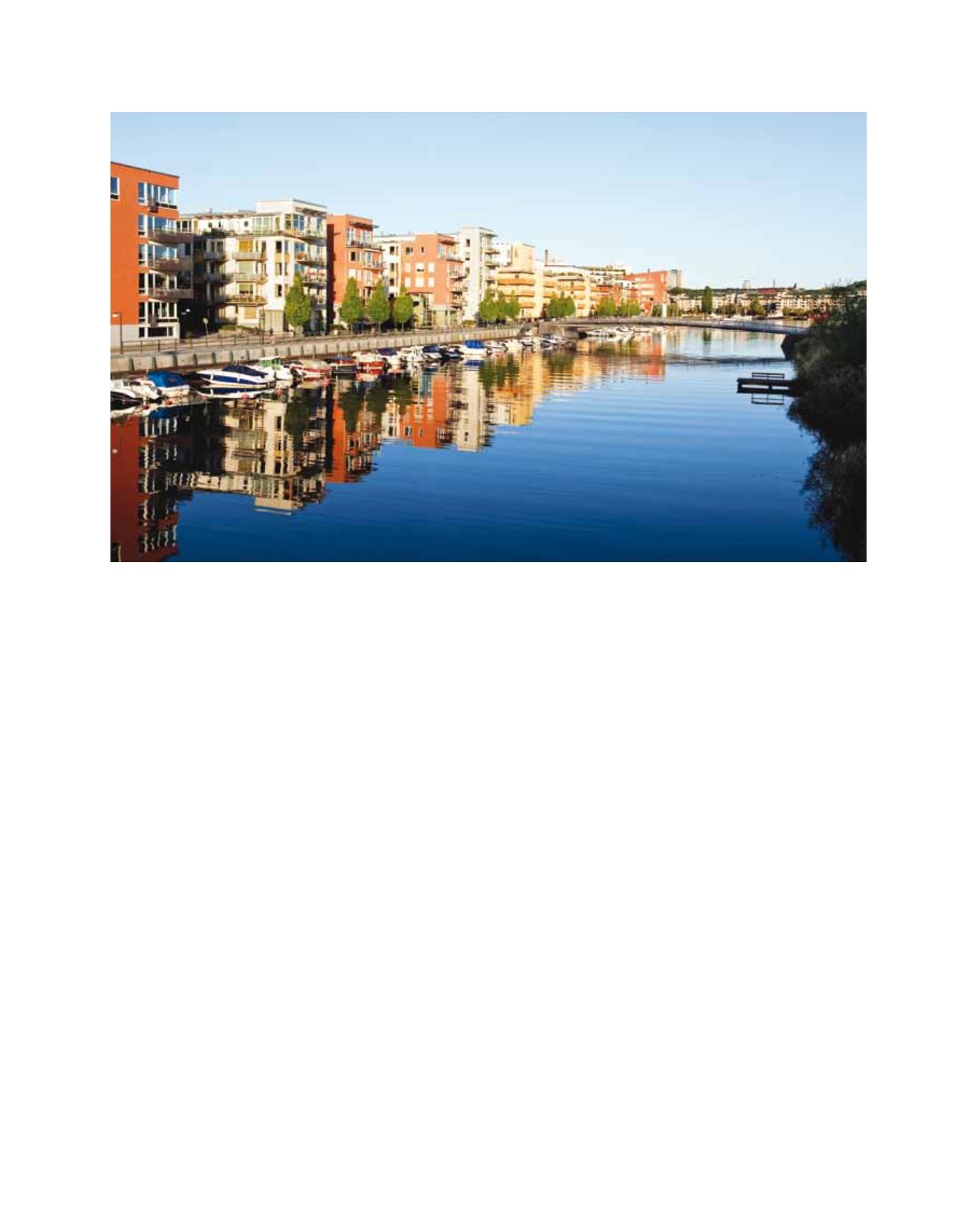
The Hammarby Sjöstad, Stockholm, has set a new standard for future housing development with its integrated planning approach
Image: Kristofer Samuelsson /Johnér