



 146 / 208

[
] 146
S
ustainability
P
olicies
, P
rogrammes
and
their
E
conomic
I
mpact
governance of urban development, which includes environmental
system solutions. There is also an urgent need for improved manage-
ment and operation of municipal technical infrastructure. Against
this backdrop, Sweden initiated and presented the Sustainable City
– SymbioCity – concept at the United Nations World Summit on
Sustainable Development in Johannesburg, in 2002.
The SymbioCity concept has been developed within the context of
Swedish urban planning. The setting is decentralized, with Swedish
municipalities enjoying a planning monopoly and the right to tax
their residents. This provides scope for innovative approaches. Some
examples of cases in which a holistic perspective has been applied
to sustainability are the ‘Bo-01’ project in Malmö, ‘Hammarby
Sjöstad’ in Stockholm and the emerging ‘Djurgårdsstaden’, also in
Stockholm. The ‘Hammarby model’, applied in a newly constructed
city district in Stockholm, has set a new standard for future housing
development. It has been presented in China, Canada and South
Africa as a model for other cities.
Plans were made in the 1990s to build Hammarby Sjöstad in a
former brownfield area of wharves and docks. The first construction
phases were finalized in 2000. By 2015, there will be 11,000 apart-
ments, 25,000 residents and 10,000 workplaces. The district is now
famous for its integrated planning approach, where every aspect
has been developed with the whole in mind. Investments include:
• Automatic underground waste collection systems
• District heating and cooling fuelled partly by local waste
collection and by heat exchangers in water treatment
• Solar-powered hot water and electricity
• Biogas from household sewage water and waste
• Collection and filtration of runoff water
• Super-efficient buildings, triple-glass windows and green roofs.
The results delivered by this approach are truly fantas-
tic. A general assessment indicates a doubling of total
environmental performance, with:
• 40 per cent less environmental stress
• 50 per cent less eutrophication
• 45 per cent less ground-level ozone
• 40 per cent less water consumption.
The SymbioCity concept has been built around the
invisible links and synergies between various systems
in cities including energy, waste management, water
supply and sanitation, traffic and transport, land-
scape planning, sustainable architecture and urban
(housing, industry and service, along with recreational
and cultural) functions. These sectors typically live
their lives independent of one another, which leads
to sub-optimization. The SymbioCity approach finds
links between the sectors and their system investments
in order to optimize results and make economic gains.
While the SymbioCity concept has been devel-
oped as a component of Swedish city planning, this
resource base is also in demand to help develop inte-
grated solutions in collaboration with local resource
bases in other parts of the world. Such interventions
form part of the Swedish development cooperation.
Within these projects, a number of stakeholders,
such as municipalities and other public authorities
at national, regional and local levels, along with insti-
tutes, universities, companies and networks, need to
be involved.
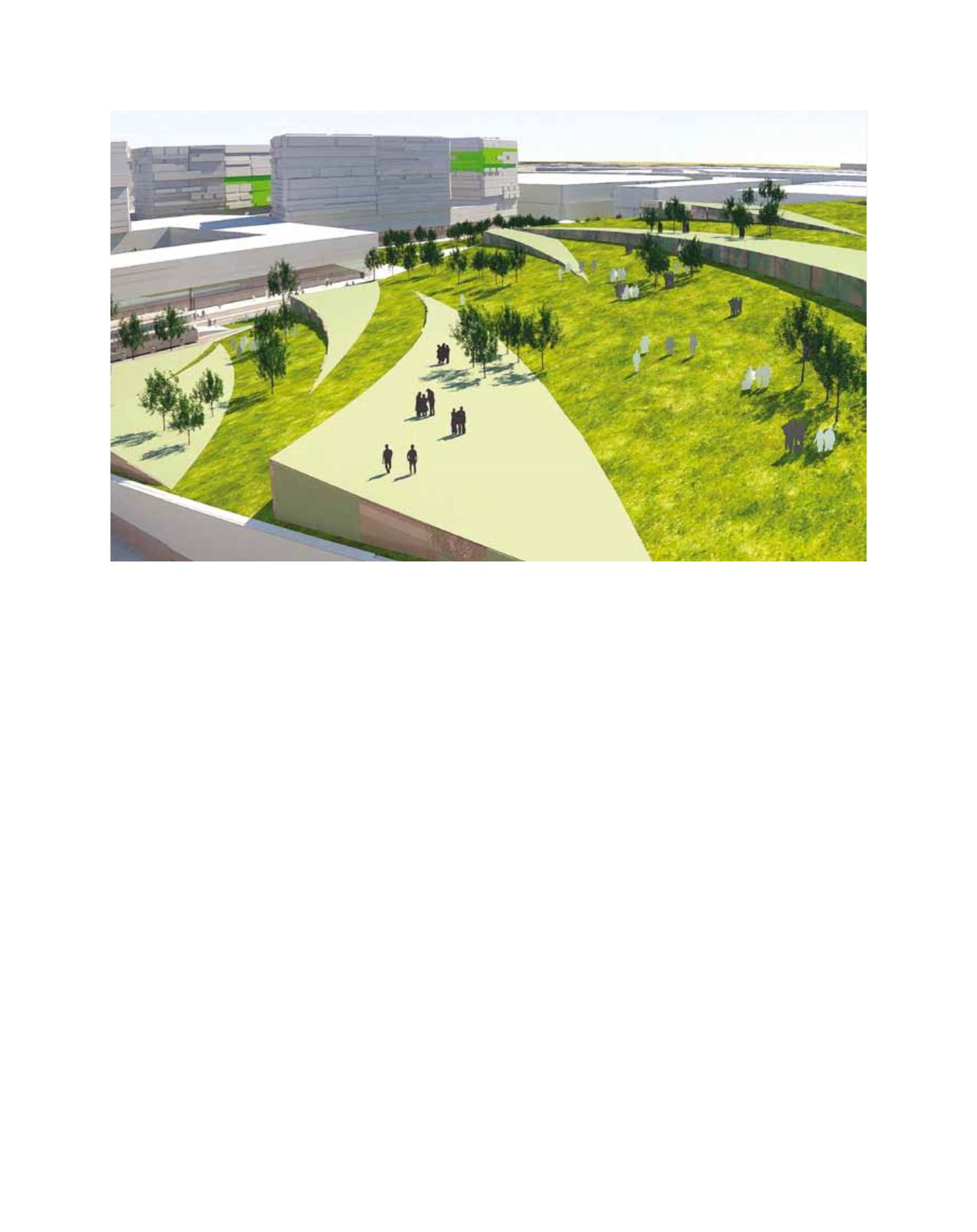
The eco-city Caofeidian, China, is developed by Swedish urban planners
Image: SWECO