



 149 / 208

[
] 149
S
ustainability
P
olicies
, P
rogrammes
and
their
E
conomic
I
mpact
Combating poverty and promoting a green economy
Switzerland has increased its share of public development assistance to
0.5 per cent of gross domestic product. Themain focus of its international
commitment to developing and emerging countries is on combating
poverty, in particular by fulfilling the Millennium Development Goals.
A key aspect of this is supporting partner countries’ efforts for transform-
ing towards a green economy. These programmes relate in particular to
the environment, energy, climate conservation, biodiversity, sustainable
agriculture/food security, chemicals and waste, sustainable trade, clean
production/technology transfer, water and forests.
In order to make the vision of sustainable development a reality,
all forces of society need to contribute. The private sector bears a
particular responsibility. Swiss companies are among the vanguard
of corporations that have expressed a commitment to sustainable
development. There are dedicated business associations and indus-
trial federations such as the Netzwerk für ökologisches Wirtschaften
(Swiss Sustainable Business Network, Öbu), and swisscleantech,
which support and reinforce the private sector’s sustainability efforts.
Many Swiss companies actively pursue sustainable products and
production processes. For example, the biggest retailers are also the
main promoters of sales of labelled products. Most large Swiss compa-
nies have also signed up to the United Nations Global Compact.
Despite all these efforts, it should be noted that in absolute terms,
Switzerland is far from being sustainable. This is illustrated first of
all by the ecological footprint, which reminds us that Switzerland
consumes almost three times the quantity of natural capital and
environmental resources than would be globally sustainable in the
long run. At the same time, the rapidly growing needs of develop-
ing countries, especially emerging countries, are likely to further
increase the pressure on the Earth’s ecosystems. This underlines
the urgency for developed and developing countries to cooperate in
adopting more sustainable consumption and production patterns.
The United Nations Conference on Sustainable Development
(Rio+20) provides a major opportunity in this regard. It enables
the international community to take stock and to take collective
action in order to promote sustainability at all levels. Switzerland
is committed to working constructively towards a successful and
ambitious outcome of Rio+20, which should renew and strengthen
the political commitment to sustainable development.
Switzerlandwelcomes the thematic focus of Rio+20 on green economy
in the context of sustainable development and poverty eradication. The
conference should demonstrate that a green economy provides solutions
for taking into account natural resource use and its environmental and
social impacts on a long-term basis. It should also advance the under-
standing that a resource-efficient economy creates green jobs in sectors of
all levels of development and that it contributes substantially to national
competitiveness. In doing so, Rio+20 should also contribute to achieving
greater equity and to addressing poverty in developed, middle income
and developing countries, while renewing the commitment of the inter-
national community to support developing countries on their sustainable
development pathway. Switzerland is convinced that Rio+20 could be
an important milestone in the transition towards a green economy that
contributes to sustainable development and poverty eradication. The
focus should be on specific goals and measures with clear timelines for
their achievement. Switzerland has therefore proposed the establishment
of an international Green Economy Roadmap which assembles these
goals, measures and timelines.
With regard to the second theme of the conference, the strengthening
of the international institutions in charge of sustainable development,
Switzerland expects the Rio+20 conference to agree
upon a comprehensive package of reform measures
both for the strengthening of governance for sustainable
development in an integrative manner and for interna-
tional environmental governance. The Commission on
Sustainable Development, established after the United
Nations Conference on Environment and Development
in 1992, has not succeeded in playing the role it was meant
to play. Switzerland therefore proposes to strengthen
governance for sustainable development by establish-
ing a Sustainable Development Council that replaces
the existing Commission for Sustainable Development.
This council should in particular be better equipped to
monitor progress in achieving sustainable development,
for example through a progress assessment mechanism
which effectively facilitates the sharing of experiences and
best practices.
With regard to strengthening international environ-
mental governance, Switzerland is also looking towards
a package of targeted reform measures including:
• Establishing universal membership in the
governance body of a strengthened anchor
institution on the basis of the United Nations
Environment Programme
• Establishing a United Nations system-wide strategy
for environmental matters, increasing authority
to provide oversight, guidance, coordination and
coherence
• Enhancing synergies among multilateral
environmental agreements.
Last but not least, Switzerland expects Rio+20 to agree
on the establishment of global Sustainable Development
Goals, including their characteristics, priority themes
and the process for their detailed elaboration.
Through these measures in particular, Rio+20 will
prove to be a real milestone on the pathway to sustain-
able development for which we will be esteemed by
future generations.
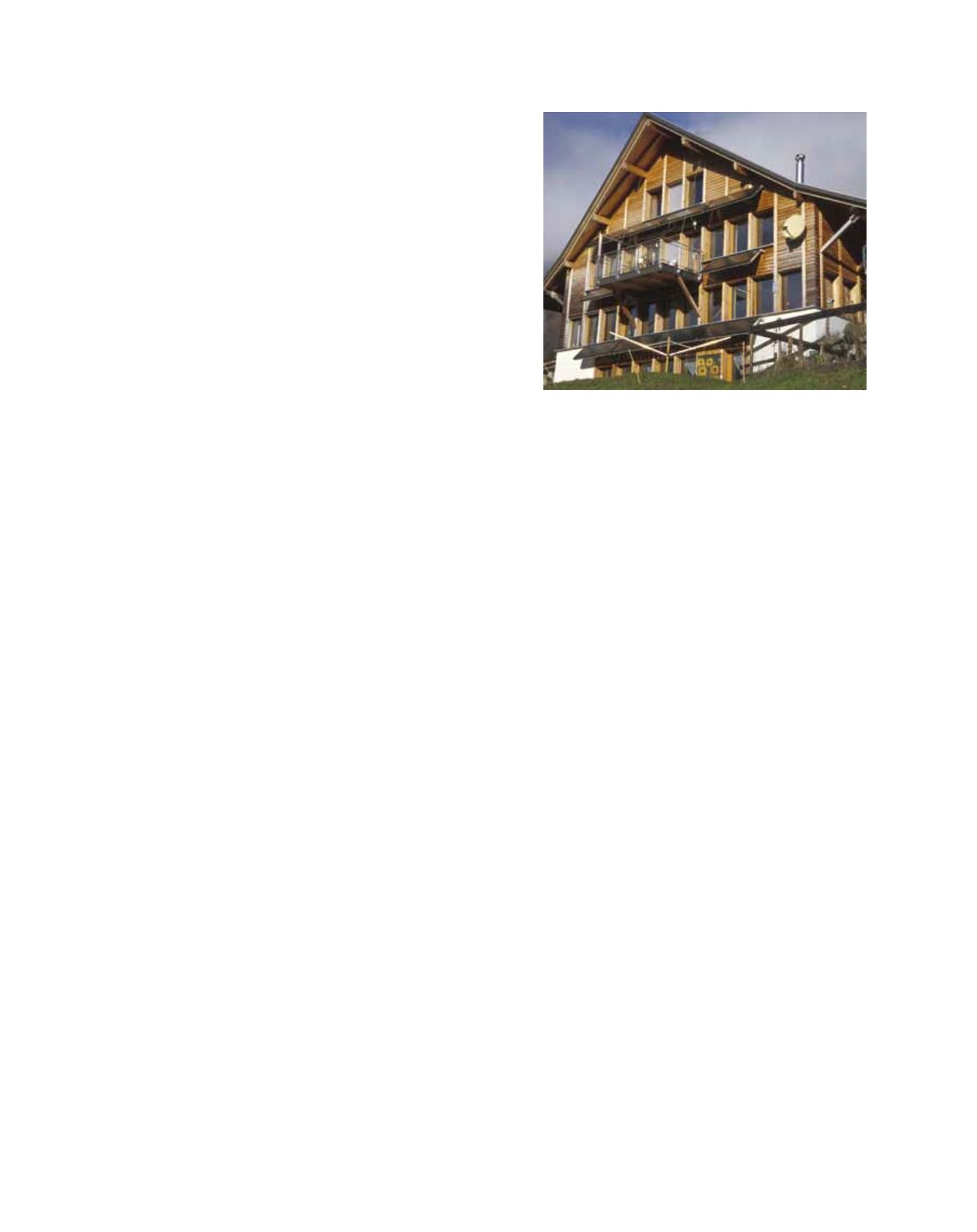
Energy efficiency in housing is being promoted through the
EnergieSchweiz programme
Image: FOEN