



 148 / 208

[
] 148
S
ustainability
P
olicies
, P
rogrammes
and
their
E
conomic
I
mpact
Cleantech Master Plan
The Cleantech Master Plan for Switzerland is intended
to boost the innovative capacity of the Swiss economy,
in particular by bundling resources and improving
coordination between the various players. Cantons,
universities and the private sector are invited to
implement the activities set out as recommendations
in the master plan and coordinate them with the
Confederation.
Integrated product policy
The Federal Government wishes to steadily reduce
resource consumption and the negative environmental
impact of product manufacture and consumption. To
achieve this, it encourages measures to close the mate-
rials cycle and to develop life cycle assessments, and is
helping to improve information on the environmental
impact of individual products. In public procurement,
it also pays special attention to goods and services
that satisfy high economic, social and environmental
requirements throughout their life cycles.
Social housing
The Government specifically supports social housing
developments by offering financial incentives for non-
profit property developers who must, in return, fulfil
high requirements with respect to ecological, energy
efficient construction with easy access.
Biodiversity Switzerland strategy
The aim of the new Biodiversity Strategy for Switzerland
is to ensure that biodiversity remains rich and resilient
to change. Biodiversity targets are to be factored into
all sectoral policies and the strategy articulates 10 stra-
tegic goals including securing areas for conservation
and networking; the sustainable use of resources; the
promotion of diversity in built-up areas; the inclusion
of biodiversity in national social welfare surveys; and
a more active international commitment in this area.
CO
2
law. In the first year (2012), an average of 65 per cent of the
most efficient new cars per importer must achieve this target. If this
is not the case, manufacturers and importers will be sanctioned. Any
income from the sanction will be reimbursed to the general public.
Energy strategy 2050
The Federal Government’s energy strategy is being revised as a
result of the Federal Council’s decision to withdraw from nuclear
power generation. As part of this new energy strategy, a broad-
based action plan is being drawn up which will place greater
emphasis on energy efficiency and the continued expansion of
renewable energies.
EnergieSchweiz programme
EnergieSchweiz is the intervention programme for energy efficiency
and renewable energies. The Confederation, cantons, municipali-
ties, environmental and consumer organizations, and key economic
players, enter into partnerships and implement voluntary measures
together. The goal is to increase the percentage share of renewable
energies by at least 50 per cent between 2011 and 2020.
Strengthening public transport
The appeal of public passenger transport and freight transport
by rail should be heightened or at least remain the same. To
achieve this, expansion projects must be fleshed out, long-term
funding secured, non-discriminatory network access guaranteed
in trans-European freight transport, and the road-to-rail shift
target achieved.
Sustainable construction
The construction sector is of particular importance owing to annual
investments of around CHF57 billion. To promote the varied activi-
ties in the area of sustainable construction in a targeted manner, the
Confederation procures construction work and buildings that meet
extremely high economic, social and environmental requirements
throughout their entire life cycle. It has a bearing on construction
norms and regulations within the scope of its powers, and manages
its extensive real estate portfolio according to sustainable develop-
ment criteria.
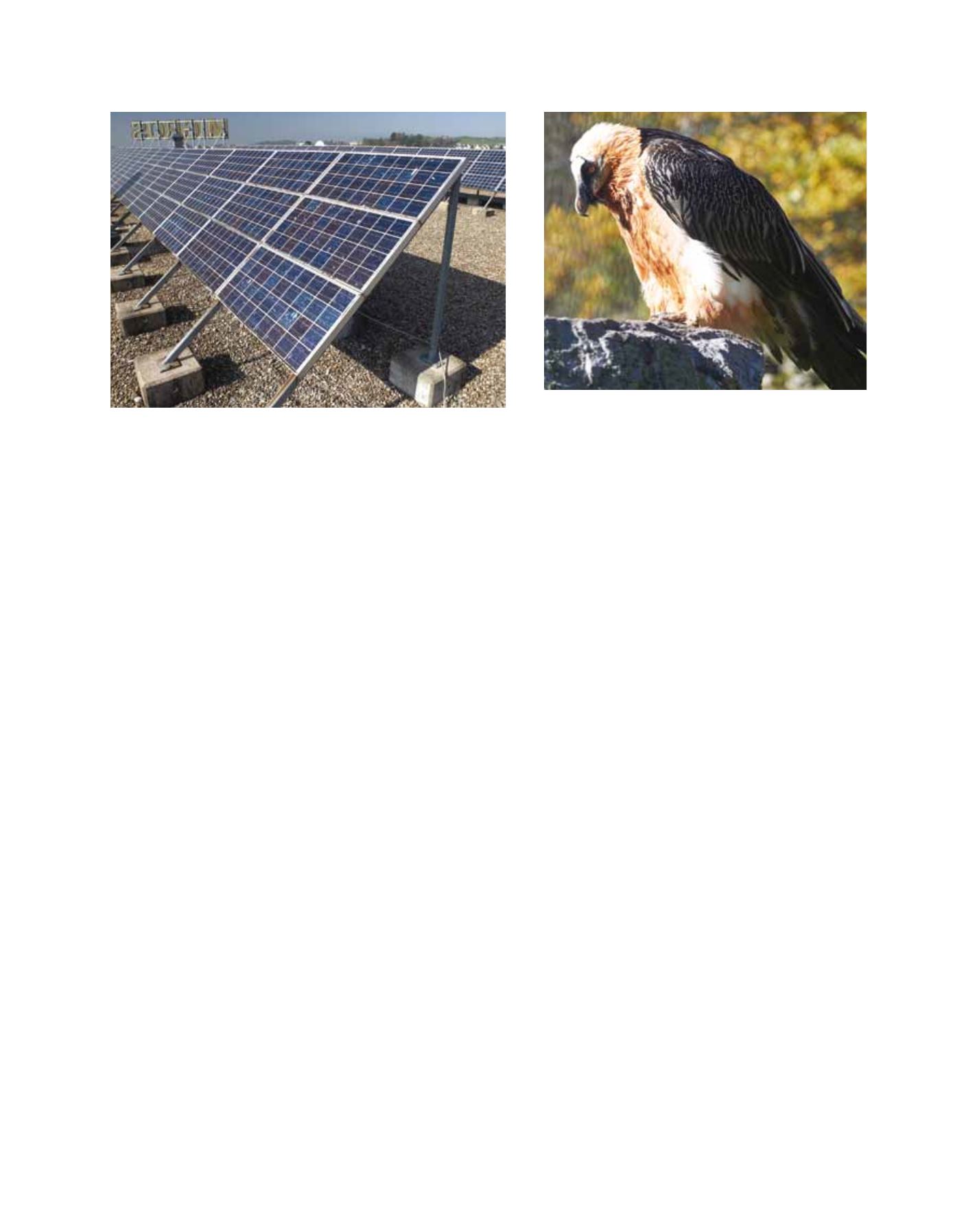
The Cleantech Master Plan intends to boost the innovative capacity of the Swiss economy
Areas for conservation provide an ideal habitat for endangered
species such as the bearded vulture
Image: FOEN
Image: FOEN