



 151 / 208

[
] 151
S
ustainability
P
olicies
, P
rogrammes
and
their
E
conomic
I
mpact
towards a safer and sustainable development path and
is at the forefront of supporting Africa’s transition to a
green growth pathway.
1
Internally, AfDB has adopted and implemented
social and environmental safeguard policies through-
out its lending operations. New departmental units
have been established to design and mainstream
the bank’s social and environmental sustainability
management instruments,
2
to ensure that its develop-
ment funding operations are embedded in sustainable
development principles.
This process has had far-reaching implications
beyond the exercise of designing policy implementa-
tion guidelines. It has triggered a bank-wide dialogue
and debates that have improved the bank’s operational
culture. In parallel, AfDB has increasingly played an
active role in global and regional political debates on
development, environmental sustainability and climate
change and their implications for Africa. The bank’s
support throughout the various processes of the United
Nations Framework Convention on Climate Change
has both boosted Africa’s capacity and awareness on
climate change issues and enhanced its endeavours to
ensure that the continent speaks with one voice during
global climate negotiations.
In January 2011, the African Union Heads of State endorsed the
Africa Consensus Statement for Rio+20. This represents Africa’s
negotiation position and aspirations for the Rio+20 outcomes
and identifies basic building blocks that should be included in
the SDGs.
In the context of Africa, the SDGs should at least seek to:
• Grant universal access to modern energy services
• Eradicate poverty
• Protect and enhance the natural resource base
• Increase resource efficiency
• Increase agricultural productivity
• Promote inclusive growth
• Move the continent towards low-carbon development.
Pursuing these goals offers win-win opportunities to integrate
economic development with environmental sustainability in all
African countries, regardless of the structure of their economy and
their level of development.
Supporting the transition to a green economy
Initiatives to support a transition to a green economy are not new in
Africa, and regional support programmes in several African coun-
tries have already begun to identify opportunities and challenges.
As Africa’s premier development finance institution, the African
Development Bank (AfDB) has a mandate to steer the continent
Supporting sustainable agriculture & fisheries projects
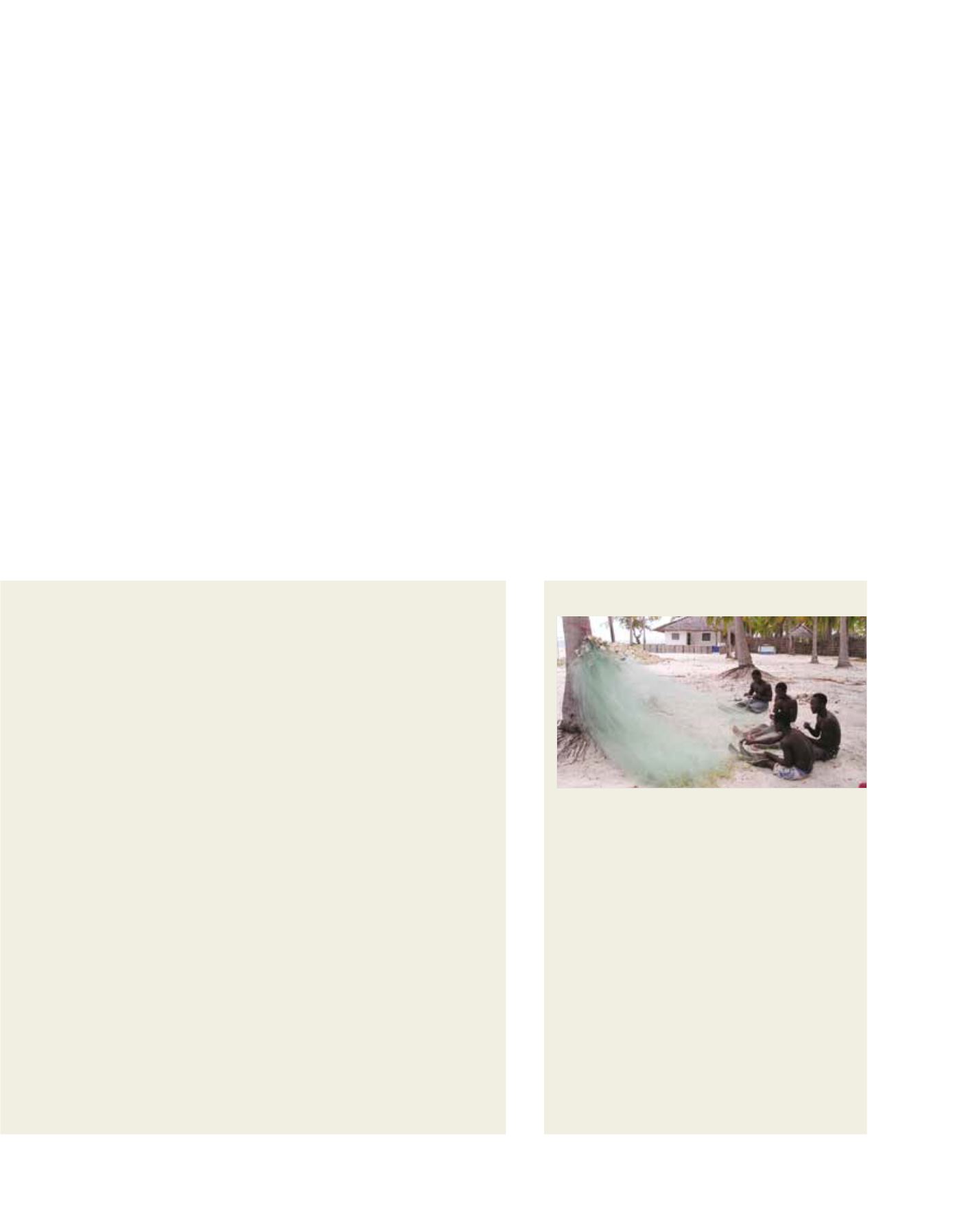
Support project to the fishing communities of Tulear,
Madagascar (
€
21 million)
Traditional sea fishing in Madagascar is practiced by about
59,000 fishermen in coastal and coral reefs, especially in the
south-west province of Tulear. The canoes have a less than
10-kilometre range of action, so the coastal zone is currently
overfished and yields are very low. However, traditional
fishing is the only source of income for coastal communities,
especially in the province of Tulear, where drought has pushed
people to the coast of mainland areas.
Intensive exploitation of the same fishing grounds has
put species such as octopus and lobster in danger of
overexploitation, while species such as sea cucumber have
virtually disappeared. Annual exports of fishery products in the
Tulear region (nearly 90 per cent octopus) were estimated at
US$16 million in the evaluation of the project. The Support
Project to the Fishing Communities of Tulear aims to promote
sustainable development of traditional fisheries by supporting
maritime organizations and recipients of state services,
the coordinated and responsible management of fisheries
resources, and adequate equipment for fishermen.
Source: AfDB, Agriculture & Agro Industry Department (OSAN)
Additional environmental benefits will include the creation of ecological
corridors and buffer zones for conservation purposes, and a decline in
greenhouse gas emissions by an estimated 200,000 tons per year.
Cabeolica wind power project (
€
15 million)
Four onshore wind farms will be constructed, operated and maintained
on four islands of the Cape Verdean archipelago (Santiago, São Vicente,
Sal and Boa Vista). These will have a combined installed capacity of 25.5
MW and will be connected to the existing electricity grid on each island.
Each wind farm will include towers with wind turbines, transformers, a
substation, a command centre, an underground transmission line and an
access road.
The project was developed by InfraCo, an infrastructure development
company established by the Private Infrastructure Development Group
to develop viable private infrastructure investment opportunities that
balance the interests of host governments, the national and international
private sectors and providers of finance. It is key to achieving the
country’s targets in terms of renewable energy generation (25 per cent of
total generation by 2011 and 50 per cent by 2020). The project helps the
country expand its clean energy infrastructure to address environmental
and climate change concerns, while providing economic development
opportunities.
Sahanivotry Plant (
€
13.9 million)
Located on the Sahanivotry River 30 kilometres south of Antsirabe in the
province of Antanarivo, the Sahanivotry Plant is Madagascar’s first privately
owned and operated hydroelectric power plant and the first hydropower
plant to be built on the island since 1982. It has an installed capacity
of 15 MW and an average gross electricity generation of 90 GWh. The
people living in the towns supplied by these grids used to be plagued with
chronic power cuts and load shedding. The plant has facilitated a 50 per
cent increase in new consumer connections at affordable tariffs. A more
reliable and clean supply of electricity has had a profound impact on local
economic development.
Source: AfDB, Energy, Environment and Climate Change Department (ONEC)
Image: AfDB