



 155 / 208

[
] 155
S
ustainability
P
olicies
, P
rogrammes
and
their
E
conomic
I
mpact
improves the flow of water in reservoirs and waterways
to ensure higher water quality and to promote aquatic
life. PUB’s public education programmes also encourage
the public to play an active role in caring for waterways
and reservoirs.
Water management
Singapore adopts the ‘Four National Taps’ strategy to
ensure a resilient and diversified water supply:
• Water from local catchments
• Imported water
• NEWater
• Desalination.
Expansion into urban catchments has maximized local
water sources, increasing Singapore’s water catchment
to two-thirds of its total land area. However, given
our land constraints, we have embarked on large-scale
used water recycling to supplement our water needs.
NEWater is produced by purifying treated used water
using advanced membrane filtration technologies,
and is supplied mainly to non-domestic customers.
Improvements in membrane technology have also
significantly decreased the cost of desalination, making
it a viable water supply option. Together, NEWater
and desalination can provide for up to 40 per cent of
Singapore’s current water needs. Singapore’s achieve-
ments in integrated water management and NEWater
have won it numerous international accolades, includ-
ing the Stockholm Industry Water Prize in 2007.
The Singapore way
Singapore has gained international recognition for its attractive and
liveable environment.
1
Its holistic approach to environmental stand-
ards can be seen in a number of areas.
Land use planning
The Concept Plan is Singapore’s long-term strategic land use and
transportation plan, which guides development over a 40-50 year
timeframe. The plan is jointly conceived by agencies involved in
economic, social, environmental and infrastructure development
and is reviewed every decade to ensure there is sufficient land to
support future economic and population growth while we pursue
our development objectives. The Master Plan translates the broad,
long-term strategies of the Concept Plan into detailed steps. It
guides Singapore’s medium-term development over a 10-15 year
period. The Master Plan is reviewed every five years in consultation
with stakeholders in the people, public and private sectors.
Pollution control
Singapore has rigorous environmental regulations and city planning
guidelines to manage pollution from industries. We locate heavy indus-
tries mainly in Jurong Island and Tuas, as far away from residential areas
as possible. We stringently review industrial development proposals
and only approve projects that can comply with pollution control and
waste disposal standards. Although it is a densely populated city state,
Singapore’s air quality compares well with major cities, with the daily
Pollutant Standards Index in the ‘good’ range for 96 per cent of 2011.
2
We have also developed a comprehensive approach to controlling
water pollution. Singapore’s national water agency, PUB, repairs and
upgrades sewers to prevent leakages and contamination at source and
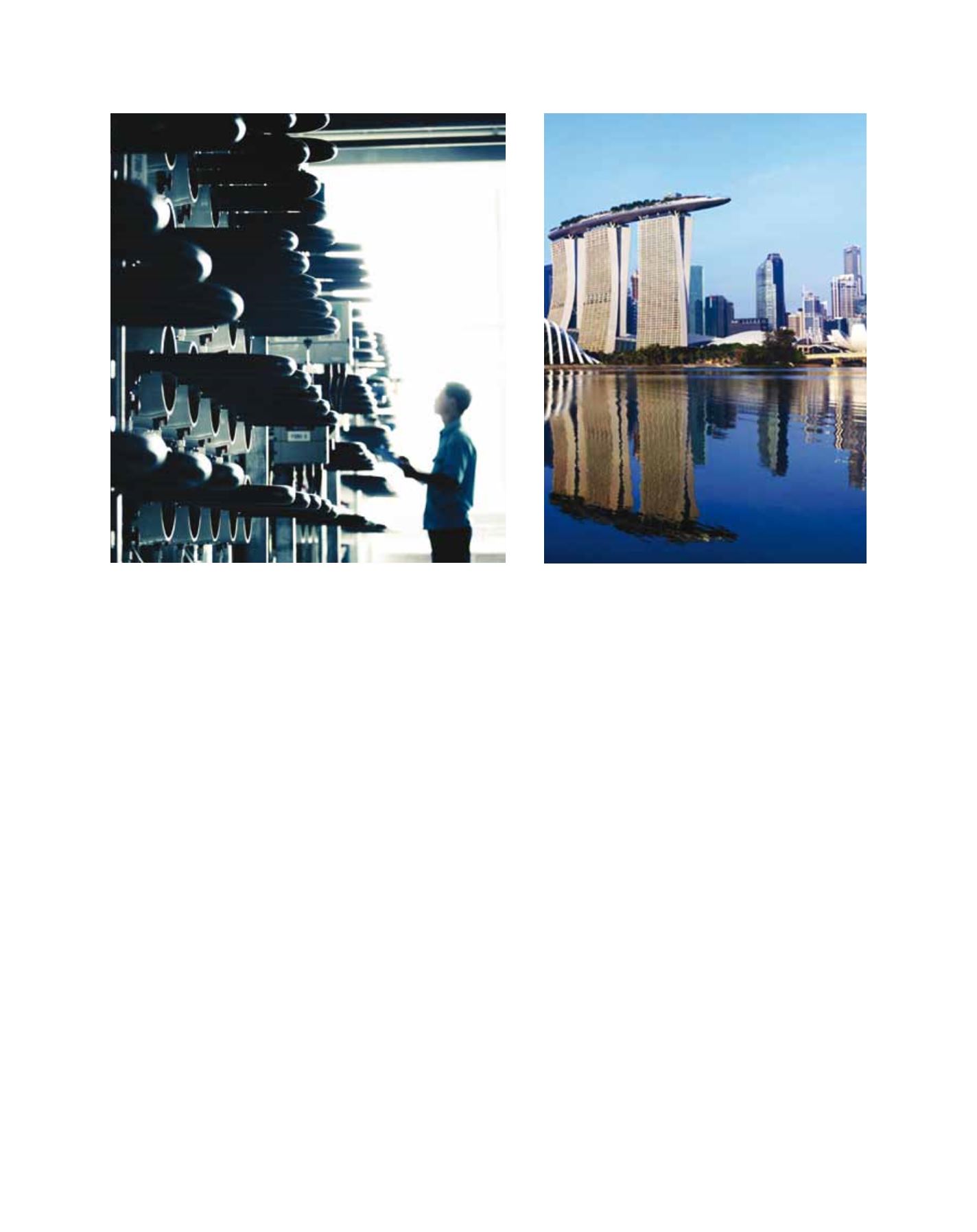
Rigorous environmental regulations govern industry in Singapore
Singapore’s air quality compares well with that of major world cities
Image: MEWR Singapore
Image: MEWR Singapore